How to Ask for Directions in German (Simple Phrases)
Picture this: you step out of the wrong exit at Berlin Hauptbahnhof, your phone is at four percent, and every street sign looks the same. You need to ask a stranger the way, but you freeze. This guide gives you simple German phrases for asking directions, explains the answers you’ll hear back, and shows you how to handle the conversation calmly.
Disclosure: This post may contain affiliate links. We may earn a commission at no extra cost to you if you make a purchase through these links. Read full disclosure.
The Core Phrases for Asking Directions in German
When I first arrived, I memorised a long, perfect sentence from a textbook. Then I stopped a woman near Alexanderplatz, recited it, and she answered so fast that I understood nothing. The lesson took me a while to learn. Short phrases you can say confidently will help you more than long ones you have to perform. You also need to recognise the handful of words that come back at you.
If you are starting from zero, it is worth pairing this guide with Survival German for Travelers: Key Phrases to Learn First. It covers the greetings and basics that sit around these direction phrases.
Opening Politely Without Startling Anyone
Germans are generally helpful with directions. They are less fond of being grabbed mid-stride without a polite opener. Start every request with one word: “Entschuldigung” (excuse me). It works like a key that unlocks the conversation. Say it, pause, and wait for eye contact before you continue.
Here are your opening options, from most basic to most polite:
- “Entschuldigung?” means excuse me. It is enough on its own if you then point at your map.
- “Entschuldigung, können Sie mir helfen?” means excuse me, can you help me?
- “Entschuldigung, darf ich Sie etwas fragen?” means excuse me, may I ask you something?
- “Sprechen Sie Englisch?” means do you speak English?
Notice the “Sie”. This is the formal “you”, and it is what you should use with any adult stranger. Younger people in Berlin or Hamburg may switch to “du” with you, and that is fine. Starting with “Sie” is never wrong, though. The nuances are covered in Polite German: Du vs Sie for Visitors.
A small tip from experience: even if you plan to switch to English, opening in German changes the mood. A quick “Entschuldigung, sprechen Sie Englisch?” often gets a warmer response than launching straight into English. Many people will happily answer in English once you’ve shown that effort.
Asking Where Something Is
There are two main sentence patterns. Learn both and you can ask for almost anything.
Pattern one: “Wo ist…?” (Where is…?)
- “Wo ist der Bahnhof?” means where is the train station?
- “Wo ist die nächste U-Bahn-Station?” means where is the nearest underground station?
- “Wo ist die nächste Haltestelle?” means where is the nearest bus or tram stop?
- “Wo finde ich eine Toilette?” means where can I find a toilet?
- “Wo ist hier eine Apotheke?” means where is a pharmacy around here?
The little word “hier” (here) in that last example is very natural. “Wo ist hier…?” carries the sense of “around here”. Native speakers use it constantly.
Pattern two: “Wie komme ich…?” (How do I get…?)
- “Wie komme ich zum Marienplatz?” means how do I get to Marienplatz?
- “Wie komme ich zur Altstadt?” means how do I get to the old town?
- “Wie komme ich am besten zum Flughafen?” means what’s the best way to get to the airport?
Saying what you are looking for
Sometimes it is easier to state what you’re searching for. This is a statement, not a question, so the verb comes second, right after the subject:
- “Ich suche das Hotel Adler.” means I’m looking for the Hotel Adler.
- “Wir suchen den Hauptbahnhof.” means we’re looking for the main station.
- “Ich suche diese Adresse.” means I’m looking for this address. Say it while showing the address on your phone.
The zum and zur Trick
German nouns have genders, which is intimidating. For directions, though, you only need one shortcut. After “zu” (to), the word changes depending on gender:
- Masculine and neuter words take “zum”: zum Bahnhof, zum Museum, zum Hotel, zum Dom.
- Feminine words take “zur”: zur Post, zur Haltestelle, zur Apotheke, zur Kirche, zur Universität.
If you don’t know the gender, don’t panic. Germans will understand “Wie komme ich zum Apotheke?” perfectly well, even though it should be “zur”. Getting it wrong costs you nothing. For named squares and streets, a handy rule is that “Straße” is feminine (zur Friedrichstraße) and “Platz” is masculine (zum Rathausplatz).
Pronouncing place names is a separate hurdle. Asking for “Köln” when you’ve only seen it written as “Cologne” can cause blank stares. Practise with How to Pronounce Common German Place Names before you rely on spoken directions.
Understanding the Answer You Get Back
Asking is the easy part. The real challenge is the reply, which usually arrives quickly, with hand gestures, and sometimes in a regional accent. Don’t try to understand every word. Listen for direction words, landmarks, and numbers.
Direction Words You Will Hear
| German | English | Typical use |
|---|---|---|
| geradeaus | straight ahead | “Immer geradeaus.” means just keep going straight. |
| links | left | “Dann links.” means then left. |
| rechts | right | “Die erste Straße rechts.” means the first street on the right. |
| abbiegen | to turn | “An der Ampel links abbiegen.” means turn left at the traffic light. |
| die Ampel | traffic light | “Bis zur Ampel.” means up to the traffic light. |
| die Kreuzung | crossroads | “An der Kreuzung rechts.” means right at the crossroads. |
| die Ecke | corner | “Gleich um die Ecke.” means just around the corner. |
| gegenüber | opposite | “Gegenüber vom Rathaus.” means opposite the town hall. |
| neben | next to | “Neben der Bank.” means next to the bank. |
| hinter | behind | “Hinter der Kirche.” means behind the church. |
| vor | in front of | “Vor dem Bahnhof.” means in front of the station. |
| über die Brücke | over the bridge | Common in Hamburg, Dresden, and Cologne. |
| zurück | back | “Sie müssen zurück.” means you have to go back. |
| die andere Richtung | the other direction | “Sie müssen in die andere Richtung.” means you need to go the other way. |
The ordinal numbers matter more than you’d expect. Learn “die erste” (the first), “die zweite” (the second), and “die dritte” (the third). A typical answer sounds like this: “Gehen Sie geradeaus bis zur Ampel, dann die zweite Straße links.” That means go straight to the traffic light, then take the second street on the left. Break it into chunks: straight, traffic light, second, left. That is all you need.
Distance and Time
Most people want to know one thing: can I walk it? These phrases help.
- “Ist das weit von hier?” means is that far from here?
- “Kann man zu Fuß gehen?” means can you walk there?
- “Wie lange dauert das zu Fuß?” means how long does it take on foot?
Answers usually sound like these:
- “Nicht weit” means not far.
- “Ungefähr zehn Minuten zu Fuß” means about ten minutes on foot.
- “Das ist zu weit zum Laufen” means that’s too far to walk.
- “Nehmen Sie lieber den Bus” means you’d be better off taking the bus.
A cultural note: German estimates tend to be honest. If someone says “fünf Minuten”, they usually mean it. If they say “das ist ziemlich weit” (that’s quite far), believe them. It may be a long walk.
When You Did Not Catch a Word
This happens to everyone, including people who’ve lived here for years. Dialects make it harder. A Bavarian giving directions near the Viktualienmarkt sounds very different from someone in Kiel. If you’re heading south, read How to Handle German Dialects as a Visitor first.
Your rescue phrases:
- “Langsamer, bitte.” means slower, please.
- “Können Sie das bitte wiederholen?” means can you repeat that, please?
- “Können Sie mir das auf der Karte zeigen?” means can you show me on the map?
- “Ich verstehe nicht. Ich spreche nur ein bisschen Deutsch.” means I don’t understand. I only speak a little German.
“Können Sie mir das auf der Karte zeigen?” is the most valuable sentence in this whole guide. Hand over your phone with the map open and people will simply point. Language barrier solved.
Always finish with thanks. “Vielen Dank!” or “Danke schön, das ist sehr nett” (thank you, that’s very kind) will leave a good impression. More variations are in How to Say Please, Thank You, and Sorry in German.
Asking Directions at Stations and on Public Transport
In my experience, most direction emergencies happen underground or on a platform, not on the street. German stations are big. Some, like Frankfurt Hauptbahnhof or Munich Hauptbahnhof, have several levels, multiple exits, and connected S-Bahn and U-Bahn lines.
Platforms, Lines, and Changes
These phrases cover most transit confusion:
- “Von welchem Gleis fährt der Zug nach Köln?” means which platform does the train to Cologne leave from?
- “Welche Linie fährt zum Flughafen?” means which line goes to the airport?
- “Welcher Bus fährt zum Zoo?” means which bus goes to the zoo?
- “Hält dieser Zug in Bonn?” means does this train stop in Bonn?
- “Wo muss ich umsteigen?” means where do I have to change?
- “Wo muss ich aussteigen?” means where do I have to get off?
- “Wo ist der Ausgang?” means where is the exit?
Watch for signs too. “Gleis” means platform or track. “Ausgang” means exit. “Eingang” means entrance. “Richtung” followed by a station name tells you the end point of the line, which is how you know which side of the platform to stand on. Berlin’s system is a good example of this, and How to Use the Berlin U-Bahn and S-Bahn as a Visitor walks through it in detail.
The best station staff to ask are at the DB Information desk or the service points in larger stations. Platform staff in red DB uniforms are also used to rushed questions. Ask them “Wo fährt der Zug nach Hamburg?” and point at your ticket.
A Real-World Scenario
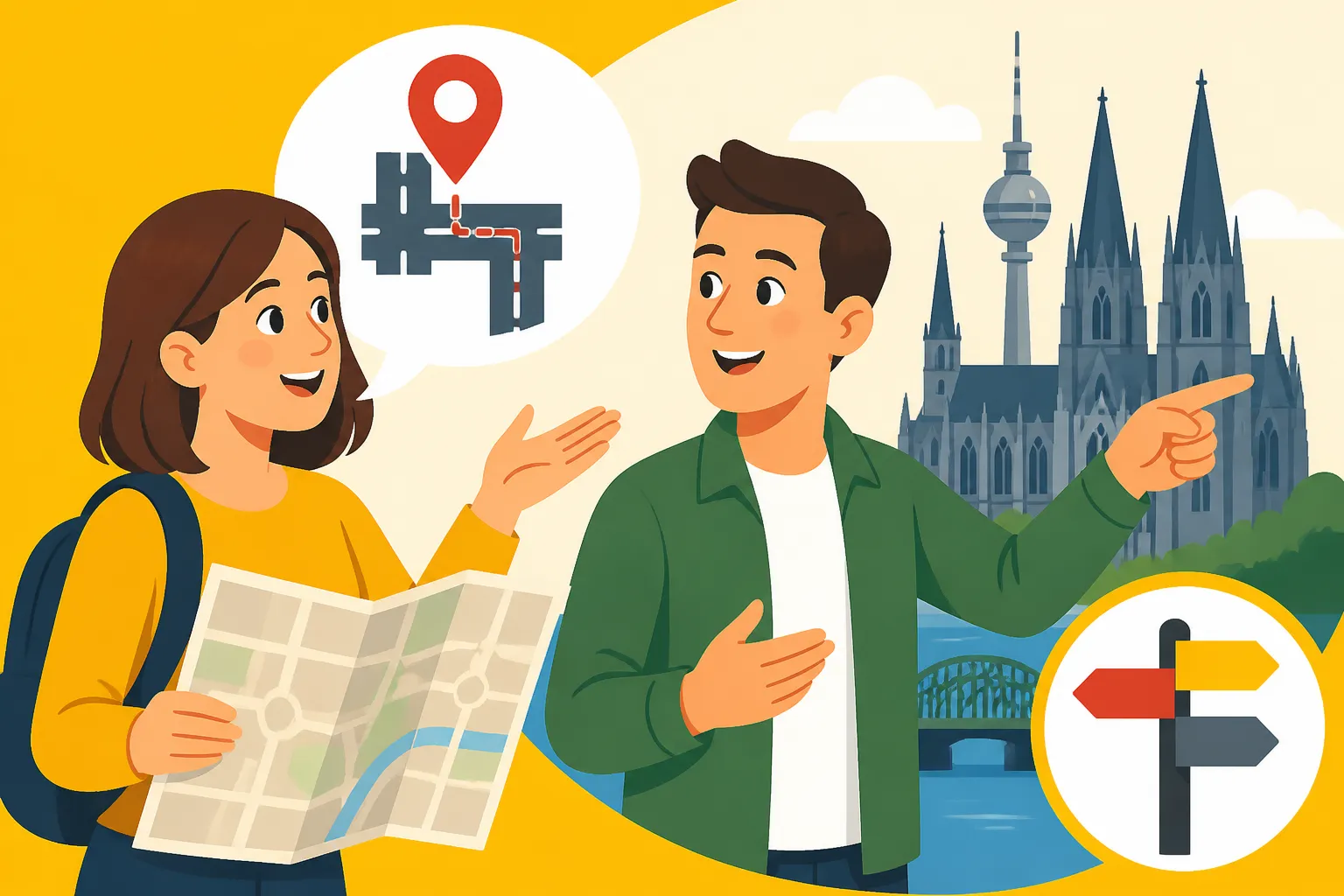
Here’s an exchange that could happen to you at Cologne Hauptbahnhof after a day trip. You come up from the platform, see the cathedral towering outside, and realise your hotel is somewhere behind it.
You: “Entschuldigung, können Sie mir helfen? Ich suche das Hotel am Römerturm.”
Passer-by: “Ach, das ist nicht weit. Gehen Sie hier raus, links am Dom vorbei, dann geradeaus. Ungefähr zehn Minuten.”
You catch “nicht weit”, “links”, “Dom”, “geradeaus”, and “zehn Minuten”. That is enough: go left past the cathedral, keep straight, about ten minutes. If you’re unsure, say “Können Sie mir das auf der Karte zeigen?” and let them point.
Before you arrive in a new city, save your hotel’s exact address. Booking.com shows the property on a map in your reservation details. Save a screenshot so you can show it to someone even without data. If you’re booking long-distance trains or buses through Omio, keep the ticket offline too. The departure station name on the ticket is exactly what you’ll want to ask about if you get lost.
Practical Strategies That Make Asking Easier
Language is only half the problem. The other half is choosing who to ask, when, and how to back yourself up.
Picking the Right Person
From years of trial and error, here’s who tends to help most:
- Shop staff, kiosk owners, and pharmacy workers. They’re stationary, local, and know the neighbourhood well. A “Späti” (corner shop) in Berlin is a goldmine.
- People waiting at a stop. They’re not rushing, and they probably know the transit lines.
- Younger people in big cities. They’re more likely to switch to English. See Do People Speak English in Germany’s Tourist Areas? for realistic expectations by region.
- Hotel receptionists, even at hotels where you’re not staying. They’re used to giving directions and usually have printed maps.
Who to avoid: people mid-commute walking fast with earbuds in, especially during rush hour. They’re not rude. They are just focused, and a hurried answer is hard to follow.
Backup Tools for When Words Fail
Even confident speakers need backup. Download offline maps for your city before you arrive. Install a translation app with the German language pack saved for offline use. You can type “Wie komme ich zum Bahnhof?” and show the screen. Setup tips are in How to Use a Translation App Offline in Germany.
If you’re in an unfamiliar old town, consider booking a walking tour on your first day. A GetYourGuide city walk in Bamberg, Heidelberg, or Nuremberg gives you a mental map of the landmarks. Later, when someone says “hinter der Kirche” or “gegenüber vom Rathaus”, you’ll know exactly which church and which town hall they mean. Landmarks matter more than street names in medieval centres, where streets curve and change names every few hundred metres.
For one of the most urgent direction questions, see How to Use Public Toilets When Traveling in Germany. It explains the coin-operated facilities and station toilets you’ll probably be directed to.
A Step-by-Step Routine for Asking Directions
When you’re stressed and lost, follow this sequence:
- Stop somewhere safe, out of the flow of foot traffic, and check your map one more time.
- Pick someone stationary, such as a shopkeeper or a person waiting at a stop.
- Open with “Entschuldigung, können Sie mir helfen?” and wait for eye contact.
- Ask using one short pattern: “Wie komme ich zum…” or “Wo ist die nächste…”. Or state your goal: “Ich suche…”.
- Show your phone with the address or map open at the same time.
- Listen only for direction words, landmarks, and numbers. Ignore the rest.
- Repeat the key points back: “Also, geradeaus, dann links?” (So, straight, then left?) They will confirm or correct you.
- If you’re still unsure, ask “Können Sie mir das auf der Karte zeigen?”
- Thank them warmly with “Vielen Dank, das ist sehr nett!”
- After a few hundred metres, if things feel wrong, ask again. Asking twice is normal, not embarrassing.
Step seven is underrated. Repeating directions back with “Also…” is very German. It shows you were listening, and it gives the other person a chance to fix any misunderstanding before you walk ten minutes the wrong way.
For a wider phrase toolkit beyond directions, including ordering food and handling shops, take a look at What Are the Most Useful German Phrases for Tourists?. With these direction phrases practised a few times out loud, you’ll find that getting lost in Germany becomes far less frightening.
Disclaimer
This article is for general informational purposes only and does not constitute professional advice. Laws, prices and regulations vary by location and change over time. Consult a qualified professional for guidance on your specific situation.