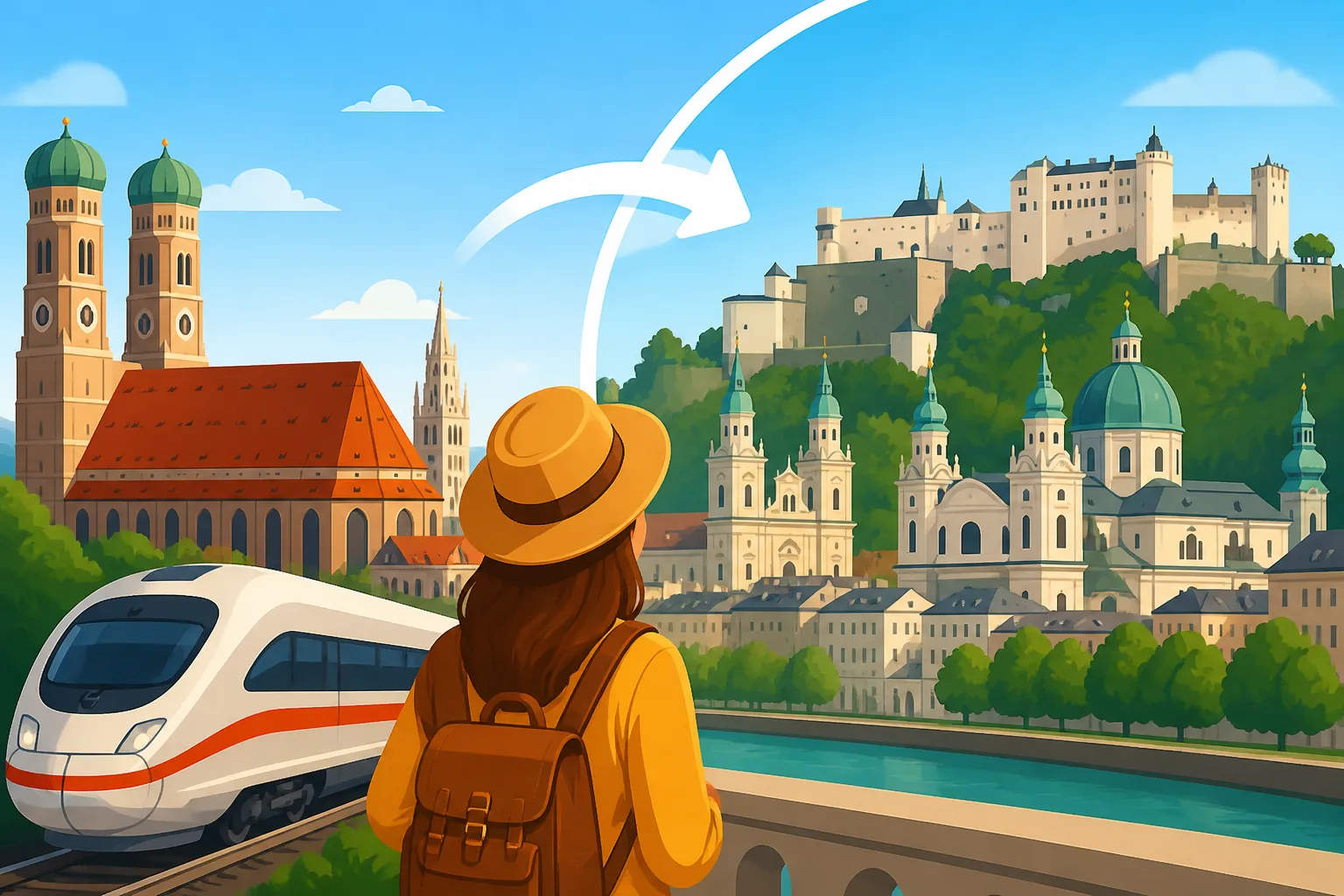
How to Visit Salzburg From Munich for the Day
Many visitors and new expats in Munich feel the pull of the Alps, yet navigating cross-border logistics can feel like a daunting administrative hurdle. You might worry about which train ticket to buy, whether your German regional pass works in Austria, or how to fit a whole different country into twelve hours. This guide eliminates the guesswork, providing a step-by-step roadmap for a seamless Munich-to-Salzburg day trip.
Disclosure: This post may contain affiliate links. We may earn a commission at no extra cost to you if you make a purchase through these links. Read full disclosure.
Transport Options: Getting from Munich to Salzburg
The journey from Munich to Salzburg is one of the most popular routes in Central Europe, and for good reason—it is incredibly efficient. However, the sheer number of options can be overwhelming if you are staring at a ticket machine at Munich Hauptbahnhof (Hbf) for the first time. As someone who has missed more than one train because I was busy decoding the fare zones, I recommend looking at three primary ways to make the trip.
The most common method is the regional train, specifically the Bayerische Regiobahn (BRB). These trains run roughly every hour and are the workhorse of the Munich-Salzburg route. While they aren't the high-speed "bullet" trains, they are reliable and offer plenty of space for travelers. On the other end of the spectrum, you have the ÖBB Railjet and the EuroCity (EC) trains. These are faster, often shaving 15 to 20 minutes off the journey, but they come with a higher price tag unless you book well in advance.
If you prefer to see all your options in one place, using a platform like Omio can be a lifesaver. It allows you to compare the regional DB trains against the faster Austrian Railjet services side-by-side. Sometimes the price difference is negligible, and other times the regional ticket is the clear winner for groups. For those who enjoy the flexibility of the road, buses like FlixBus also operate this route, usually departing from the ZOB (Central Bus Station) near Hackerbrücke. While the bus can be cheaper, it is subject to traffic on the A8 autobahn, which is notorious for "Staus" (traffic jams) during the ski season and summer holidays.
How to Buy Deutsche Bahn Tickets and Save Money is a skill every expat needs to master early on, especially since the German rail system has its own set of unwritten rules. For this specific trip, your choice of transport will dictate your budget and your morning stress levels. If you are traveling solo and in a rush, the Railjet is a dream. If you are a family or a group of friends, the regional train is almost certainly your best bet.
The Magic of the Bayern-Ticket
If there is one "hack" that veteran expats scream from the rooftops, it is the use of the Bayern-Ticket (Bavaria Ticket). It is one of the most generous regional transit deals in Europe, and despite Salzburg being in Austria, the ticket covers the entire route from Munich to Salzburg Hbf. This is because Salzburg is considered a border station within the German rail tariff system.
The Bayern-Ticket allows for unlimited travel on all regional trains (RB, RE, BRB) within Bavaria for a single day. The pricing structure is "the more, the merrier"—you pay a base price for the first person and a small additional fee for every person up to five travelers. However, there is a catch that catches many newcomers off guard: the 9:00 AM rule. On weekdays, the ticket is only valid from 9:00 AM onwards. If you board an 8:30 AM train on a Tuesday with a Bayern-Ticket, you will be facing a hefty fine. On weekends and public holidays, the ticket is valid from midnight, making it the perfect choice for a Saturday excursion.
When using this ticket, remember that it is only valid on regional trains. You cannot hop on an ICE or a Railjet. I’ve seen many confused tourists get booted off the high-speed trains because they thought their "Bavaria" ticket covered everything on tracks. It doesn’t. Stick to the blue-and-white BRB trains or the red DB regional trains. Also, ensure you How to Use the DB Navigator App in Germany to check which trains are eligible; the app clearly marks which connections are "local transport" (Nahverkehr).
| Feature | Bayern-Ticket | Railjet / EC | FlixBus |
|---|---|---|---|
| Average Cost | ~€29 for one, +€10 per extra person | €20 – €45 per person | €7 – €15 |
| Travel Time | ~1h 45m | ~1h 30m | ~2h 00m+ |
| Flexibility | High (Any regional train) | Low (Specific train only) | Low (Specific bus only) |
| Best For | Groups and budget travelers | Solo travelers seeking comfort | Ultra-budget travelers |
A Perfect One-Day Salzburg Itinerary
Once you arrive at Salzburg Hauptbahnhof, don't be deterred by the somewhat modern and sterile surroundings of the station area. The magic lies about a 15-minute walk or a short bus ride away toward the Salzach River. Salzburg is a city built on salt, music, and baroque ambition, and you can see the best of it in a single day if you are strategic.
Morning: Mirabell Gardens and the Altstadt
Start your morning at the Mirabell Palace and Gardens. If you feel a sudden urge to skip down the stairs singing "Do-Re-Mi," you aren't alone; this was a primary filming location for The Sound of Music. The gardens are free to enter and offer one of the most iconic views of the Hohensalzburg Fortress framed by flowers. From there, cross the Makartsteg bridge—covered in "love locks"—into the Altstadt (Old Town).
The heart of the Altstadt is the Getreidegasse, a narrow shopping street famous for its ornate wrought-iron guild signs. Even the local McDonald’s has a gold-leaf sign here to match the historical aesthetic. This is also where you will find Mozart’s Birthplace (Hagenauer House). It is a bright yellow building that is hard to miss. If you want to dive deep into the history, I recommend checking GetYourGuide for a guided walking tour or a combined Mozart museum ticket. Having a local guide explain the nuances of the Archbishop-Princes who ruled this city makes the architecture come alive.
Afternoon: The Fortress and the Cathedral
After a hearty Austrian lunch—think Schnitzel or Kasnocken—head toward the Salzburg Cathedral (Dom). The turquoise domes are a staple of the skyline. Just behind the cathedral is the funicular (Festungsbahn) that whisks you up to the Hohensalzburg Fortress. You can walk up the hill to save money, but it is a steep climb, and on a hot summer day, the funicular is worth every cent.
The fortress is one of the largest medieval castles in Europe. The views from the ramparts are breathtaking, offering a 360-degree look at the city on one side and the towering Alps on the other. If you have extra time, the St. Peter’s Cemetery (Petersfriedhof) nearby is hauntingly beautiful and was the inspiration for the escape scene in the aforementioned musical. For those who want to skip the ticket lines for the fortress or the Mozart museums, booking ahead via GetYourGuide is a smart move, especially during the peak Salzburg Festival months in July and August.
Essential Expat Advice for a Smooth Trip
Living in Germany teaches you that even "simple" trips require a bit of foresight. Crossing the border into Austria is usually seamless, but since the 2015 refugee crisis and various recent security updates, random passport checks on the train are common. Always carry your Residence Permit (Aufenthaltstitel) and your passport. "I forgot it at home in Munich" is an excuse the border police have heard a thousand times, and it won't spare you a lengthy delay.
Another tip: Salzburg is a very walkable city, but it is also a city of "Schnürlregen"—a local term for a specific type of thin, persistent "string rain." Even if the weather in Munich looks clear, check the Salzburg forecast specifically. The mountains create their own microclimate. Bringing a compact umbrella or a sturdy raincoat is non-negotiable.
When it comes to Cash vs Card in Germany: What Visitors Should Know, the same logic applies to Austria. While the main tourist shops in Salzburg accept cards, many of the smaller traditional cafes and the stalls at the green market (Grünmarkt) prefer cash. Keep some Euros on you for that essential Sachertorte or a bag of Mozartkugeln (pistachio marzipan chocolate balls).
If you find yourself falling in love with the city and realize one day isn't enough, you can always check Booking.com for last-minute stays in the Altstadt. Sometimes the evening atmosphere, once the day-trippers have left, is the most magical time to experience the city's quiet, lantern-lit alleys.
Cultural Nuances and Practicalities
While Munich and Salzburg share a common dialect and a love for beer, there are subtle differences. Austrians are often perceived as slightly more formal than Bavarians in service settings. A polite "Grüß Gott" is the standard greeting here, just as it is in Munich. If you are worried about the language, Do People Speak English in Germany's Tourist Areas? Yes, and in Salzburg, the level of English is exceptionally high due to the international nature of the music conservatories and the tourism industry.
Food-wise, you must try the Salzburg Nockerl for dessert. It is a sweet souffle meant to represent the three snow-capped mountains surrounding the city. Be warned: it is massive and usually designed for two or three people. For a quick bite, the "Bosna" sausage is a local specialty—it’s like a spicy currywurst in a toasted bun, and you can find the most famous stand tucked away in a small passageway off the Getreidegasse.
Before heading back to Munich, check the DB Navigator App one last time. Regional trains back to Munich usually run until late, but the last one can be crowded. If you have a Bayern-Ticket, you can jump on any of the regional departures. If you find the station overwhelming, look for the "Blue" departures on the board; these are typically the BRB trains headed back toward Munich Hbf.
Common Cultural Surprises for First-Time Visitors to Germany often apply to Austria too, such as the fact that almost all shops close on Sundays. If your day trip falls on a Sunday, you can still visit museums, the fortress, and restaurants, but the boutiques on Getreidegasse will be shuttered. Plan your souvenir shopping for a Saturday or a weekday if you want the full experience.
Health and Safety on Your Trip
Salzburg is generally a very safe city, even safer than Munich in some regards. However, the usual rules of Staying Safe in Germany: Common-Sense Tips for Travelers apply. Watch out for pickpockets in crowded areas like the Getreidegasse or the Christmas markets. If you are hiking up to the fortress or around the Mönchsberg, ensure you have appropriate footwear; those cobblestones get incredibly slippery when wet.
In the event of a minor medical issue, a German Apotheke (Pharmacy) works the same way in Austria. They can provide over-the-counter advice for common ailments. If you have public health insurance in Germany, your European Health Insurance Card (EHIC) on the back of your insurance card covers you for emergency treatment in Austria, providing peace of mind as you cross the border.
Conclusion and Final Checklist
Visiting Salzburg from Munich is perhaps the most rewarding day trip you can take in the region. It offers a perfect blend of history, music, and Alpine scenery with very little travel friction. To ensure your day is a success, keep this quick checklist in mind:
- Check if the Bayern-Ticket is your best option (especially for groups).
- Remember the 9:00 AM rule on weekdays.
- Carry your passport and residence permit.
- Download the DB Navigator app for real-time train updates.
- Bring an umbrella—Salzburg’s rain is legendary.
Whether you are here to see Mozart’s legacy or simply to enjoy a coffee in a 300-year-old cafe, Salzburg will not disappoint. It is the perfect antidote to the hustle of Munich, offering a slower, more baroque pace of life just an hour and a half away.
Disclaimer
The information provided in this guide is for educational and informational purposes only. While we strive to keep all travel details, including train prices and visa requirements, up to date, regulations and schedules in Germany and Austria can change frequently. Always verify specific travel rules and ticketing policies with official providers such as Deutsche Bahn (DB) or the Austrian Federal Railways (ÖBB) before your trip. The author is not responsible for any travel disruptions or legal issues arising from the use of this guide.