Berlin to Dresden and Leipzig: Eastern Corridor Ticketing
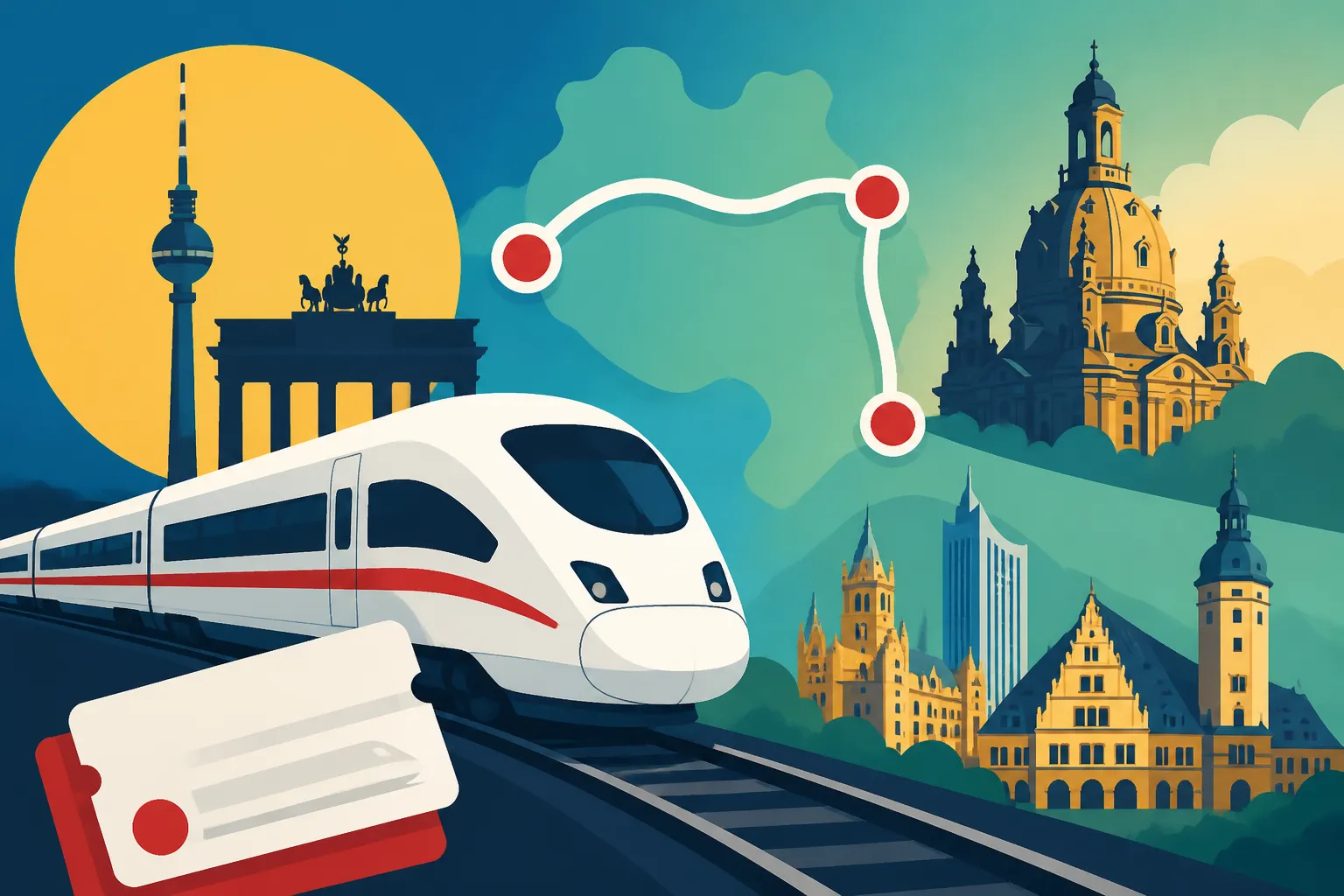
Many people plan a Berlin, Leipzig and Dresden trip and then get stuck on the tickets. The Deutsche Bahn site shows one set of fares, the FlixBus app shows another, and the regional options seem to need a decoder ring. This guide explains how the eastern corridor works, which connections make sense, and how to book the whole route without overpaying.
Disclosure: This post may contain affiliate links. We may earn a commission at no extra cost to you if you make a purchase through these links. Read full disclosure.
How the Berlin, Dresden and Leipzig Triangle Actually Works
I lived in Berlin for years before I took this corridor seriously. In my head, Dresden and Leipzig were “somewhere south, I’ll get there eventually.” When I finally did, I made every mistake on the list. I bought a flexible fare when a cheaper one would have done. I sat on a slow regional train because I didn’t know a faster one ran twenty minutes later. And I ended up at Dresden-Neustadt when my hotel was a short walk from Dresden Hauptbahnhof.
The geography helps once you see it. Berlin sits at the top. Leipzig lies south-southwest and Dresden south-southeast, and the two Saxon cities are linked by their own busy line. That gives you three legs: Berlin to Leipzig, Berlin to Dresden, and Leipzig to Dresden. They feel very different to ride, and they are ticketed differently.
Berlin to Leipzig: The Fast Leg
This is the corridor’s showpiece. Berlin and Leipzig are joined by a high-speed line that carries ICE trains running on to Erfurt, Nuremberg and Munich. Because Leipzig sits on that main north-south spine, you get frequent departures through the day. The fastest trains get you there in well under two hours, often noticeably less. Some services stop at Lutherstadt Wittenberg or Bitterfeld and add a few minutes. If you are a Reformation history fan, Wittenberg also makes a worthwhile stop on its own.
Most ICE trains leave from Berlin Hauptbahnhof, and many also stop at Berlin Südkreuz on the way out of the city. If you are staying in Schöneberg, Tempelhof or Kreuzberg, Südkreuz can save you a cross-town trip. I have watched people drag suitcases from Neukölln to Hauptbahnhof when Südkreuz was ten minutes away and served the exact same train.
There are also slower ways. Regional trains link Berlin with Saxony-Anhalt and onward to Leipzig, but you will usually change and spend much longer on board. That only pays off if you hold a Deutschland-Ticket, which I’ll cover below. Long-distance buses also run between the two cities. They are often the budget pick when train fares climb close to departure.
Berlin to Dresden: The Slower, Scenic Leg
Berlin to Dresden surprises many visitors. There is no ICE-style high-speed line here. The main long-distance trains are EuroCity and Intercity services, and many of the EuroCity trains run on through Dresden to Prague. The trip still takes roughly two hours, which is perfectly civilised, but the trains are fewer and fuller than on the Leipzig line.
These are international trains, so on busy days you share the carriage with people heading to the Czech Republic with big luggage and long-distance plans. Seats can get scarce on Friday afternoons and Sunday evenings. If you plan to continue south, our guide on Berlin to Prague, Warsaw, and Vienna: Cross-Border Rail Bookings explains the Prague extension in detail.
Dresden has two main stations, and the difference matters. Dresden Hauptbahnhof sits at the southern edge of the old town, a pleasant walk from the Frauenkirche and the Zwinger. Dresden-Neustadt is across the Elbe in the livelier, younger Neustadt district. Trains from Berlin usually call at Neustadt first and then Hauptbahnhof. Check which one is closer to where you are sleeping before you stand up. Our guide Where to Stay in Dresden: Neustadt vs Altstadt helps you choose the district before you book the train.
Leipzig to Dresden: The Short Hop Between Saxony’s Two Big Cities
The third side of the triangle is the easiest. Leipzig and Dresden are linked by a mix of fast long-distance trains and frequent regional express services, roughly in the range of one to one and a half hours depending on the train. Regional trains on this line are covered by the Deutschland-Ticket. The faster long-distance services are not.
This leg is why I recommend a loop rather than two separate return trips from Berlin. Go Berlin to Leipzig, Leipzig to Dresden, Dresden back to Berlin, or the reverse. You see both cities, you never retrace the same track, and the middle leg is short enough to do in the morning and still have a full afternoon of sightseeing. For itinerary ideas, see How to See Saxony: Dresden and Leipzig in a Weekend.
Here is the corridor at a glance. Journey times are approximate and vary by service. Check the timetable for your travel date.
| Route | Main long-distance trains | Rough journey time | Regional option | Long-distance bus | Best for |
|---|---|---|---|---|---|
| Berlin to Leipzig | ICE on the high-speed line | Under two hours on the fastest trains | Yes, with changes and much slower | Yes, frequent | Speed and frequent departures |
| Berlin to Dresden | EuroCity and Intercity, some continuing to Prague | Around two hours | Yes, with changes and much slower | Yes, frequent | Direct comfort, Prague add-ons |
| Leipzig to Dresden | ICE and Intercity plus regional express | Roughly one to one and a half hours | Yes, direct and simple | Yes | The middle leg of a loop |
| Full loop of all three | Mix of the above | A day of travel spread over a trip | Possible but slow | Possible | Seeing both cities without backtracking |
Why I Book the Eastern Corridor Through Omio
I’ll be honest about how I came to this. For years I booked everything on the Deutsche Bahn website out of habit, then checked FlixBus separately in a second tab, then forgot what the train cost by the time I’d found the bus. On the eastern corridor, where the right answer really does swing between train and bus depending on the day, that tab-juggling cost me money more than once.
Omio fixed that for me. It is a travel booking platform that searches trains, buses and flights across operators and shows the results side by side. You compare a Deutsche Bahn ICE to Leipzig and a FlixBus coach on the same screen, sorted by departure time, duration or price. On a corridor this short and this competitive, that matters.
Seeing Trains and Buses on One Screen
Picture this. It’s Thursday night, you’ve decided on a spontaneous trip to Leipzig on Saturday morning, and train fares have climbed because everyone else had the same idea. On a single-operator site you see one expensive number and wonder whether to grit your teeth. In Omio you see that number next to a coach that leaves at almost the same time and takes longer, but costs far less. Now you are making a real decision instead of guessing.
The reverse happens too. Sometimes a saver train fare booked a few weeks ahead costs about the same as the bus, and then the train wins easily. It is faster, you can walk around, and the toilet is not at the bottom of a staircase. For a deeper look at that trade-off, see FlixBus vs Deutsche Bahn: Total Cost and Time on Germany’s Main Routes.
What I like about searching the corridor in Omio is that it shows both answers at once. I am not loyal to trains or buses. I am loyal to whatever gets me to Dresden in time for coffee and cake without wrecking my budget.
Fare Types, Flexibility and What to Tick
Deutsche Bahn long-distance tickets come in different fare families. The cheaper saver fares are usually tied to a specific train and come with restrictions on changes and refunds. The flexible fares cost more but let you take any suitable train on the day and are easier to cancel. Coach tickets have their own change and cancellation rules, which differ from the rail ones.
When you book through Omio, the fare conditions show before you pay. Read them every time. That sounds obvious, but I have watched friends book the cheapest possible ticket for a trip they weren’t sure about, then lose it when plans changed. If there is any real chance you’ll leave Dresden a day early or linger in Leipzig, the extra flexibility can be worth it. The detailed breakdown is in Sparpreis vs Flexpreis on Deutsche Bahn: Change Rules and Refunds.
My rule of thumb: book the saver fare for any leg pinned to something fixed, like a concert at the Gewandhaus, a dinner reservation or a hotel check-in. Pay up for flexibility on the leg most likely to move, which is usually the last one home to Berlin.
On cost, Omio may add a booking or service fee depending on the route and payment method. It is shown at checkout before you confirm. Check Omio’s own pages for current terms. Then weigh the fee against the time you save, and against the money you save by spotting the cheaper option on screen.
Mobile Tickets, Names and Foreign Cards
This is where the platform has saved me real frustration. Many visitors try to book German transport from abroad and hit payment problems: a foreign card declined at the last step, a form that rejects an address, or a confirmation email entirely in German. Omio’s interface is in English and accepts common international payment methods. For anyone not yet living in Germany, that removes a lot of friction.
Most train and bus tickets from Omio arrive as mobile tickets in the app or by email. On a German long-distance train, the conductor scans the code on your phone. Some rail tickets are personal and must match the name of the traveller, and the conductor may ask for ID. Enter names exactly as they appear on your passport or ID card, and carry that document on the train. I once watched a traveller argue with a conductor somewhere around Riesa because the booking said “Mike” and the passport said “Michael.” It was sorted out, but nobody enjoyed the conversation.
If you have trouble with card payments on other sites, our guide Paying for German Transport With a Foreign Card: Declines and Fixes covers the common causes. On my own bookings, using Omio has meant fewer of those problems.
Step by Step: Booking a Berlin, Leipzig and Dresden Loop
Here is the exact process I use when friends visit and want to see Saxony from Berlin. It works whether you have three days or a week.
- Decide the direction of your loop. If you love buzzy neighbourhoods, end in Dresden’s Neustadt. If you want to finish with a slower evening, end in Leipzig’s Südvorstadt or Plagwitz. Either direction works, so let your accommodation choices decide.
- Fix your dates and nights first. Book accommodation before transport so you know which station you need. Leipzig has one obvious main station, Leipzig Hauptbahnhof. Dresden has two, so check yours.
- Search each leg separately in Omio. Run Berlin to Leipzig, Leipzig to Dresden, and Dresden to Berlin as three one-way searches. On this corridor, separate one-ways usually give you the clearest view of train and bus options for each day.
- Compare train and bus on every leg. Look at departure time, total duration and total price together, not price alone. A cheap coach that arrives after dark on a short winter day can cost you half a day of sightseeing.
- Pick your fare type per leg. Use saver fares for the legs you are sure about and flexible fares for legs likely to change.
- Check the arrival station for Dresden. Choose the train stop closest to your hotel, either Dresden-Neustadt or Dresden Hauptbahnhof.
- Enter traveller names exactly as on ID. Do this for every passenger and every leg.
- Pay and save the tickets in the Omio app. Download them before you travel so you’re not hunting for signal in a tunnel or a crowded concourse.
- Plan your local transport on arrival. Leipzig and Dresden both have good tram networks. Your long-distance ticket generally does not include city trams unless the fare conditions say so, so buy a local ticket for getting around.
- Check for disruptions the evening before. Look at the live status of your train, especially on Friday and Sunday, when this corridor is busiest.
Scenario: A Long Weekend for Two From Berlin
Say you are a couple living in Prenzlauer Berg with a Friday off. You want Leipzig’s café culture and Dresden’s baroque skyline without feeling rushed.
On Friday morning you leave from Berlin Hauptbahnhof on an ICE and reach Leipzig before lunch. Friday afternoon is for the Nikolaikirche, the arcades of the Mädler-Passage, and a long walk to the Völkerschlachtdenkmal. On Saturday you take a mid-morning regional or long-distance train to Dresden. You are on the Brühl Terrace by early afternoon, with an evening in the Neustadt bars. On Sunday you see the Frauenkirche and the Zwinger, then catch a late-afternoon EuroCity back to Berlin.
Searching each leg in Omio, you’d probably find that the Friday ICE, booked ahead, is reasonably priced on a saver fare. The Saturday middle leg is short and fairly priced whichever train you take. The Sunday return is the one that gets expensive, because everyone heads back to Berlin at once. That’s when it pays to look at the coach as well, or to pay a little more for a flexible fare so you can stay for another coffee if the weather is good. For more on choosing a base in Leipzig, see Where to Stay in Leipzig: Zentrum, Sudvorstadt, and Plagwitz.
Scenario: The Deutschland-Ticket Holder on a Budget
Now say you already have a Deutschland-Ticket because you commute in Berlin. That ticket covers regional trains, S-Bahn, U-Bahn, trams and buses across Germany. It does not cover ICE, Intercity or EuroCity trains, with a few local exceptions that change over time.
Technically, you could ride regional trains all the way from Berlin to Leipzig or Dresden at no extra cost. In practice you change trains, the trip takes much longer, and Friday-afternoon regional services can be very full. I did this once out of stubbornness. I arrived in Dresden tired, with a numb backside and a much better appreciation for the EuroCity.
A smart hybrid is to pay for one fast long-distance leg out of Berlin and use your Deutschland-Ticket for the Leipzig to Dresden regional hop, plus all the trams once you arrive. Omio’s comparison screen shows you exactly what the fast legs cost, so you can judge where paying is worth it. For the rules on what is and isn’t included, see Regional Trains and the Deutschland-Ticket Explained. To mix fare types on one trip, Combining Long-Distance and Regional Tickets in One Journey walks through the mechanics.
Scenario: The International Visitor Starting From BER
Many visitors land at Berlin Brandenburg Airport and want to head straight to Dresden or Leipzig without spending a night in Berlin. You can do it, but plan the first hop. Getting from BER to Berlin Hauptbahnhof or Südkreuz takes a regional train or S-Bahn, and your airport ticket needs to cover the right fare zone. See How to Get From Berlin Brandenburg Airport to the City for the details.
Once you’re in central Berlin, the long-distance trains south are easy to catch. Allow a generous buffer between your landing time and your train, because baggage reclaim and passport control take as long as they take. If your flight is late and you’re on a saver fare tied to one train, a flexible fare might have been the safer choice. For travellers flying in, I’d usually book the first leg with flexibility and save money on the later legs.
Pitfalls on the Eastern Corridor and How to Avoid Them
The eastern corridor is one of the more pleasant rail trips in Germany, but it has a few quirks that catch newcomers. These are the ones I see most often, and the ones I fell for myself.
Choosing the Wrong Berlin or Dresden Station
Berlin’s big stations can confuse visitors. Berlin Hauptbahnhof is huge and serves most long-distance trains. Südkreuz and Gesundbrunnen serve many of them too, depending on direction. Trains towards Leipzig and Dresden generally stop at Südkreuz on their way south, which helps if you’re staying in the southern half of the city. When you search in Omio, try your nearest major station as the starting point and see which departures appear. Sometimes the same train is far easier to catch from a different station across town.
In Dresden, as I mentioned above, the Neustadt versus Hauptbahnhof question is the classic mix-up. They’re on opposite sides of the river. Getting off at the wrong one isn’t a disaster, since trams and onward trains link them, but it’s an annoying extra twenty minutes with luggage.
Leipzig is simpler. Leipzig Hauptbahnhof is one of the largest station buildings in Europe and sits right at the edge of the old town. From the main hall you can walk to the Thomaskirche and the market square without any onward transport.
Delays, Missed Connections and Peak Weeks
German trains run late often enough that you should plan for it, especially on Friday afternoons and Sunday evenings. The Berlin to Dresden EuroCity trains run on to Prague, and international services can pick up delays from far away, so a train can arrive in Berlin already behind schedule.
Here’s what I do. On a loop I leave a comfortable gap between arrival and anything time-critical, like a concert or tour. For tight plans I choose a flexible fare. If your train is significantly delayed, EU and German passenger rights may entitle you to partial compensation, and sometimes to take a different train. The rules depend on the length of the delay and your ticket type. Our full guide DB Strikes and Delays: Your Rights, Compensation, and Rebooking explains how to claim and what to keep as proof.
Peak periods are the other trap. Advent is especially busy because of the Christmas markets: Dresden’s Striezelmarkt is among the oldest in Germany, and Leipzig’s market fills the whole old town. Easter and the long weekends around public holidays also push fares up and seats down fast. If you’re travelling then, search early in Omio and book as soon as your dates are firm. See Christmas Markets, Easter, and Bruckentage: Germany’s Worst Weeks to Book Late for the calendar, and How to Visit Dresden’s Striezelmarkt if the market is the reason for your trip.
Luggage, Bikes and Getting Around on Arrival
There’s no luggage weight limit on German long-distance trains, but you have to carry and stow everything yourself. Luggage racks fill up fast on the EuroCity trains to Prague. Board promptly and use the overhead racks for smaller bags. Coaches have their own rules on bag size and number, and extra or oversized bags may cost more. Check the conditions shown when you book.
Bikes are a whole separate topic. Some long-distance trains need a bike reservation, and space is limited. Regional trains generally take bikes more easily, but they get crowded in summer. The Elbe cycle path runs through Dresden, so many cyclists use this corridor. The details are in Luggage and Bike Rules on German Trains and Buses.
Once you arrive, both cities are easy to explore. Leipzig’s trams run straight from the main station into every neighbourhood worth visiting. Dresden’s trams cross the Elbe and link the old town with Neustadt. Buy a local day ticket from the machine or the city transport app, or rely on your Deutschland-Ticket if you have one. To understand the two cities beyond transport before you go, see Dresden and Leipzig: Saxony’s Cultural Cities and the broader regional overview in Saxony and the East: Dresden, Leipzig, and Beyond.
My Honest Bottom Line on Booking This Route
After years of doing this corridor badly and then doing it well, my advice is simple. Fix your accommodation first so you know your stations. Search all three legs in one place so you can compare train and bus fairly. Spend extra on flexibility only where your plans might actually change. For me, that one place is Omio. It shows every operator on the corridor side by side, issues mobile tickets in English, and spares me the tab-juggling I used to do.
So open Omio, type in Berlin to Leipzig for your first day, and see what comes up. Leipzig’s cafés and Dresden’s skyline are only a couple of hours from Berlin, and with the right ticket the trip there is easy.
Disclaimer
This article is for general informational purposes only and does not constitute professional advice. Laws, prices and regulations vary by location and change over time. Consult a qualified professional for guidance on your specific situation.