How to Get Your Gesundheitskarte After Registering in Germany
Waiting for your physical health insurance card to arrive in the mail is one of those classic German "patience tests" that every newcomer has to pass. I still remember the panic of waking up with a splitting sinus infection three weeks after moving to Berlin, looking at my empty mailbox, and wondering if I’d have to pay hundreds of Euros out of pocket just to see a doctor. This guide solves that anxiety by walking you through exactly how to secure your Gesundheitskarte and what to do while you wait.
Disclosure: This post may contain affiliate links. We may earn a commission at no extra cost to you if you make a purchase through these links. Read full disclosure.
Understanding the Electronic Health Card (eGK) in Germany
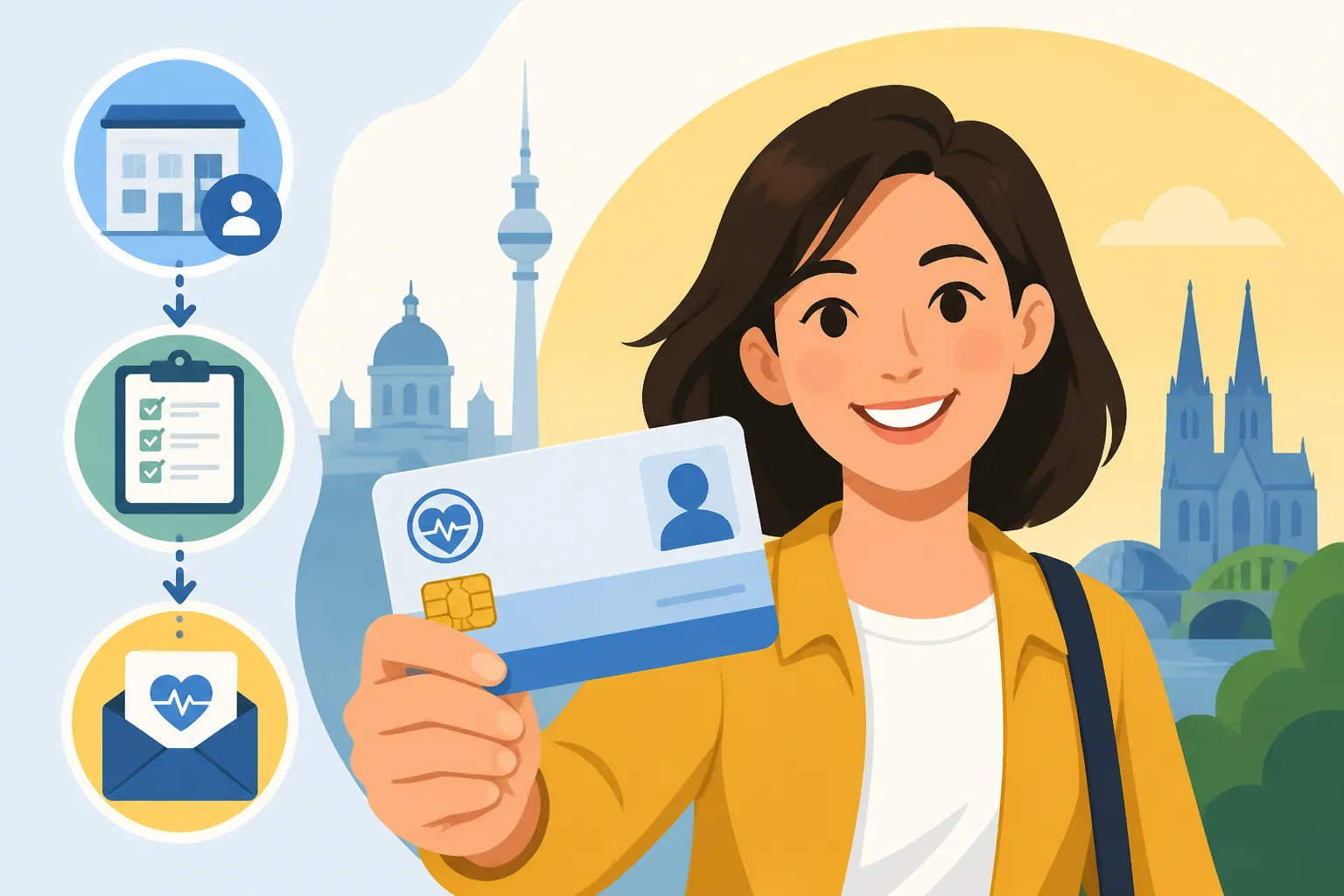
The electronic health card, or elektronische Gesundheitskarte (eGK), is much more than just a piece of plastic. It is your golden ticket to the German medical system. Without it, you are essentially "invisible" to the administrative software used by every Hausarzt (GP) and specialist in the country. The card contains a small chip that stores your administrative data, such as your name, date of birth, address, and insurance status.
When you first arrive, navigating Healthcare in Germany: A Comprehensive Guide for Expats can feel like a full-time job. The eGK was introduced to streamline this by replacing old paper-based systems. Today, it also serves as the foundation for the new digital health infrastructure, including the e-Rezept (e-prescription) system. This means that when a doctor prescribes you medicine, they "load" it onto your insurance profile, and you simply tap your card at a pharmacy to pick it up.
It is important to note that the card is issued by your specific insurance provider. Whether you have opted for Public Health Insurance (gesetzliche Krankenkasse): What It Covers and Costs or chose the path of Private Health Insurance in Germany: Benefits, Costs, and Eligibility, the card serves as proof of coverage. However, the features and the speed at which you receive it can vary significantly depending on the provider you choose.
The Step-by-Step Process for Public Health Insurance (GKV)
If you are an employee earning above the "Mini-job" threshold or a student, you will most likely be entering the public system. Getting your card isn't an automatic "Day 1" event; it requires a specific sequence of actions that usually starts with your employer or your university.
1. Registering with a Krankenkasse
The first step is actually choosing which "Krankenkasse" (public fund) you want to join. While they all offer the same basic level of care, their digital interfaces and English-speaking support vary. You can read more about Choosing a Krankenkasse in Germany: TK, AOK, Barmer, and Others Compared to find the best fit. Once you apply, the insurer will send you a welcome package, often via email first, confirming your membership number (Versichertennummer).
2. The Photo Upload Requirement
German law requires that every eGK for individuals over the age of 15 includes a passport-style photo to prevent fraud. You cannot get your card without this. Most modern insurers like TK or Barmer allow you to upload this photo through their mobile app or a dedicated web portal. I highly recommend doing this the very second you get your membership number. If you wait for the letter asking for the photo, you’ve already added a week of postal delay to your timeline.
3. Verification and Mailing
Once the photo is approved, the insurer sends the data to a specialized printing facility. It generally takes 10 to 14 business days for the card to arrive at your registered address. This is why having your Anmeldung (address registration) sorted is vital; if your name isn't on the mailbox, the postman will return the card to the insurer, and you’ll have to start the 2-week waiting period all over again.
| Step | Action Required | Typical Timeline |
|---|---|---|
| 1. Application | Sign up with a provider (e.g., TK, AOK, Barmer) | 1-3 Days |
| 2. Photo Upload | Submit a digital passport-style photo via App/Portal | Immediate |
| 3. Processing | Insurer verifies data and triggers card production | 3-5 Days |
| 4. Delivery | Physical card arrives via Deutsche Post | 7-10 Days |
| 5. Activation | No action needed; card is active upon arrival | Immediate |
Getting Your Card with Private Health Insurance (PKV)
The private insurance world works a bit differently. If you are a high-earner or a freelancer, you might have signed up for a private plan through providers like ottonova or worked with a broker like Feather Insurance to find a tailored policy.
In the private system, the card is often used primarily for identification and for the doctor to scan your details. Unlike public insurance, where the doctor bills the insurer directly, private patients often receive an invoice at home, which they then submit to their provider for reimbursement. Because of this, some private insurers are much faster at issuing cards or even provide digital versions that can be used immediately.
If you are using a digital-first provider like ottonova, the process is usually handled entirely through their app. You’ll upload your ID and photo, and they often provide a digital certificate that doctors can accept while the plastic card is in the mail. For those on a budget or in transitional periods, such as job seekers or digital nomads, a solution like SafetyWing might offer a different type of documentation, but for long-term residency, a full eGK is the standard.
For a deeper dive into the nuances of the private path, check out Health Insurance for Freelancers and Self-Employed: Navigating the System. It's a different beast entirely, and the administrative hurdles can be higher if you aren't prepared.
What to Do While You Wait: The Temporary Certificate
What happens if you have a medical emergency or a sudden fever before that plastic card arrives? This is the most common frustration expats face. The good news is that you are covered from the first day your membership begins, even if the card is still in a printing press in Nuremberg.
If you need to see a doctor immediately, you must contact your insurance provider and ask for a Mitgliedsbescheinigung (Certificate of Membership) or a Behandlungsschein (Treatment Certificate). Most providers can email this to you within an hour or even fax it directly to your doctor’s office.
When you go to your Doctor’s Appointments in Germany: Making Appointments and Avoiding Long Waits, simply present this paper (or the PDF on your phone). The receptionist will manually enter your insurance number into the system. It’s a bit more paperwork for them, but they are legally required to treat you if you have proof of coverage. Once your card eventually arrives, you should bring it to the office on your next visit so they can scan it and update your permanent record.
If you find yourself in a situation where you don't even have a doctor yet, you might want to look into Finding a Doctor (Hausarzt) in Germany: How to Choose and Register to ensure you're in someone's system before an emergency strikes.
The "E-Rezept" and Digital Features of the New Cards
Since 2024, the Gesundheitskarte has taken on a much larger role in daily life. All new cards issued by public insurers are NFC-enabled (near-field communication). This is essential for the e-Rezept.
In the old days, a doctor would give you a pink slip of paper for medicine. Now, they usually save the prescription digitally. When you walk into an Apotheke (Pharmacy) in Germany, you don't need a paper slip. You just hand over your health card. The pharmacist inserts it into their reader, and your prescription appears on their screen.
Furthermore, many insurers are now pushing the Elektronische Patientenakte (ePA), or electronic patient file. This allows you to store your vaccination records, blood test results, and x-rays directly on a secure cloud linked to your card. While you have to "opt-in" to many of these features, having the physical card is the first step to unlocking this level of convenience. If you’re curious about how to handle your medications, our guide on Pharmacies in Germany (Apotheke): How to Get Medication and Advice offers plenty of local tips.
Common Pitfalls and How to Avoid Them
Even with a clear plan, things can go sideways. Here are the most frequent issues I’ve seen expats deal with:
- Wrong Address: If you moved between applying for insurance and the card being mailed, the card will go to your old address. Ensure your name is clearly visible on the mailbox (Briefkasten) at your new place. In Germany, if the name on the mail doesn't match the name on the box, the mail is often not delivered.
- The Photo is Rejected: The photo needs to be a clear, front-facing "biometric" style. Don't use a selfie with a busy background or a filter. If the insurer rejects it, they might not tell you immediately—you might just find yourself waiting weeks for a card that was never triggered for printing.
- Employer Inaction: If you are an employee, your HR department must register you with the Social Security system before the insurer can finalize your membership. If your HR is slow, your insurance is stuck. Keep a close eye on your first payslip to ensure the deductions for Health Insurance Premiums: How Much You’ll Pay Per Month and Why are actually happening.
- Missing the PIN Letter: Many new cards come with a separate letter containing a PIN and PUK (similar to a SIM card). Do not throw this away! You need this PIN to use the digital features of the card or to access your insurer’s app on a new phone.
If you are still waiting and feeling overwhelmed by the terminology, you can refer to Common German Medical Terms: A Mini Dictionary for Patients to help you communicate with the customer service agents at your Krankenkasse.
Summary of Actions for Newcomers
To wrap this up, the moment you have your Anmeldung: Registering Your Address in Germany certificate, follow this checklist:
- Confirm your insurance provider (or sign up with Feather Insurance or ottonova if you haven't yet).
- Log into the insurer’s portal and upload your photo immediately.
- Check that your name is on your physical mailbox.
- If you get sick before the card arrives, call your insurer for a digital Mitgliedsbescheinigung.
- Once the card arrives, keep the PIN letter in a safe place.
Getting your card is a major milestone in your "settling in" journey. It’s one less thing to worry about so you can focus on enjoying your new life in Germany.
Disclaimer
This guide is for informational purposes only and does not constitute legal or professional medical advice. The German healthcare system is subject to frequent legislative changes. Always verify current requirements and procedures directly with your chosen insurance provider or a qualified legal professional.