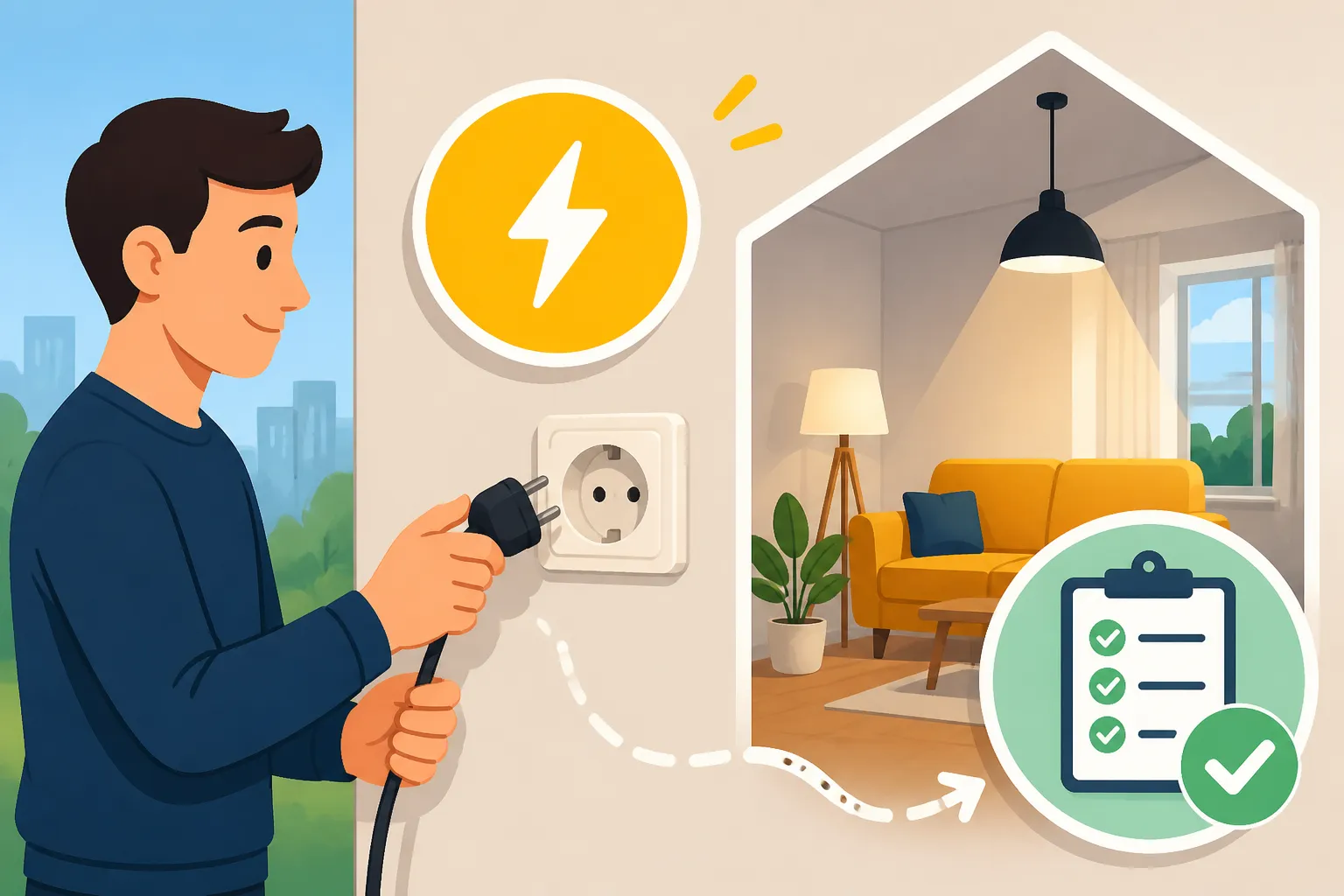
How to Set Up Electricity in a German Apartment
Moving into your first Berlin or Munich flat only to realize the lights do not just stay on by magic can be a cold awakening for any newcomer. I remember sitting in my empty living room by candlelight on my first night because I assumed the landlord handled the power, only to find a cryptic letter from the local utility company a week later. This guide will walk you through the labyrinth of German energy providers and the specific steps required to get your power flowing legally and affordably.
Disclosure: This post may contain affiliate links. We may earn a commission at no extra cost to you if you make a purchase through these links. Read full disclosure.
Decoding the German Electricity System
When you move into a new apartment in Germany, you are technically never without power, but you are often in a high-priced "default" state. The German energy market was liberalized years ago, meaning you have the freedom to choose from hundreds of different suppliers. However, if you do nothing, the local "Grundversorger" (default provider) will automatically pick you up the moment the previous tenant moves out. While this ensures you aren't literally in the dark, it is almost always the most expensive way to power your home.
Understanding the difference between Understanding German Rental Costs: Kaltmiete, Warmmiete, Nebenkosten is vital here. In the vast majority of cases, electricity is not included in your "Nebenkosten" (service charges). It is a separate contract you must sign with a provider of your choice. Unlike water or heating, which are usually managed by the building management and billed through the landlord, electricity is a personal contract between you and the energy company.
The first thing you need to do when you get your keys is find your "Stromzähler" (electricity meter). In older buildings (Altbau), these are often hidden in a wooden cabinet in the hallway or even inside your apartment near the ceiling. In newer buildings (Neubau), they are usually located in a central basement room (Keller). You will need two pieces of information from this meter: the "Zählernummer" (the serial number of the meter itself) and the "Zählerstand" (the current reading in kWh). Do not rely on the landlord’s word for this; take a photo of the meter on the day you move in to avoid paying for the previous tenant’s marathon gaming sessions.
Finding and Signing Your First Contract
Once you have your meter reading, it is time to shop around. If you are starting out in a furnished apartment via Wunderflats, the electricity might already be included in the price, but for a standard long-term rental, you are on your own. Most expats head straight to comparison portals like Check24 or Verivox. These sites are the gold standard for finding a deal, though they can be overwhelming if your German is still a work in progress.
When choosing a provider, look closely at the "Preisgarantie" (price guarantee). Energy prices in Germany can fluctuate wildly based on global markets. A contract with a 12-month or 24-month price guarantee protects you from sudden spikes. Also, pay attention to the "Neukundenbonus" (new customer bonus) and "Sofortbonus" (instant bonus). These can shave hundreds of Euros off your first year's bill, but be warned: the price usually jumps significantly in the second year. If you aren't the type of person who enjoys switching contracts every 12 months, look for a provider with a low "Arbeitspreis" (price per kWh) rather than high one-time bonuses.
After you select a provider, you will need to provide your Best Banks in Germany for Expats: Low Fees and English Support details. Most German energy companies operate strictly on a SEPA direct debit basis (Lastschrift). They will calculate a monthly "Abschlag" (estimate) based on the size of your apartment and the number of people living there. For a single person in a one-bedroom flat, this usually lands between 40 and 60 Euros per month. This isn't your actual usage cost; it’s a monthly prepayment that gets reconciled once a year.
| Feature | Grundversorger (Default) | Alternative Provider |
|---|---|---|
| Contract Duration | None (Cancel anytime) | Usually 12-24 months |
| Price per kWh | Highest | Lower (Competitive) |
| Bonus Payments | None | Often high (100€ – 300€) |
| Green Energy Options | Basic | Highly customizable |
| Ease of Setup | Automatic | Manual registration required |
Managing the Yearly Reconciliation and Usage
One of the biggest culture shocks for expats is the "Abrechnung" (annual statement). In many countries, you pay exactly what you used the previous month. In Germany, the system is built on these monthly estimates. Once a year—or when you move out—the provider asks for a new meter reading. They then compare what you actually used against the "Abschlag" payments you made throughout the year.
If you used less energy than they estimated, you get a lovely "Guthaben" (credit) sent back to your bank account. If you were running a portable air conditioner all summer or left the lights on 24/7, you will face a "Nachzahlung" (back-payment). I have seen expats hit with 500-Euro surprise bills because they didn't realize how expensive electricity is in Germany compared to the US or UK. This makes Cost of Utilities in Germany: Average Prices for Electricity, Gas, Water a critical topic to study so you can budget accordingly.
To keep your costs down, consider investing in smart home gadgets. You can find energy-efficient LED bulbs and smart plugs on Amazon Germany that allow you to track real-time usage for specific appliances. Old refrigerators and washing machines are the primary culprits for high bills in German apartments. If your flat came with a kitchen that looks like it belongs in the 1980s, you might be paying double the electricity of a modern setup. Using an app to monitor your energy can save you from that heart-stopping moment when the annual statement arrives in your mailbox.
The Technical Steps for a Smooth Transition
If you have just arrived and are still waiting for your home internet to be installed—which, let’s be honest, can take weeks in Germany—you can use an eSIM from Airalo to handle your energy registration on your phone. Most providers have mobile-friendly websites or apps where you can upload a photo of your meter reading. This is much faster than trying to call a hotline where the "English-speaking" representative might be busy.
Remember that Apartment Handover Protocol: Documenting Condition When Moving In/Out is your legal shield. When you sign the "Übergabeprotokoll" with your landlord or the previous tenant, ensure the electricity meter number and the current reading are written down and signed by both parties. This document is your proof of when your responsibility for the bills started. If the previous tenant didn't pay their final bill, the energy company might try to chase you for it unless you have this signed protocol to prove your move-in date.
If you ever find yourself in a dispute with your provider, it is helpful to know German Tenant Rights and Laws: What Expats Need to Know. Energy companies must follow strict rules regarding notice periods and price increases. For instance, if they raise their prices, you almost always have a "Sonderkündigungsrecht" (special right to cancel), allowing you to leave the contract immediately regardless of how many months are left on your term. This is a great way to jump to a cheaper provider if your current one decides to get greedy.
Specialized Tariffs and Green Energy
Germany is very serious about the "Energiewende" (energy transition), and you will find that many providers offer "Ökostrom" (green electricity). In many cases, these green tariffs are actually cheaper than the standard ones because they are subsidized or part of large-scale wind and solar initiatives. If you are environmentally conscious, look for the "ok-power" or "Grüner Strom" labels, which guarantee that the company is actively investing in new renewable energy plants rather than just buying carbon offsets.
For those who have moved into a flat that uses electricity for heating—such as "Nachtspeicherheizung" (night storage heaters) or "Durchlauferhitzer" (instantaneous water heaters)—your setup will be slightly different. You might need to learn How to Set Up Gas and Water in a German Home as well, but for electric heating, you often have a dual-rate meter. This meter tracks "HT" (Haupttarif/Day) and "NT" (Nebentarif/Night) usage. The electricity at night is significantly cheaper, and a smart expat will time their dishwasher and laundry for these off-peak hours.
Finally, do not forget The Anmeldung: Registering Your Address in Germany. While you can usually sign up for electricity before you have your official registration paper from the city, some providers might ask for it as proof of residence. Additionally, if you are struggling to find a flat and are stuck with the "empty kitchen" problem common in German rentals, check out Furnishing a German Apartment and the Empty-Kitchen Problem for tips on how to pick energy-efficient appliances that won't blow your budget once they are plugged in.
Important Considerations for Moving Out
When the time comes to leave your apartment, the process is the reverse of moving in, but with a few extra hurdles. You must "abmelden" (deregister) your electricity contract. Most contracts require you to give at least two weeks' notice before your move-out date. You will need to provide your final meter reading on your very last day, along with your new address so they can send you the final closing statement.
If you are moving within Germany, many providers will allow you to "take your contract with you" to the new address. This can be convenient, but it is also a perfect opportunity to check if a better deal exists in your new city. Prices vary by region because the "Netznutzungsentgelte" (grid usage fees) are different in Bavaria than they are in Hamburg. A quick 10-minute check on a comparison portal before you move could save you another 100 Euros a year.
Ultimately, setting up electricity in Germany is a rite of passage for every expat. It feels bureaucratic and stressful at first, but once you have your first contract confirmed and your monthly "Abschlag" set up, it becomes one of the few parts of German life that truly runs on autopilot. Just keep an eye on those meter readings, avoid the default provider like the plague, and you’ll be able to enjoy your new German home without any literal or metaphorical power outages.
Disclaimer
The information provided in this article is for general informational purposes only and does not constitute legal or financial advice. While we strive to keep the information up to date and correct, we make no representations or warranties of any kind, express or implied, about the completeness, accuracy, or reliability of the content. Energy laws and provider policies in Germany are subject to change, and we recommend consulting with a professional or the respective utility provider for specific cases.