Mandatory vs Optional Insurances: Which Ones You Really Need in Germany
Looking at a massive stack of German insurance policies while trying to figure out if you really need glass breakage coverage is a deeply overwhelming initiation to expat life here. I once paid hundreds of euros for policies I didn’t even understand out of sheer panic. This guide demystifies the German insurance maze, separating absolute legal requirements from optional peace of mind.
Disclosure: This post may contain affiliate links. We may earn a commission at no extra cost to you if you make a purchase through these links. Read full disclosure.
The German Obsession with Insurance Explained
Understanding the Vollkaskomentalitaet
When you first arrive in the country, you will quickly notice that the locals have an insurance policy for absolutely everything. Expats usually come from cultures where you only insure high-value items like your health, your home, and your car. In the local culture, however, risk aversion is practically a national sport. This deeply ingrained desire for total, comprehensive safety is perfectly encapsulated by the untranslatable word “Vollkaskomentalität,” which translates roughly to an “all-risk insurance mentality.”
This mentality means that brokers will try to sell you coverage for scenarios that seem almost comical to a foreigner. You will be offered specific policies to cover dropping your mobile phone, losing your apartment keys, or your bicycle being stolen from a train station. It is incredibly easy to get swept up in the fear-mongering and sign contracts you simply do not need, draining your monthly budget in the process. Validating what is actually necessary is your first line of defense against over-insuring your life and protecting your hard-earned salary.
As an expat, you must strike a balance between respecting the local rules of engagement and protecting your wallet. The frustration of trying to decipher complex, compound German nouns in thirty-page legal contracts is entirely valid. Do not let eager sales representatives push you into the Vollkaskomentalität without stepping back to analyze your actual, realistic risk exposure in your new environment. It is helpful to calculate your lifestyle costs using our Cost of Living in Germany Budgeting Guide before committing to a dozen different monthly premiums.
Bureaucracy and the Fear of Liability
To understand why the locals are so obsessed with being insured, you have to understand the underlying legal framework of the society. Under the local civil code, specifically Section 823 of the BGB, if you cause damage to another person’s property, health, or life, you are held personally liable for the costs. The terrifying caveat to this law is that your liability is completely unlimited. There is no cap on what you might be forced to pay if you make a careless mistake.
This is not a highly litigious society in the American sense, where people sue for emotional distress over spilled coffee. Instead, it is a highly methodical, bureaucratic society based on exact calculations. If you accidentally step into the street while looking at your phone and cause a cyclist to swerve, crash, and sustain a severe head injury, you are responsible for their medical bills, their rehabilitation, and their lost wages for the rest of their life. Your future earnings can be garnished indefinitely to pay off this debt.
When you grasp the severity of this unlimited liability, the obsession with insurance suddenly makes perfect, rational sense. The system is designed under the assumption that everyone carries a safety net to cover these catastrophic life events. Attempting to navigate this society without understanding the sheer weight of personal liability leaves you exposed to risks that could literally bankrupt you forever.
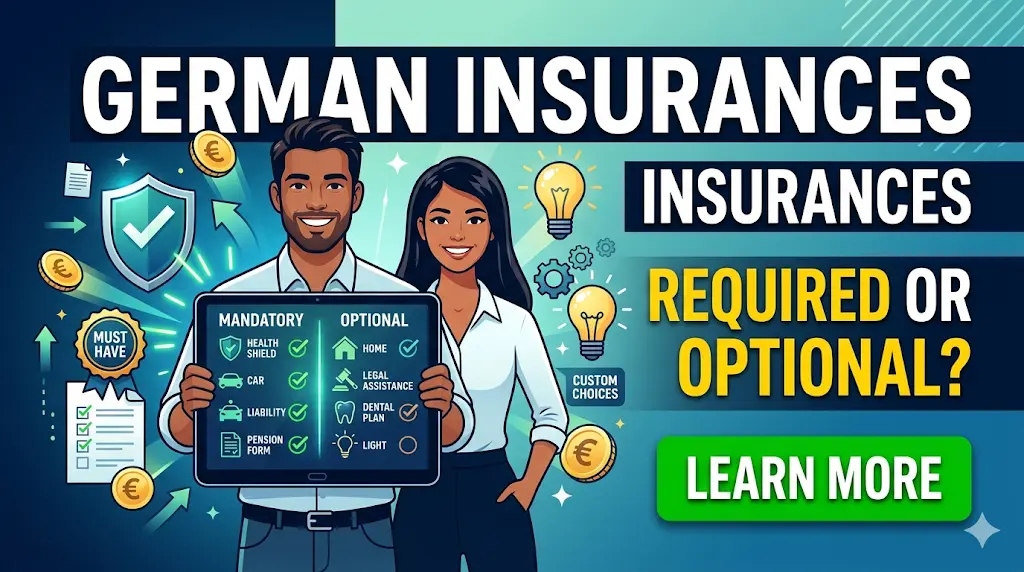
The Absolute Legal Non Negotiables
Statutory Health Insurance
You literally cannot live, work, or breathe legally in the country without holding valid health insurance. It is the absolute bedrock of your residency. Whether you are applying for a university spot, signing a corporate employment contract, or simply registering your address at the local citizens’ office, you will be demanded to present a certificate of insurance. The system is broadly divided between the statutory public system and the private system.
For the vast majority of expats, entering the statutory public system is the default and most logical route. The contributions are automatically deducted from your gross salary, and your employer covers half of the premium. This public system is incredibly robust, covering doctor visits, hospital stays, and basic dental care without charging you a deductible or presenting you with a confusing invoice after every consultation. If you are struggling to decide which route is best for your family situation, our deep dive into Health Insurance in Germany Public vs Private Coverage will clarify the ongoing debate.
However, the initial setup phase can be tricky. Often, expats moving here need to pay their first premium or an initial deposit for expat incoming insurance before they even have a local bank account functioning. Using Wise allows you to easily transfer your initial premium from your home currency directly to the German provider without getting destroyed by hidden banking fees. Relying on Wise to handle these international transfers ensures your coverage is active the moment your plane lands, keeping you compliant with strict visa regulations.
Motor Vehicle Liability Kfz Haftpflichtversicherung
If you intend to buy and drive a car, motorcycle, or even a fast e-scooter, motor vehicle liability insurance is a strict, unavoidable legal requirement. You physically cannot register a vehicle at the vehicle registration office without providing an electronic insurance confirmation number. The state mandates this to ensure that if you cause a traffic accident, the victims are guaranteed financial compensation for their injuries and property damage.
The legally mandated minimum coverage limits are quite low, but standard policies offered by local providers automatically cover you for up to one hundred million euros in damages. It is crucial to understand that this mandatory portion only pays for the damage you inflict on others. If you crash your own car into a tree, the mandatory liability insurance will pay absolutely nothing toward repairing your vehicle.
If you want your own car covered, you must opt into the voluntary tiers of vehicle insurance: partial cover or fully comprehensive cover. Partial cover usually protects against theft, fire, glass breakage, and wildlife collisions. Fully comprehensive covers everything, including vandalism and accidents where you are at fault. For expats leasing a vehicle or buying a brand-new car, fully comprehensive coverage is almost always required by the financing bank. Comparing these options is vital when reviewing your overall mobility budget.
Social Security Contributions Sozialversicherung
While not a traditional insurance policy that you shop around for, the statutory social security system is the most expensive mandatory coverage you will pay for. If you are a standard employee, you have no choice in the matter. These contributions are automatically skimmed off your gross salary every single month, making up the massive gap between your gross income and your net take-home pay.
This umbrella covers four main pillars: pension insurance, unemployment insurance, long-term care insurance, and statutory accident insurance. The premise is collective solidarity. You pay heavily into the system while you are young and employed, and the state guarantees you a safety net if you lose your job, require nursing care in old age, or suffer an accident while commuting to the office. If you want to understand exactly how much of your paycheck vanishes into these funds, examining our guide on Understanding Your German Payslip and Net Income will help you plan accordingly.
Freelancers and self-employed expats face a completely different, highly stressful reality. Because they are not standard employees, they are largely exempt from mandatory social security deductions. However, this means they operate entirely without a safety net unless they proactively, and expensively, opt into the public system voluntarily or purchase private equivalents. Navigating this massive administrative burden is one of the hardest parts of Setting Up as a Freelancer in Germany for self-employed foreigners.
The Unofficial Mandatory Coverages
Personal Liability Insurance Privathaftpflichtversicherung
If there is only one piece of advice you take from this entire guide, let it be this: buy personal liability insurance immediately. While it is not legally mandated by the federal government, it is culturally and practically mandatory. Almost every landlord will demand to see proof of this policy before handing you the keys to an apartment. It protects you against the terrifying, unlimited civil liability mentioned earlier.
The coverage is astonishingly broad. If you accidentally sit on your friend’s expensive eyeglasses, if you drop a borrowed laptop, or if you leave a tap running and flood your downstairs neighbor’s newly renovated ceiling, your personal liability insurance will cover the damages. It essentially acts as a protective shield against the clumsy mistakes of daily life that would otherwise cost you thousands of euros out of pocket.
The best part about this coverage is its affordability. For a single expat, a top-tier policy with fifty million euros in coverage will cost somewhere between forty and sixty euros for the entire year. It is the cheapest, highest-value insurance product you will ever buy. Do not live a single day in the country without it, as the risk-to-reward ratio makes skipping it a genuinely reckless financial decision when exploring Finding an Apartment in Germany Best Websites and Tips.
Occupational Disability Berufsunfaehigkeitsversicherung
Often abbreviated simply as the “BU,” occupational disability insurance is heavily pushed by every financial advisor and consumer protection agency in the country. The premise is simple: what happens if you develop a severe chronic illness, suffer a catastrophic injury, or experience severe burnout, and can never work in your chosen profession again? Your ability to earn an income is your greatest financial asset, and losing it leads straight to poverty.
Many expats falsely assume the state pension system will catch them if they become disabled. The reality is that the statutory reduced earning capacity pension is incredibly difficult to qualify for and pays out a fraction of your previous salary. Furthermore, the state only pays if you cannot work any job whatsoever for more than three hours a day. If you are a highly paid software engineer who loses their vision, the state will argue you can still work in a call center, and therefore deny you full benefits.
The occupational disability policy fills this massive gap. It pays you a pre-agreed monthly tax-free pension if a doctor certifies you can no longer perform your specific, current job. The catch is that securing a BU is incredibly difficult if you have pre-existing medical conditions, and the premiums for expats who work physical or high-stress jobs can be very expensive. Despite the cost, it is widely considered the second most important voluntary coverage to hold to protect your career.
Pet Liability Insurance Hundehaftpflicht
If you are moving abroad with a furry companion, you must navigate a completely separate tier of liability. In the eyes of local civil law, pet owners are strictly liable for any damage their animal causes, regardless of whether the owner was acting negligently or not. Crucially, your standard personal liability insurance explicitly excludes damages caused by dogs or horses.
Because of the severe risks involved, such as a dog breaking loose, running into the street, and causing a multi-car traffic collision, pet liability insurance is legally mandatory in several federal states, including Berlin, Hamburg, and Lower Saxony. Even if you live in a state where it is theoretically optional, local landlords will flatly refuse to rent an apartment to a dog owner who does not hold a dedicated policy.
The policy covers property damage, such as your dog chewing through the rental apartment’s wooden doorframes, as well as bodily injury if your dog bites another person or animal. Premiums typically run around fifty to eighty euros a year, depending on the breed of the dog. Ensuring you have this paperwork sorted is a vital step when coordinating your relocation and searching the platforms listed in Bringing Your Pets to Germany Relocation Guide.
Nice to Have but Strictly Optional
Legal Expenses Insurance Rechtsschutzversicherung
Because the local culture relies heavily on rules, contracts, and regulations, disputes are rarely settled with a handshake. They are settled with formal cease-and-desist letters and lawyers. Legal expenses insurance covers the exorbitant costs of hiring an attorney, court fees, and expert witness testimony if you find yourself entangled in a legal battle.
This policy is highly modular. You can purchase specific modules for employment law, traffic law, or tenancy law. Expats often consider this insurance because they feel vulnerable dealing with complex agreements, which is completely understandable when navigating Understanding German Employment Contracts in a foreign language. However, it is an expensive luxury, easily costing two hundred to three hundred euros a year, and policies invariably come with waiting periods of several months to prevent you from buying coverage for a dispute that has already started.
For most expats, there are cheaper alternatives. If you are worried about your landlord unfairly withholding your security deposit or issuing an illegal eviction notice, joining the local tenants’ association provides you with legal representation for tenancy issues at a fraction of the cost. You should evaluate your personal risk tolerance before committing to a costly, comprehensive legal policy.
Household Contents Hausratversicherung
Household contents insurance protects everything inside your apartment that is not physically nailed down to the structure of the building. If you were to turn your apartment upside down and shake it, everything that falls out—your clothes, your television, your sofa, your kitchen appliances—is covered by this policy against theft, fire, storm damage, and tap water leaks.
Whether you need this depends entirely on your lifestyle. Expats frequently move into completely unfurnished apartments, a massive cultural shock we detail extensively in Furnished vs Unfurnished Apartments in Germany, and spend thousands of euros buying a fitted kitchen and modern furniture. In this scenario, protecting your massive upfront investment makes excellent financial sense. The policy also frequently covers bicycles stolen from locked cellars, which is a rampant problem in major cities.
However, if you are a student living in a furnished, shared apartment with hand-me-down furniture and a laptop, the total replacement value of your worldly possessions might be very low. In that case, paying for household contents insurance is likely a waste of money. You are better off putting that monthly premium directly into a savings account to self-insure against minor losses.
Private Pension Insurance Private Rentenversicherung
As you settle into your new life, you will inevitably be targeted by aggressively friendly, English-speaking financial advisors attempting to sell you complex private pension insurances. They will warn you, correctly, that the statutory state pension will not be enough to maintain your standard of living in old age. Their solution is usually a state-subsidized product or a private unit-linked life insurance policy.
The hidden reality of these German insurance products is their notorious inflexibility and staggering hidden fee structures. The broker earns a massive commission upfront, meaning your investments often do not see actual growth for the first five years. Furthermore, if you decide to leave the country and move back home or to another European nation, extracting your capital from these rigid insurance contracts can trigger severe financial penalties and tax nightmares.
For highly mobile expats, locking wealth into a domestic insurance product rarely makes sense. Instead of funding a broker’s commission, many financially savvy foreigners prefer to manage their own wealth. Opening a brokerage account with platforms like Interactive Brokers gives you the total freedom to invest in low-cost, global index funds on your own terms. Using Interactive Brokers allows you to build a retirement portfolio across multiple currencies and international markets. If you ever leave the country, your Interactive Brokers account can seamlessly move across borders with you, providing a level of liquidity that a traditional private pension simply cannot match.
Insurance Coverage Comparison Table
To help you quickly identify what you need to prioritize upon arrival, consult this summary table of the most common insurance types.
| Insurance Type | German Name | Status | Who Really Needs It |
| Health Insurance | Krankenversicherung | Mandatory | Absolutely everyone. |
| Motor Vehicle Liability | Kfz-Haftpflicht | Mandatory | Anyone who registers a vehicle. |
| Personal Liability | Privathaftpflicht | Highly Recommended | Everyone. Essential for renting. |
| Occupational Disability | Berufsunfähigkeits | Highly Recommended | Anyone relying on their monthly salary. |
| Pet Liability | Hundehaftpflicht | Varies by State | All dog owners. |
| Household Contents | Hausratversicherung | Optional | Those with expensive furniture/kitchens. |
| Legal Expenses | Rechtsschutz | Optional | Highly risk-averse individuals. |
Managing Premium Payments as an Expat
Navigating SEPA Direct Debits Lastschrift
Once you have decided which policies to purchase, the actual mechanics of paying for them introduces another layer of cultural friction. In many countries, you simply type your credit card number into a website to pay for insurance. Here, the entire economy runs on the SEPA core direct debit mandate. You must provide the insurance company with your International Bank Account Number, and give them explicit permission to pull funds directly from your checking account.
This automated pulling of funds can be highly unnerving for newcomers who are used to pushing payments manually. To maintain control over your finances, it is highly advised to use a modern, digital banking solution. Having an account with N26 makes setting up and managing SEPA mandates incredibly transparent. Because N26 provides instant, real-time push notifications on your smartphone, you are immediately alerted the exact second an insurance company deducts a premium.
This transparency ensures you are never caught off guard by a forgotten annual deduction that pushes your account into expensive overdraft territory. If a company pulls the wrong amount, the digital banking interface allows you to easily track the mandate and dispute the charge. Managing your direct debits with confidence is a core component of mastering Setting Up a German Bank Account as a new arrival.
Budgeting for Annual vs Monthly Premiums
When you finalize an insurance contract, you will be asked to choose a payment frequency: monthly, quarterly, semi-annually, or annually. What brokers often fail to explicitly tell expats is that choosing anything other than an annual payment incurs a hidden installment surcharge. Insurers will penalize you with a premium markup of five to ten percent simply for the convenience of paying monthly.
To optimize your finances, you should always opt to pay your insurance premiums annually. However, fronting hundreds of euros in a single lump sum can be a severe hit to an expat’s cash flow, especially right after an expensive international relocation. If you need to fund a large annual premium immediately, transferring a lump sum from your home country via Wise is the most strategic move. Using Wise to convert your savings into euros guarantees you the real mid-market exchange rate, ensuring the money you saved by choosing the annual payment isn’t instantly lost to terrible banking conversion fees.
To avoid cash flow panic in the following years, you must actively budget for these lump sums. The most effective method is to utilize virtual sub-accounts within your primary banking app. The Spaces feature within N26 allows you to create dedicated digital envelopes for your insurances. You can set up an automated rule to pull one-twelfth of your annual premium into a hidden space every time you receive your salary. When the annual SEPA direct debit hits your account next year, the funds are already safely stashed away in N26, ready to be deployed without disrupting your daily spending budget.
References
Primary sources official
- BaFin – Federal Financial Supervisory Authority: The official German regulatory body overseeing the insurance sector, providing objective definitions of mandatory and voluntary insurance products. https://www.bafin.de/EN/Verbraucher/Versicherungen/versicherungen_node_en.html
- Make it in Germany – Insurance: The federal government’s official portal outlining the legal mandates for health and long-term care insurance for incoming skilled workers. https://www.make-it-in-germany.com/en/living-in-germany/money-taxes/insurance
- Verbraucherzentrale – Haftpflichtversicherung: The German Consumer Advice Centre’s definitive, unbiased guide on why personal liability insurance is the single most important voluntary policy. https://www.verbraucherzentrale.de/wissen/geld-versicherungen/weitere-versicherungen/privathaftpflichtversicherung-darum-ist-sie-so-wichtig-13891
Other helpful sources
- GDV – German Insurance Association: The umbrella organization for German insurers, offering detailed statistical overviews and explanations of policy conditions (AHB). https://www.gdv.de/en
- Settle in Berlin – Insurance Guide: A highly empathetic, practical expat breakdown decoding the jargon of German insurance contracts and which brokers actually speak English. https://www.settle-in-berlin.com/insurance-germany-guide/
Disclaimer
The information provided in this article is for general informational and educational purposes only and does not constitute professional financial, legal, or insurance advice. German insurance laws, specifically regarding the statutory mandate for health insurance (Krankenversicherungspflicht) and motor vehicle liability (Pflichtversicherungsgesetz), are highly complex and strictly enforced. Failing to maintain mandatory coverage can result in massive financial penalties, back-billing, and the revocation of your residence permit. While utilizing modern financial platforms like Wise, N26, and Interactive Brokers can significantly optimize your premium payments, capital management, and self-insurance strategies, they do not replace legally required coverage.