German Food Culture: Eating and Drinking as a Visitor
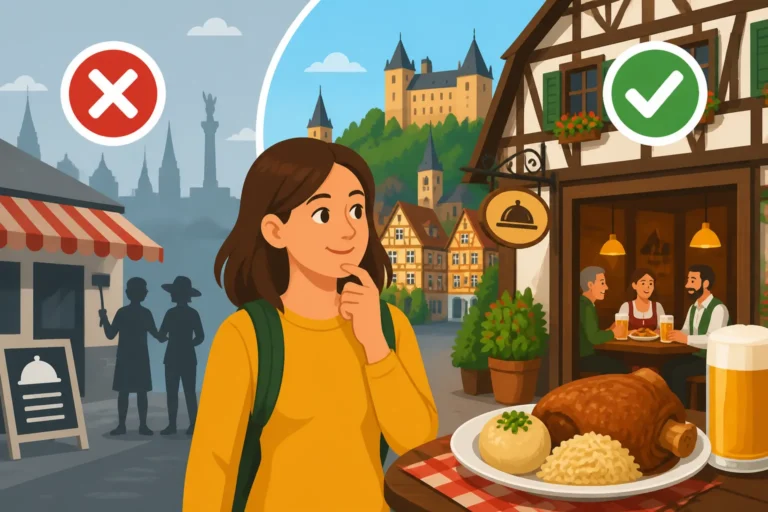
You walk into a traditional German Wirtshaus, find an empty table, and sit down, only to have the server ignore you for fifteen minutes while you wonder if you’ve somehow become invisible. I remember that exact feeling of frustration during my first month in Berlin, sitting there with a growling stomach and no idea that I was supposed to make aggressive eye contact or simply wait for the "German pace" of service. This guide solves the mystery of German dining etiquette, decoding everything from the unwritten rules of table sharing to the complex world of sparkling water, ensuring you eat like a local rather than a confused tourist.
Disclosure: This post may contain affiliate links. We may earn a commission at no extra cost to you if you make a purchase through these links. Read full disclosure.
The Philosophy of German Dining: More Than Just Sausage and Beer
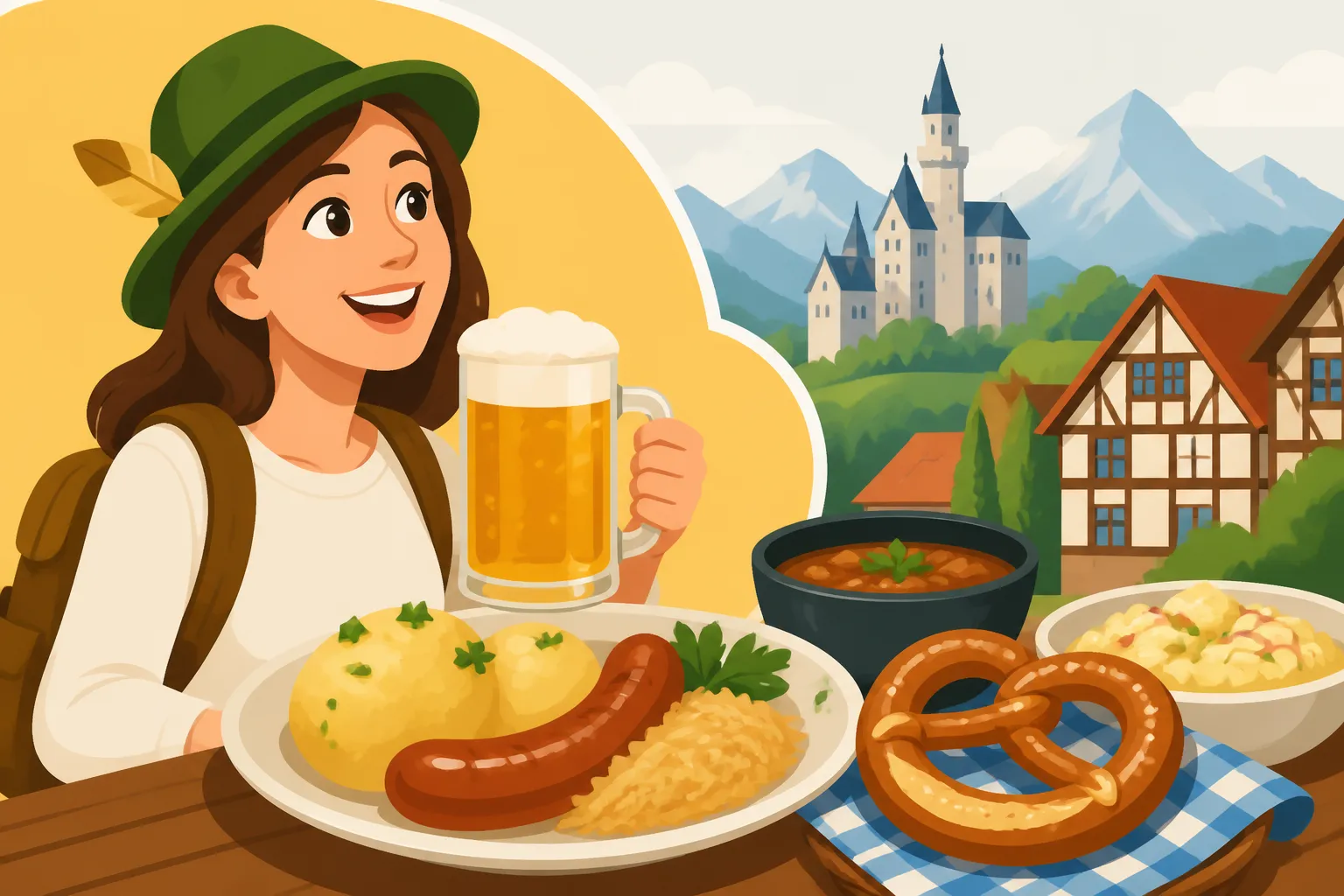
When most people think of German food, their minds immediately go to a heavy plate of Bratwurst and a massive liter of beer. While that certainly exists, the reality of German food culture is deeply rooted in regional pride and a surprising level of seasonal obsession. To understand how Germans eat, you first have to understand the concept of "Gemütlichkeit"—a word that doesn't have a direct English translation but encompasses a sense of coziness, belonging, and unhurried enjoyment. When you sit down for a meal here, you aren't just refueling; you are participating in a social ritual that values quality and tradition over speed.
The regional divide is the first thing you’ll notice as you travel across the country. In the North, you’ll find a heavy emphasis on fish, particularly Bismarck herring and North Sea shrimp, reflecting the maritime history of cities like Hamburg. As you move South into Bavaria and Baden-Württemberg, the cuisine becomes much heartier, featuring the iconic Spätzle (egg noodles) and various roasts. I often tell visitors to use a platform like Omio to book train tickets between these regions just to witness how the menus transform every few hundred kilometers. It’s like traveling through different countries, all held together by a shared love for potatoes and rye bread.
Seasonality is perhaps the most overlooked aspect of the German palate. If you visit in May, you will be hit with "Spargelzeit" (asparagus season), where every restaurant in the country suddenly features a dedicated menu for white asparagus. This isn't just a food trend; it’s a national event. Later in the year, you’ll find "Pfifferlinge" (chanterelle mushrooms) and eventually the heavy, comforting dishes of winter. Learning to eat what is currently in season is the best way to ensure you’re getting the highest quality produce, as Germans take great pride in their local agriculture. For a deep dive into what to look for on the menu, check out German Regional Dishes Every Visitor Should Try.
Finally, the pillars of the German diet are the Bäckerei (bakery) and the Metzgerei (butcher). These aren't just shops; they are the heart of every neighborhood. A German would rarely buy a pre-packaged loaf of bread from a supermarket if there’s a local baker nearby. The sheer variety of bread—over 3,000 types recognized by the German Bread Institute—speaks to a culture that treats carbohydrates with religious reverence. When you understand that food here is built on these high-quality, local foundations, the "heaviness" of the cuisine starts to feel more like "wholesomeness."
Decoding the German Breakfast: The Most Important Meal
Breakfast in Germany, or "Frühstück," is a marathon, not a sprint. If you’re staying at a hotel booked through Booking.com, you’ll likely see a spread that looks more like a lunch buffet than a morning meal. My first time facing a German breakfast spread, I looked for the pancakes and syrup and found instead a mountain of cold cuts, cheeses, and soft-boiled eggs. It’s a savory-heavy start to the day that provides the stamina needed for a day of sightseeing.
The centerpiece of any breakfast is the "Brötchen"—the crusty, fresh rolls that are bought fresh every single morning. A standard breakfast involves slicing these rolls in half and layering them with butter, jams, honey, or more commonly, "Wurst" (sausage) and "Käse" (cheese). You might also find "Muesli," which is a mixture of oats, nuts, and dried fruits, often served with yogurt. It’s a balanced way to eat, but the emphasis is always on the bread. You can learn more about this ritual in German Bread, Bakeries, and the German Breakfast.
On weekends, the breakfast ritual evolves into an even longer affair. It’s common for families or friends to gather for a "Sektfrühstück," which includes a glass of sparkling wine. You’ll see people sitting at cafes for two or three hours, slowly working through their bread baskets and refilling their coffee. There’s no rush to clear the table, which can be a shock if you’re used to the high-turnover culture of US diners. In Germany, the table is yours for as long as you want it.
One thing that often catches expats off guard is the "Zweites Frühstück" or second breakfast. This is a small snack, often a piece of fruit or a small sandwich, eaten around 10:30 AM to bridge the gap until lunch. It’s particularly common in schools and offices. This constant grazing ensures that you’re never truly hungry, which is probably why the portion sizes at lunch and dinner can be so impressively large.
Navigating the Restaurant Experience: Rules of the Table
Eating out in Germany is where most visitors run into cultural friction. The service model here is "functional" rather than "servile." Your waiter will not come by every five minutes to ask how your food tastes; in fact, they’ll generally leave you alone unless you signal them. To a newcomer, this feels like bad service, but to a German, it’s a sign of respect for your privacy and your time. If you want the bill or another drink, you need to catch the server's eye and perhaps give a small wave.
Table sharing is another quirk that surprises many. If a restaurant is crowded and you see a table with two empty seats, it is perfectly acceptable to ask, "Ist hier noch frei?" (Is this spot free?). If they say yes, you sit down and enjoy your meal. You aren't expected to make small talk with the strangers at your table; you simply share the physical space. It’s an efficient use of resources that reflects the practical nature of German society. You can find more practical advice on this in German Meal Times and Restaurant Basics for Visitors.
The "Water Dilemma" is perhaps the most famous struggle for tourists. If you ask for water in a restaurant, you will be served bottled water, and it will often be more expensive than beer. If you want tap water, you have to specifically ask for "Leitungswasser," but even then, many traditional restaurants will refuse to serve it or will charge a small fee for the service. Furthermore, "water" by default means "sparkling water" (mit Kohlensäure). If you want still water, you must specify "Stilles Wasser." I’ve seen many a visitor take a big gulp of what they thought was plain water only to be shocked by the carbonation.
When it comes to paying, the process is its own dance. The server will usually bring a leather wallet to the table and ask "Zusammen oder getrennt?" (Together or separate?). Germans love to split the bill down to the cent, and the server will happily calculate each person’s total at the table. For more on the nuances of financial etiquette, see Tipping in Germany: When, Where, and How Much. Generally, you don't leave the tip on the table; you tell the server the total amount you want to pay, including the tip, as they are processing the transaction.
Street Food and Quick Bites: Beyond the Sit-Down Meal
While sit-down dinners are great, Germany’s street food scene is where you’ll find the most local flavor. The most iconic of these is the Currywurst—a sliced bratwurst drowned in a spiced ketchup and dusted with curry powder. It’s a post-war invention that has become a cult classic. Whether you’re at a high-end restaurant or a literal hole-in-the-wall in the Ruhr Valley, every German has a strong opinion on where to find the best one. You can find a guide on how to navigate these stands in How to Order Currywurst and German Street Food.
Then there is the Döner Kebab. While it has Turkish roots, the modern Döner as we know it—served in a pita with salad and sauce—was popularized in Berlin. It is arguably the most popular fast food in the country, surpassing even McDonald’s. It’s cheap, filling, and available on almost every street corner until the early hours of the morning. For many expats, the first Döner after a long flight is a rite of passage that signifies you have truly arrived in Germany.
The "Imbiss" is the traditional German snack stand. These are often small, standing-only structures where you can get a quick sausage, a portion of fries (Pommes), or a Leberkäsesemmel (a thick slice of meatloaf in a roll). The Imbiss culture is about speed and efficiency. You’ll often see businessmen in suits standing next to construction workers, both leaning over a small shelf to eat their lunch. It’s one of the few places in German society where social hierarchies seem to disappear completely.
Don't overlook the "Wochenmarkt" (weekly market). Most neighborhoods have a market once or twice a week where local farmers sell produce, but these markets also host food stalls. You can find fresh Reibekuchen (potato pancakes), pea soup, and various regional specialties that are often much better than what you’d find in a tourist-trap restaurant. If you’re looking to explore these local food spots, booking a guided culinary tour through GetYourGuide is a fantastic way to find the hidden gems that aren't on the main maps.
Drinking Like a Local: Beer, Wine, and Everything Else
Beer is, of course, the liquid gold of Germany. But it isn't just about quantity; it’s about the "Reinheitsgebot" or the Beer Purity Law, which dates back to 1516. This law dictates that beer can only be made from water, barley, and hops (yeast was added later). This means you won’t find many of the fruity or chemically altered beers that are common elsewhere. Each region has its own style: Cologne has its light, crisp Kölsch; Düsseldorf has its malty Altbier; and Munich is the home of the Helles and Weissbier. To really understand the culture, you should spend an afternoon in one of the many Beer Gardens and Beer Halls in Germany.
Wine culture is equally significant, though often overshadowed by beer. The Rhine and Moselle valleys produce some of the world’s best Rieslings. Germans drink a lot of "Schorle," which is wine mixed with sparkling water. It might seem like a crime to wine aficionados, but on a hot summer day, a "Weinschorle" is the most refreshing thing you can imagine. If you’re visiting during the warmer months, keep an eye out for local wine festivals, which are much more common in the West and Southwest. You can find more information on this in German Wine Regions: Riesling and Beyond.
If you aren't an alcohol drinker, you won’t be left out. Germany has a massive culture of "Apfelschorle" (apple juice mixed with sparkling water), which is often seen as the national drink for children and athletes. There is also "Spezi," a mix of cola and orange soda that is surprisingly delicious and found in almost every restaurant. For those looking for a caffeine kick, German coffee culture is strong, though it leans more towards the filtered "Filterkaffee" or espresso-based drinks rather than the giant lattes common in the US.
A quick note on toasting: it is vital to make eye contact when you say "Prost!" Failing to do so is considered bad luck (traditionally, seven years of bad sex, according to local legend). You should also clink the bottom of the glass if you’re drinking Weissbier, as the glass is sturdier there and it helps stir up the yeast. It’s these small, ritualistic details that turn a simple drink into a cultural experience. If you’re heading to the biggest beer event of all, make sure to read Oktoberfest in Munich: A First-Timer's Guide before you go.
The Sweet Side: Kaffee und Kuchen and Beyond
One of my favorite German traditions is "Kaffee und Kuchen" (coffee and cake). It typically takes place on Sunday afternoons between 3:00 PM and 5:00 PM. It’s the German equivalent of British high tea, but with much bigger portions of cake. This isn't just a snack; it’s a social institution. Families gather, neighbors visit each other, and cafes fill up with people enjoying a slice of Schwarzwälder Kirschtorte (Black Forest Cake) or Apfelkuchen (apple cake). You can learn more about this sweet tradition in German Cafés and Kaffee und Kuchen Culture.
German cakes are generally less sweet and much fruitier than their American counterparts. They often use a "Quark" base (a creamy, curd-like dairy product) or are topped with fresh seasonal berries and a glaze. The "Torten" are the elaborate, multi-layered cakes, while "Kuchen" refers to simpler sheet cakes. If you are in a bakery, you might be overwhelmed by the choice, but you can never go wrong with a classic Käsekuchen (German cheesecake), which is denser and less sweet than the New York version.
Seasonal baking is another major highlight. In the lead-up to Christmas, the country turns into a giant gingerbread factory. "Stollen," a dense fruit bread covered in powdered sugar, is the king of the season. "Lebkuchen" (gingerbread) from Nuremberg is also world-famous. If you visit a Christmas market, you must try "Gebrannte Mandeln" (candied almonds), the scent of which defines the German winter experience. These treats are more than just food; they are tied to centuries of folklore and festive tradition.
Outside of the bakery, German desserts often involve "Rote Grütze," a red berry compote served with vanilla sauce or ice cream. It’s a staple in the North and a perfect way to end a heavy meal. Even in the grocery store, you’ll find a massive aisle dedicated to "Pudding" and "Quark-speise," reflecting the local love for creamy, spoonable desserts. Just remember: in a cafe, a slice of cake is often a meal in itself, so plan your appetite accordingly!
Practical Tips for Special Diets
Twenty years ago, being a vegetarian in Germany meant eating a lot of side salads and plain potatoes. Today, things have changed dramatically. Germany, particularly Berlin, is now one of the most vegan-friendly places in the world. Most modern restaurants will have clearly marked vegetarian (V) and vegan (VE) options. Even traditional Wirtshäuser have adapted, offering versions of classic dishes made with seitan or mushrooms. For more tips on navigating this, see Vegetarian and Vegan Dining in Germany.
Gluten-free (glutenfrei) eating is also becoming much easier. Because of the strict labeling laws in the EU, allergens must be clearly listed on every menu. Most supermarkets have a dedicated "Frei von" (free from) section where you can find gluten-free bread, pasta, and snacks. However, in traditional bakeries, cross-contamination is a real risk because of the sheer amount of flour in the air, so those with Celiac disease should exercise caution.
If you have a nut allergy, you need to be very careful with German bread and cakes. Hazelnuts (Haselnüsse) and walnuts (Walnüsse) are used extensively in everything from breakfast spreads to sophisticated Torten. Always ask the server: "Sind Nüsse darin?" (Are there nuts in there?). Most staff are well-trained on allergy protocols, but it’s always better to be proactive, especially in smaller, rural towns where English might be less common.
| Food Category | Common German Term | Expat Advice |
|---|---|---|
| Water | Sprudel / Stilles Wasser | Default is sparkling; "Leitungswasser" (tap) is rarely free. |
| Bread | Brötchen / Vollkornbrot | Buy from a Bäckerei, not the supermarket, for the real deal. |
| Sausage | Bratwurst / Currywurst | Every region has its own; try the local specialty first. |
| Side Dish | Spätzle / Knödel | These are the "pasta" and "dumplings" of the south. |
| Dessert | Kaffee und Kuchen | A mandatory Sunday ritual; don't skip the whipped cream (Sahne). |
| Payment | Bar / Karte | Always carry cash; many traditional places are "Nur Bargeld." |
Essential Cultural Comparisons for Foodies
To help you plan your culinary journey, it helps to know what to expect versus what you might be used to at home. In many countries, "service" is part of the price of the meal, and staff are highly attentive. In Germany, you are paying for the food and the space. Once the food is on the table, the server considers their job mostly done until you flag them down for the bill. This can feel like neglect, but it's actually the ultimate freedom to sit and talk for hours without being "turned" for the next customer.
Another major difference is the role of the "Stammtisch." In many traditional bars and restaurants, you’ll see a table with a sign that says "Stammtisch." This is reserved for locals who have been coming to that specific spot for decades. Do not sit there! It is a sacred space for the community. Seeing a group of older Germans laughing and playing cards at their Stammtisch is a beautiful glimpse into the social fabric of the country.
When it comes to "eating on the go," Germans have a high standard. Even a "quick" sandwich from a bakery will likely be on a high-quality roll with fresh lettuce and tomato. There is a general disdain for "processed" tasting food. This is why you’ll see so many people standing and eating—they want a quick meal, but they aren't willing to sacrifice the quality of the bread or the meat to get it. For a look at how to pay for all these treats, check out Cash vs Card in Germany: What Visitors Should Know.
Finally, the concept of "Bio" (organic) is massive here. Germany has one of the largest markets for organic food in the world. You’ll see "Bio-Märkte" (organic supermarkets) everywhere, and even budget discounters like Aldi and Lidl have extensive organic lines. This focus on "clean" eating exists alongside the love for sausage and beer, creating a unique culinary landscape where you can have a heavy pork roast for lunch and a superfood green smoothie for breakfast.
Disclaimer
The information provided in this guide is for educational and informational purposes only. While I strive to provide accurate and up-to-date details about German food culture and restaurant practices, traditions and prices can change. Always check local listings and restaurant policies during your visit. This guide does not constitute legal or professional advice regarding food safety or dietary requirements.