How to See Berlin’s Main Sights in Two Days
Most travelers arriving in Berlin for a short stay quickly realize the city is not a single "center" but a sprawling collection of distinct neighborhoods, each with its own rhythm and history. This guide solves the common frustration of trying to navigate Berlin’s massive scale by providing a curated, hyper-efficient two-day itinerary that balances iconic landmarks with the authentic, gritty soul of the city.
Disclosure: This post may contain affiliate links. We may earn a commission at no extra cost to you if you make a purchase through these links. Read full disclosure.
Laying the Groundwork: Logistics and Arrival
Berlin is roughly nine times the size of Paris, a fact that often shocks newcomers who think they can simply wander from sight to sight on foot. When you first arrive, your priority should be understanding the layout. The city is divided into zones A, B, and C, but for a 48-hour sprint, you will spend almost all your time in A and B. I’ve seen countless tourists waste their first morning staring at a ticket machine in a state of paralysis because the interface feels like a logic puzzle. To avoid this, I recommend looking at How to Get From Berlin Brandenburg Airport to the City before you even touch down at BER.
Before you start your first day, you need a place to drop your bags. Choosing where to stay is a tactical decision. Many people default to Mitte because it is the geographical center, but it can feel a bit sterile and tourist-heavy after dark. If you want a more "local" experience, consider Friedrichshain or Prenzlauer Berg. You can find excellent deals and boutique stays through Booking.com, which allows you to filter for proximity to S-Bahn or U-Bahn stations—a non-negotiable for a short trip. Being within a five-minute walk of a station like Alexanderplatz or Friedrichstraße will save you hours of transit time over two days.
Once you are settled, your next step is mastering the transit system. Berlin doesn't have turnstiles, which leads some to believe the "honor system" is a suggestion. It is not. Plainclothes controllers are frequent and unforgiving. To navigate the complexities of the network, including the difference between the Ringbahn and the regional lines, you should read up on How to Use the Berlin U-Bahn and S-Bahn as a Visitor to ensure you aren't caught off guard by a 60-euro fine that ruins your morning.
Navigating the Berlin Transport Maze
The S-Bahn (suburban trains) and U-Bahn (underground) are your primary tools for conquest. For a two-day trip, skip the single-trip tickets. They are expensive and a hassle to validate every time. Instead, look into a 48-hour Berlin WelcomeCard or a standard 24-hour ticket. If you are coming into Berlin from another German city like Munich or Hamburg, you likely used Omio to book your high-speed ICE train, and you can often use that same platform to keep your digital tickets organized.
When standing on the platform, pay attention to the destination on the train’s front. Berlin’s lines often branch or end unexpectedly. I remember my first month here, thinking I was heading to the West, only to find myself in a sleepy suburb because I didn't realize the S7 changes its terminal regularly. Always check the digital displays. If you feel overwhelmed, there is no shame in using a navigation app, but remember that GPS can be finicky in the deep U-Bahn tunnels.
Finding Your Home Base in the City
Mitte is the logical choice for first-timers because the majority of the "Prussian" sights are within walking distance of each other. However, Berlin's true magic lies in its "Kieze" or micro-neighborhoods. If you choose a spot in Kreuzberg, you’ll be surrounded by street art and canal-side bars, but you’ll have a 15-minute commute to the Brandenburg Gate. Using Booking.com to find a hotel near the "Tiergarten" area can offer a nice middle ground—quiet, green, and centrally located between the East and West centers.
Think about what you want your evening to look like. If you want a quiet dinner and a walk through a cobblestone street, Prenzlauer Berg is your winner. If you want to experience the legendary Berlin techno scene or visit a gritty bar, Neukölln or Friedrichshain is where you should lay your head. Just make sure you are near a line that runs 24 hours on weekends, or you'll be facing a very expensive taxi ride back to your room.
Day 1: The Heart of Prussian and Cold War Berlin
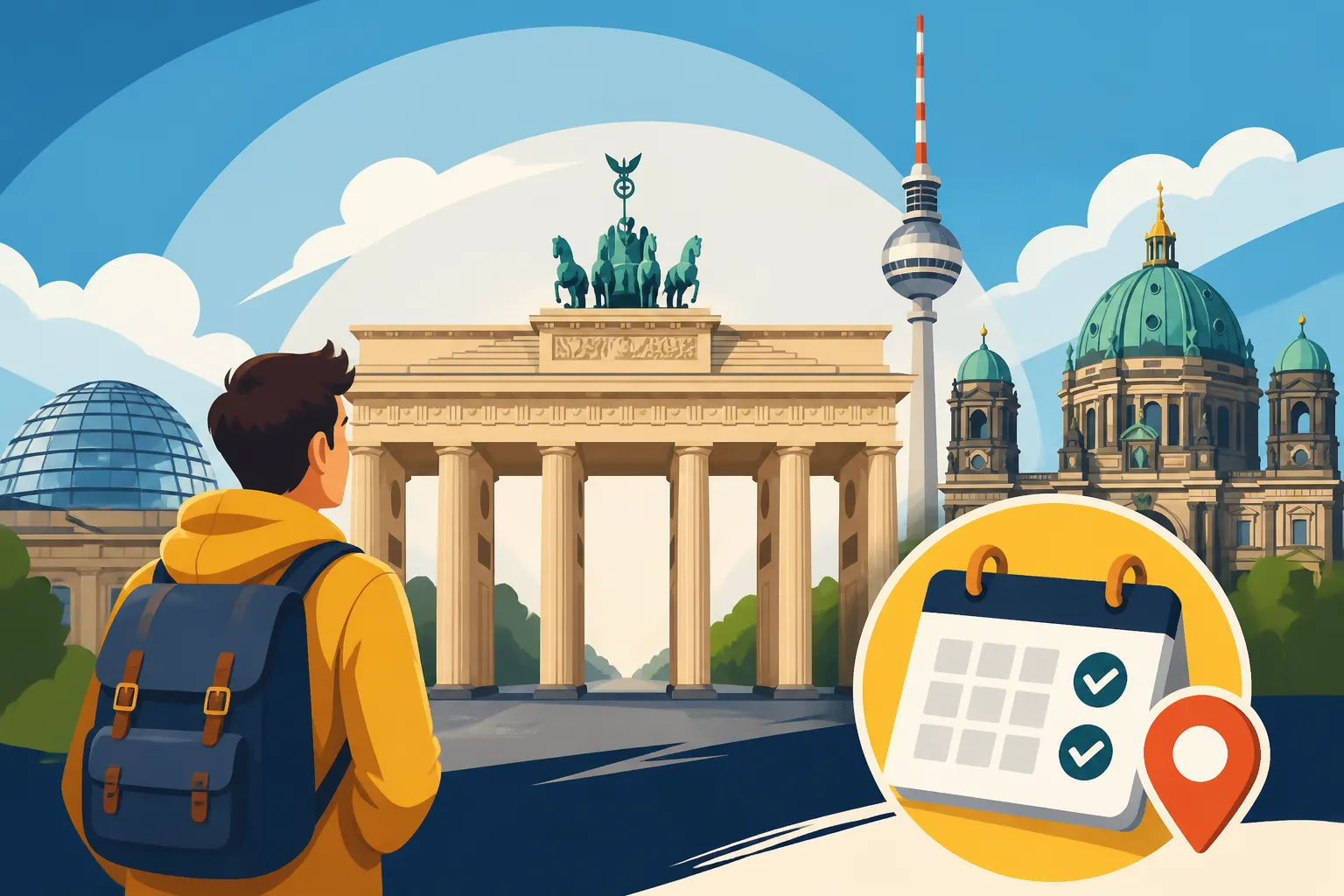
Your first day should be dedicated to the "Big Sights." Start early at the Brandenburg Gate (Brandenburger Tor). This is the symbol of German reunification and, arguably, the most famous landmark in the country. Standing under the Quadriga at 8:00 AM before the tour buses arrive is a hauntingly beautiful experience. From here, you are perfectly positioned to walk through the history of the 20th century in a matter of blocks.
Just a short walk from the gate is the Memorial to the Murdered Jews of Europe. It consists of 2,711 concrete slabs of varying heights. Walking through the narrow, undulating paths is meant to evoke a sense of disorientation and unease. It is a powerful, silent tribute that requires a moment of quiet reflection. Do not be the tourist taking "jumping photos" here; the local staff and residents take the sanctity of this space very seriously.
Continuing south, you will hit Checkpoint Charlie. To be perfectly honest as an expat, this spot is the definition of a tourist trap, complete with actors in uniforms and overpriced souvenir shops. However, it is a historical milestone you have to see once. Don't linger too long; instead, look at the cobblestone line in the street that marks where the Wall once stood. It snakes through the city and serves as a constant reminder of the division. For a deeper dive into the actual mechanics of the Wall, I highly recommend checking out How to Visit the Berlin Wall and Its Memorials to find the less crowded, more authentic spots.
Morning: From the Brandenburg Gate to Checkpoint Charlie
After the Holocaust Memorial, head toward Potsdamer Platz. Before the war, this was the busiest intersection in Europe. During the Cold War, it was a desolate "no-man's land" bisected by the Wall. Today, it is a forest of steel and glass skyscrapers. It’s a great place to see how Berlin reinvented itself after 1990. If you are hungry, skip the chains and find a small bakery nearby for a "Schrippe" (Berlin-style roll).
As you move toward Checkpoint Charlie, you will pass the Topography of Terror. This is an indoor/outdoor museum located on the site of the former Gestapo and SS headquarters. It is one of the few places where a significant stretch of the "Outer Wall" still stands in its original, battered state. The exhibition is free and incredibly detailed, documenting the rise of the Nazi regime. It is heavy, but essential for understanding the modern German psyche.
Afternoon: Museum Island and Unter den Linden
Walk or take the bus up Friedrichstraße to Unter den Linden, the grand boulevard of the Prussian Kings. This area is currently undergoing massive renovations, but the scale of the buildings remains impressive. You’ll pass the Bebelplatz, the site of the infamous Nazi book burning in 1933. Look for the small glass plate in the ground; it looks down into an empty library with enough shelf space for the 20,000 books that were destroyed.
Your destination for the afternoon is Museum Island (Museumsinsel). This UNESCO World Heritage site houses five world-class museums. If you only have time for one, make it the Pergamon Museum (though check for current closures) or the Neues Museum to see the bust of Nefertiti. To avoid the legendary queues that can eat up half your day, I strongly suggest booking a timed-entry ticket through GetYourGuide. It allows you to bypass the ticket office shuffle and walk straight into the history of the ancient world. After the museums, take a breath at the Berlin Cathedral (Berliner Dom). The interior is stunning, and the climb to the dome offers one of the best views of the city.
Evening: Prenzlauer Berg Dining
As the sun begins to set, head north to Prenzlauer Berg. This neighborhood was once a hotspot for GDR dissidents and is now a beautifully restored area full of families and cafes. Walk around Kollwitzplatz and find a spot for dinner. Berlin's food scene has evolved far beyond sausages. You can find world-class Vietnamese, Sudanese, and Italian food here.
When the bill arrives, remember that German service is efficient but not "bubbly." You are expected to tell the server the total amount you want to pay, including the tip, rather than leaving cash on the table. For a breakdown of the social nuances, refer to Tipping in Germany: When, Where, and How Much so you don't accidentally offend your waiter. Finish your night with a beer at Prater Biergarten, the oldest beer garden in the city, which has survived every regime change Berlin has ever seen.
Day 2: Alternative Vibes and Dark History
Day two is about the "other" Berlin—the East, the underground, and the modern seat of power. Start your morning in the East at the East Side Gallery. This is the longest remaining stretch of the Berlin Wall, now covered in murals by artists from all over the world. It is an open-air gallery that runs along the Spree river. The famous "Fraternal Kiss" mural is here, but take the time to look at the lesser-known works that speak to global struggles for freedom.
From the East Side Gallery, cross the Oberbaumbrücke. This double-deck bridge is arguably the most beautiful in Berlin, with its red-brick towers. It used to be a pedestrian crossing point for West Berliners entering the East. Today, it connects the two coolest neighborhoods in the city: Friedrichshain and Kreuzberg. This area is the heart of Berlin's alternative culture. You'll see street art on every corner and a distinct lack of "suit and tie" culture.
If you are visiting on a Sunday, you have a unique challenge. Most shops are closed, but the flea markets come alive. The most famous is at Mauerpark, where you can find everything from vintage GDR medals to hand-crafted jewelry. It’s a chaotic, wonderful mess. However, be aware that What Closes on Sundays in Germany? applies to supermarkets and pharmacies, so don't plan on doing your souvenir shopping at a standard mall.
Morning: The East Side Gallery and Friedrichshain
After walking the Wall, wander into the side streets of Friedrichshain. Boxhagener Platz is the local heart here. On Saturdays, there is a food market; on Sundays, a flea market. It’s the perfect place to grab a "Döner Kebab," which was actually popularized in its modern form right here in Berlin. If you want to ensure you're getting the real deal and not a tourist version, check out How to Find Authentic Restaurants in Germany (Not Tourist Traps) for some local favorites.
This neighborhood is also home to the RAW-Gelände, a former train repair yard that has been taken over by artist studios, climbing gyms, and nightclubs. It is gritty and covered in graffiti, which might be a shock if you’ve just come from the pristine streets of Munich. But this is Berlin. It’s raw, unfinished, and incredibly creative.
Afternoon: The Tiergarten and Reichstag
Head back toward the center to visit the Reichstag, the seat of the German Parliament. The building is a metaphor for German history: a 19th-century shell with a modern, transparent glass dome designed by Norman Foster. The dome signifies that the people are above the government and that the proceedings below are transparent. You must register weeks in advance to visit the dome. If you missed the official window, sometimes GetYourGuide offers guided tours that include dome access as part of a larger package.
After the Reichstag, walk through the Tiergarten. This is Berlin's version of Central Park, but much wilder. In the center stands the Victory Column (Siegessäule). If your legs aren't dead yet, you can climb the 285 steps for a view that looks straight down the 17th of June Street toward the Brandenburg Gate. It’s the best "geography lesson" you can get of the city.
Evening: West Berlin Glamour or Kreuzberg Nights
For your final evening, you have a choice. If you want old-world West Berlin glamour, head to Kurfürstendamm (Ku'damm). This was the glittering heart of the West during the division. Visit the Kaiser Wilhelm Memorial Church, which was left as a ruined spire after the war as a memorial against destruction. It stands in stark contrast to the modern buildings surrounding it.
Alternatively, if you want to see how the "locals" party, stay in Kreuzberg. Head to Oranienstraße and hop between small bars. This is also where you’ll find some of the best nightlife. If you're nervous about the safety of these grittier areas, rest assured that Berlin is generally very safe, but it's always smart to review Staying Safe in Germany: Common-Sense Tips for Travelers to stay aware of common pickpocketing spots like Alexanderplatz or Kottbusser Tor.
Essential Practical Tips for Your 48-Hour Sprint
Time is your most precious resource. One mistake I see travelers make is trying to fit in a day trip to Potsdam or Sachsenhausen on a two-day itinerary. Don't do it. Berlin has enough depth to fill a month, and rushing out of the city will only leave you stressed. Stick to the city limits and embrace the "Späti" culture. A Späti is a late-night convenience store where locals buy a beer and sit on the sidewalk. It is the cheapest and most authentic way to experience Berlin's social life.
Another critical tip: Cash is still king in many parts of Berlin. While the "big" museums and hotels will accept cards, that small, amazing schnitzel place in Neukölln might be "Nur Barzahlung" (cash only). To avoid being that person stuck at the table while their partner hunts for an ATM, read Using Cash vs Card in Germany: Is Germany Going Cashless? to understand the current landscape.
| Feature | Berlin WelcomeCard | Day Ticket (AB) | Single Trip (AB) |
|---|---|---|---|
| Price (Approx) | €26 (48h) | €9.90 | €3.50 |
| Transport | Unlimited | Unlimited | One-way (2 hours) |
| Discounts | 25-50% off attractions | None | None |
| Best For | Heavy Sightseeing | Efficient Travel | One-off journeys |
| Validation | Once at first use | Once at first use | Every time |
Planning Your Next Steps
If you’ve followed this guide, you’ve seen the Prussian grandeur, felt the weight of the Cold War, and tasted the alternative energy that makes Berlin unique. But this is just the tip of the iceberg. Many people leave Berlin and immediately start planning their move here—I certainly did. If you find yourself bitten by the Berlin bug, you might start looking into Finding a Job in Germany: Top Job Portals and Networking Tips to see if a more permanent stay is in your future.
For those continuing their journey through Europe, your next stop is likely just a train ride away. Berlin is exceptionally well-connected to Prague, Warsaw, and Amsterdam. You can easily map out your onward journey by looking at How to Plan a Germany Itinerary by Train to see how to make the most of the Deutsche Bahn network.
Disclaimer
The information provided in this guide is based on personal experience and current travel conditions in Germany. Regulations regarding visa requirements, transport costs, and museum opening hours can change without notice. Always verify specific details such as Reichstag registrations or transit updates on official government websites before your trip. This guide is for informational purposes and does not constitute legal or professional travel advice.