Cologne to Amsterdam and Brussels: Which Operator Is Cheapest
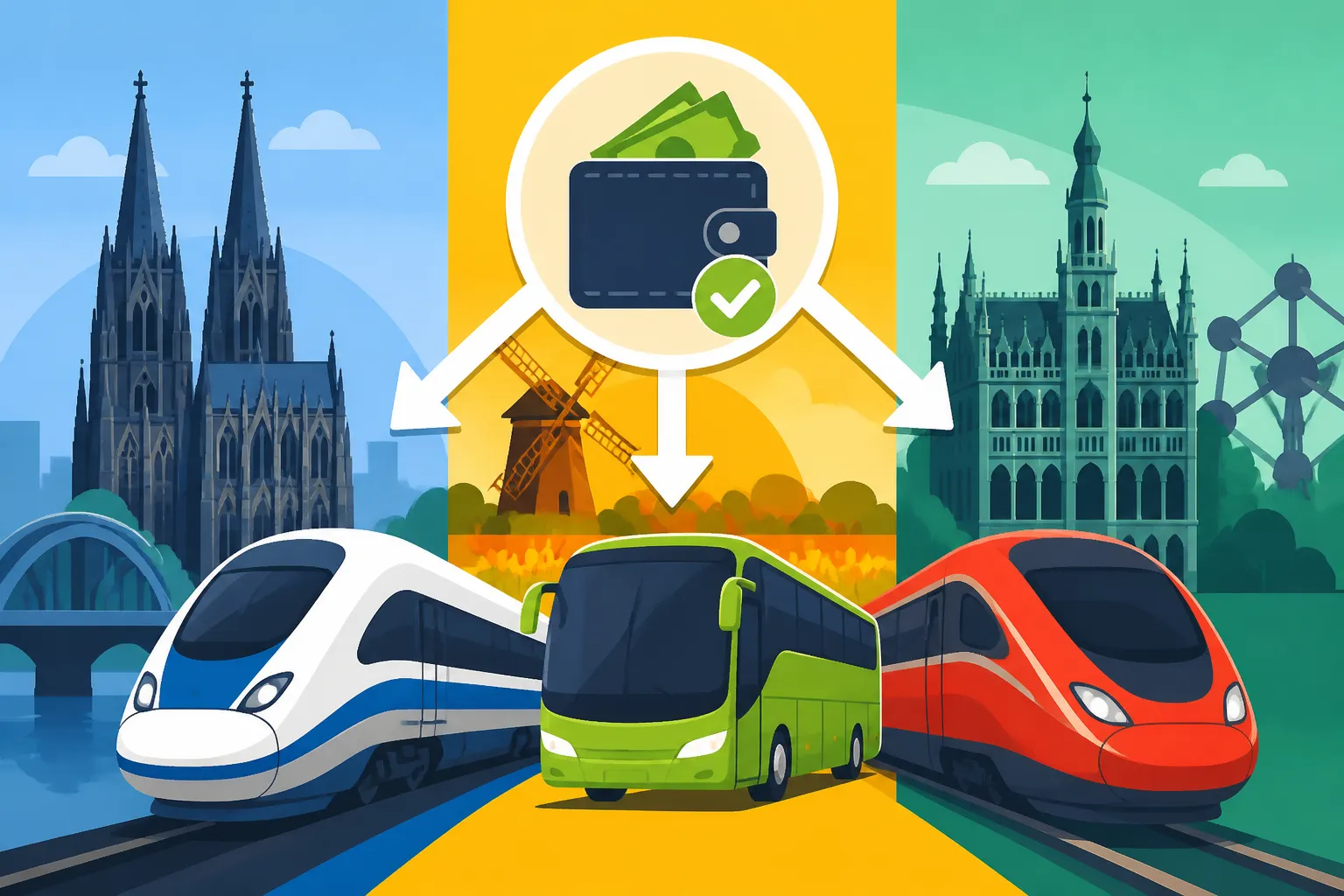
Cologne sits barely a couple of hours from both Amsterdam and Brussels, yet the fares for the same trip can swing wildly depending on the operator, the day and how early you book. This guide compares Deutsche Bahn’s ICE, Eurostar, FlixBus and the slow regional routes so you can find the cheapest seat without wasting an evening across three booking sites.
Disclosure: This post may contain affiliate links. We may earn a commission at no extra cost to you if you make a purchase through these links. Read full disclosure.
Why Fares From Cologne Are So Confusing
When I first lived in the Rhineland, I assumed a trip this short would have one obvious price. It doesn’t. Cologne Hauptbahnhof is a hub for several international operators, and each one prices its seats with its own logic. Fares rise as trains fill up. Buses run their own promotions. Some tickets only show up on one operator’s website. If you’ve opened four tabs and ended up more confused than when you started, you’re not alone.
The Operators You Will Actually See
On the Cologne to Amsterdam corridor, the main players are Deutsche Bahn’s ICE International trains, run together with Dutch NS, and long-distance buses, mainly FlixBus. On Cologne to Brussels, you’ll see Deutsche Bahn’s ICE to Brussels-Midi and Eurostar, which now runs the high-speed service many people still call by its old name, Thalys. FlixBus also covers Brussels. On top of that, there is always the patient traveller’s option: a chain of regional trains via Aachen.
Each of these is a separate company with separate fare rules. A cheap Deutsche Bahn Sparpreis follows different change and refund rules from a Eurostar fare. A FlixBus ticket works differently again. That is the first reason prices look inconsistent. The cheapest operator on a Tuesday morning may be the most expensive on a Friday afternoon.
Why the Same Seat Costs Different Amounts
Both rail operators use demand-based pricing. A limited number of seats go on sale at the lowest fare level. When those sell, the next tier opens. So a train that looks cheap three weeks out can cost several times more the day before. Buses use a similar model, though their price ladder is usually less steep.
The frustrating bit is that nobody publishes a simple chart of when prices jump. You only see the price at the moment you search. That is exactly why comparing everything in one place matters, and why I now start every trip from Cologne by running the route through Omio before going anywhere else.
Where Omio Fits In
Omio is a booking platform that pulls trains, buses and flights into a single search. Type in Köln and Amsterdam, and you’ll see Deutsche Bahn trains, FlixBus coaches and other options lined up by departure time, duration and price. For a corridor like this, where several operators compete within the same few hours, that side-by-side view saves real time and real money.
It won’t magically lower an operator’s base fare. What it does is stop you missing the cheaper option you didn’t know existed. Most of my early overspending on this route came from booking the first train I found on one website when a bus or an earlier departure was much cheaper. Omio may add a service or booking fee depending on the route and payment method, so check the final total at checkout and compare it with the operator’s own site when the gap is small.
Cologne to Amsterdam: Operators Compared
Amsterdam is the trip I’ve done most often from Cologne, usually for weekends, sometimes for work. The route runs through the Lower Rhine, crosses the border near Emmerich and continues through Arnhem and Utrecht. You have two serious choices here, train or bus, plus a slow regional workaround.
ICE International: Fast and Direct
The direct ICE from Köln Hbf to Amsterdam Centraal is the comfortable choice. You board in the shadow of the cathedral, settle in and arrive in central Amsterdam in a little under three hours without changing trains. Stops typically include Düsseldorf, Duisburg, Oberhausen, Arnhem and Utrecht, which is handy if your final destination isn’t Amsterdam itself.
Pricing follows the Deutsche Bahn model. Book early and you can often grab a Super Sparpreis or Sparpreis fare that competes with the bus. Book late and you’ll pay a Flexpreis that hurts. If you want to understand what you give up with the cheaper tiers, my breakdown in Sparpreis vs Flexpreis on Deutsche Bahn: Change Rules and Refunds walks through the trade-offs. In short, cheap fares tie you to a specific train, which matters if your plans are likely to change.
A real-life example: a friend of mine booked a Friday evening ICE to Amsterdam about two weeks ahead and paid roughly what a bus would cost. Her colleague booked the same train on Thursday night and paid several times more. Same seat class, same train. The only difference was timing.
FlixBus: Usually the Lowest Price
If price is your only concern, the bus usually wins on this route. FlixBus runs several departures a day from Cologne to Amsterdam, with the journey usually taking somewhere between three and four and a half hours, depending on traffic and stops. Arrival points in Amsterdam vary, with services often using Sloterdijk or other stops rather than Centraal, so check your ticket carefully.
In Cologne, long-distance buses commonly depart from the bus stop at Breslauer Platz, on the north side directly behind Köln Hauptbahnhof, and some services use Köln/Bonn Airport instead. Stops can change, so always read the exact departure point on your ticket rather than assuming. Mixing up the stop is the classic way to miss a cheap bus.
The trade-offs are predictable. The A3 and A12 motorways get clogged on Friday afternoons and around Dutch and German public holidays. You’ll have less legroom than on the ICE, and luggage limits are stricter. My guide to Long-Distance Buses in Germany: FlixBus and Networks covers what to expect onboard, and Luggage and Bike Rules on German Trains and Buses explains why your oversized suitcase might cost extra on a coach but not on a train.
The Regional Train Workaround
There is a slower option that some budget travellers swear by: regional trains to the border and Dutch trains beyond. It involves at least one change, often more, and takes considerably longer than the ICE. It can make sense if you hold a ticket that already covers part of the German section, or if every direct option has sold out at a painful price.
Be careful with the Deutschlandticket here. It covers German local and regional transport, and only some specific cross-border sections, so it will not take you all the way to Amsterdam. Check the current rules for the border section you plan to use before relying on it. For most people, the time lost makes this option worthwhile only in a pinch.
Cologne to Brussels: Operators Compared
Brussels is the quicker hop. High-speed trains run via Aachen and Liège and reach Brussels-Midi, also called Brussel-Zuid, in under two hours. This route has genuine rail competition, which is good news for your wallet if you compare properly.
Deutsche Bahn ICE to Brussels-Midi
Deutsche Bahn runs direct ICE trains between Köln Hbf and Brussels-Midi, some of which continue from Frankfurt. The ride is smooth, the scenery through the Ardennes foothills near Liège is lovely, and the trains feel spacious. Cheap fares follow the same early-booking logic as on the Amsterdam route.
One detail many travellers miss: these ICEs stop at Brussels-Nord and Brussels-Midi rather than Brussels-Central on some services, so check where you actually want to end up. Brussels-Midi is the main international station and the one you’ll want if you’re connecting to Eurostar toward London.
For more on how ICE fares and routes behave across Germany, see High-Speed Trains in Germany (ICE): Deutsche Bahn Routes and Savings.
Eurostar: The Former Thalys Route
Eurostar runs the high-speed service between Cologne, Brussels and Paris, the route long known as Thalys before the two brands merged. Trains depart from Köln Hbf, and travel time to Brussels is similar to the ICE. Eurostar sells its tickets in fare classes with different flexibility levels and onboard comforts, and the cheapest seats go quickly on popular weekends.
This is where comparing matters most. On a given morning, the ICE might be cheaper than Eurostar by a noticeable margin, or the reverse. I’ve seen both happen in the same week. Because the two companies price independently, checking only one operator means you could easily overpay. Running the search through Omio shows both rail options next to each other, which is the quickest way I know to spot which operator is cheaper for your exact departure time.
FlixBus to Brussels
FlixBus also covers Cologne to Brussels, usually in around three hours or a little more, depending on traffic. It’s typically the cheapest option, especially for last-minute travel when train fares have climbed. The same departure-stop advice applies: check whether your bus leaves from Breslauer Platz behind the main station or from the airport.
The bus makes the most sense when train fares have spiked, when you’re travelling light, or when the departure time simply suits you better. If you’re heading on to Paris or London, though, the train usually saves enough time to justify a modest premium.
Side-by-Side Comparison
Here is how the options generally stack up. Prices change constantly, so this table describes the shape of each option rather than specific fares. Check current figures with a live search.
| Route | Operator | Mode | Typical journey | Change needed | Price pattern | Best for |
|---|---|---|---|---|---|---|
| Cologne to Amsterdam | Deutsche Bahn with NS | ICE International | A little under three hours | No | Cheap if booked early, expensive last minute | Comfort and speed |
| Cologne to Amsterdam | FlixBus | Coach | Around three to four and a half hours | No | Usually lowest, rises less steeply | Tight budgets |
| Cologne to Amsterdam | Regional trains | Local rail | Much longer | Yes, several | Varies, depends on tickets held | Emergencies or pass holders |
| Cologne to Brussels | Deutsche Bahn | ICE | Under two hours | No | Early-booking discounts | Speed, Brussels-Midi connections |
| Cologne to Brussels | Eurostar | High-speed rail | Under two hours | No | Fare classes, popular slots sell out | Continuing to Paris or London |
| Cologne to Brussels | FlixBus | Coach | Around three hours or more | No | Often cheapest close to departure | Last-minute budget trips |
How to Find the Cheapest Ticket Step by Step
After many trips and a few expensive mistakes, I’ve settled into a routine. It takes about ten minutes and has saved me a lot over the years.
My Booking Routine
- Decide how flexible your travel day really is. Being able to shift by a day often matters more than which operator you choose.
- Open Omio and search Cologne to your destination for your preferred date, with all transport modes visible.
- Sort the results by price, then by duration, and note the cheapest train and the cheapest bus.
- Check neighbouring days and earlier or later departures. Early morning and mid-day trains on weekdays are often cheaper.
- Compare the final checkout total, including any service fee, against the operator’s own website if the difference between options is small.
- Read the fare conditions before paying, especially whether the ticket ties you to one specific train or bus.
- Confirm the exact departure point, particularly for buses, and the arrival station in Amsterdam or Brussels.
- Download your ticket to your phone and keep a screenshot in case you lose data at the border.
That last step matters more than people think. Mobile signal can drop on parts of the route, and you don’t want to be fumbling for a ticket when the conductor arrives. My guide to Mobile Data and eSIMs for Travel in Germany covers how to stay connected across the border.
When Booking Directly Makes Sense
Omio is my first stop for comparison, but I won’t pretend it’s always the final one. If you hold a BahnCard, you may want to book Deutsche Bahn fares through the DB channels where your discount is applied automatically. Rail pass holders have their own reservation rules too, which I explain in Interrail and Eurail in Germany: Reservation Fees and Whether It Works Here.
For most visitors and occasional travellers without discount cards, though, the convenience of seeing every operator together usually outweighs everything else. I also find it easier when booking from a foreign card, a pain point covered in detail in Booking German Trains From Abroad: Foreign Cards, Names, and Failures. Foreign travellers sometimes struggle with operator checkouts, and an aggregator with an English interface can be a relief.
Common Mistakes to Avoid
The biggest mistake is booking too late on Friday and Sunday evenings. These slots fill with weekend travellers and commuters, and fares climb fast. If you can travel Saturday morning or mid-week, do it.
The second mistake is ignoring disruption. Rail strikes, engineering works on the Lower Rhine and delays on the Belgian network all happen. A cheap ticket tied to one train can become a headache if that train is cancelled. Know your rights before you travel, and read DB Strikes and Delays: Your Rights, Compensation, and Rebooking so you’re not caught off guard. Buses aren’t immune either; motorway closures can add hours.
The third mistake is forgetting the full journey. A cheap bus that drops you at Sloterdijk late at night might cost you a taxi or a long tram ride into central Amsterdam. Factor that in when comparing.
Which Option I Would Choose
If you ask me over a Kölsch at a pub on the Alter Markt which operator is cheapest, my honest answer is that it depends on when you book. As a rule of thumb, FlixBus wins on raw price most of the time, especially close to departure. Deutsche Bahn and Eurostar can match or beat it when booked well in advance, and they win easily on comfort and speed.
So my practical advice is this. If you’re booking weeks ahead, compare the trains first, because an early-bird rail fare is the best value you’ll find. If you’re booking days ahead or on the day itself, check the bus. Either way, run the search on Omio before you commit, so you’re choosing from every option rather than whatever happened to appear first.
If you’re planning to keep going beyond Brussels or Amsterdam, my wider guides to Germany to the Netherlands and Belgium: ICE, Eurostar, and Bus Options and Multi-Country Europe Trips Starting in Germany: Route Planning and Booking help you string the legs together. And if you’re starting your trip in the city itself, Cologne and the Cathedral City Guide has tips on getting to Köln Hbf with time to spare.
Next time you’re planning that weekend in Amsterdam or a day trip to Brussels, open Omio, put Cologne in the departure box and let the operators compete for your money.
Disclaimer
This article is for general informational purposes only and does not constitute professional advice. Laws, prices and regulations vary by location and change over time. Consult a qualified professional for guidance on your specific situation.