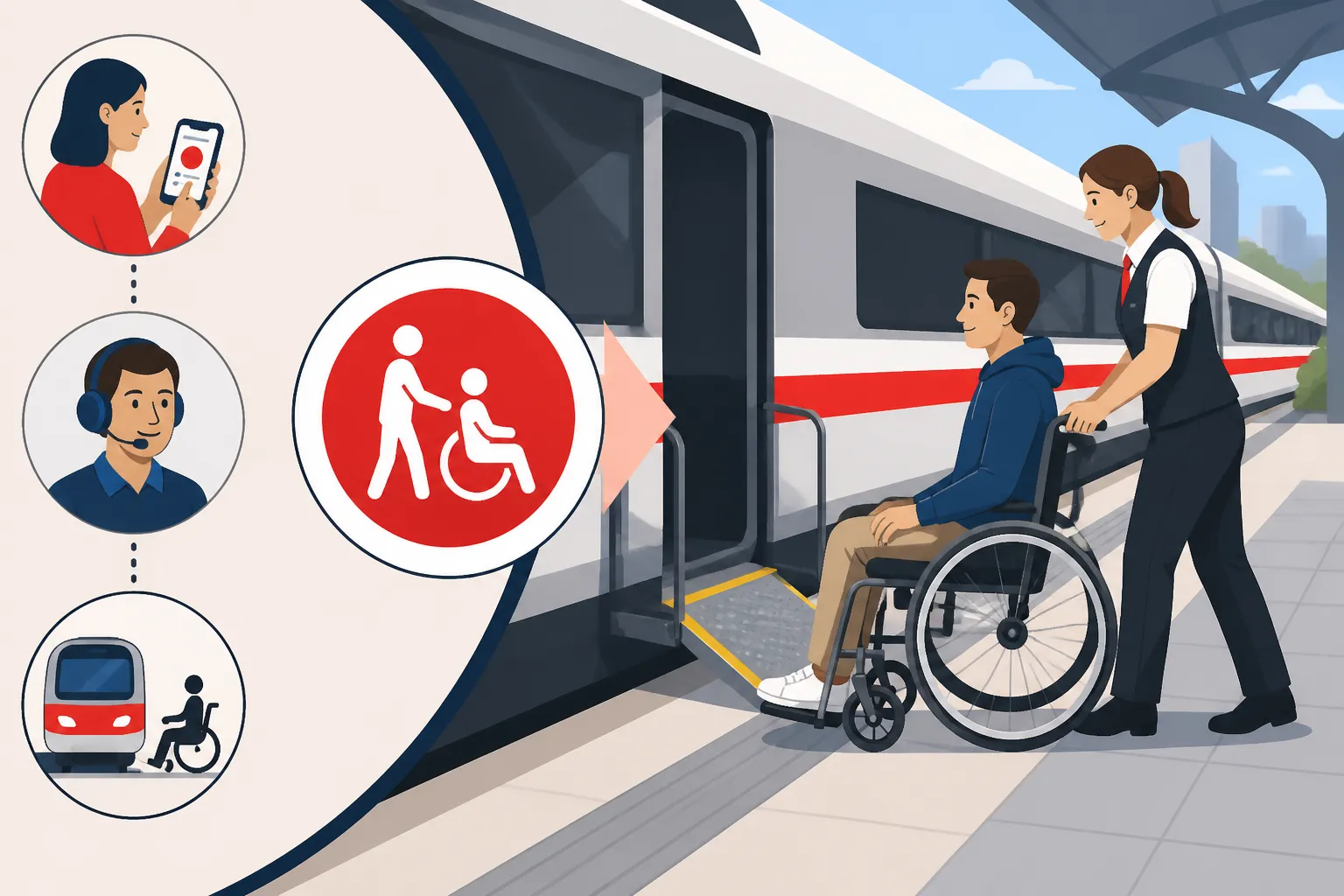
Booking Mobility Assistance With Deutsche Bahn: How the Service Works
If you use a wheelchair, walk with a cane, or are travelling with an elderly parent, a German station can feel daunting. There may be a platform change with four minutes to spare, a high step up into an ICE, and a lift that is out of service. This guide explains how Deutsche Bahn’s mobility assistance works, how to book it properly, and how to plan the ticket side so the help actually turns up.
Disclosure: This post may contain affiliate links. We may earn a commission at no extra cost to you if you make a purchase through these links. Read full disclosure.
How Deutsche Bahn Mobility Assistance Actually Works
When I first helped my mother-in-law across Germany by train, I assumed you could tell the conductor you needed help and someone would appear. That is not how it works, and learning it the hard way at Mannheim, with a folded walker in one hand and a suitcase in the other, is not something I would wish on anyone.
Deutsche Bahn runs a dedicated department called the Mobilitätsservice-Zentrale, usually shortened to MSZ. It coordinates assistance for travellers with reduced mobility across the stations DB operates. The service does not charge for the assistance itself. The catch is that it runs on advance notice. Staff are scheduled, ramps and platform lifts are allocated, and train crews are informed, all based on registrations that come in before the journey.
For a broader overview of travelling Germany with a disability, including attractions and city planning, start with Accessible Travel in Germany: Mobility and Planning Tips. This article zooms in on the rail assistance itself and on getting your tickets sorted in a way that makes the assistance booking painless.
What the Mobilitätsservice-Zentrale Can Do for You
The MSZ is not a single helper but a coordination centre. Once you register a journey, it arranges help at each station along your route. Depending on the station and the train, that help typically includes:
- Meeting you at an agreed point in the station, often near the DB Information desk or the main entrance.
- Guiding or accompanying you to the correct platform, including through lifts.
- Helping you board and alight, using a mobile ramp, an on-board lift, or a platform lift depending on the train type.
- Accompanying you during a change of trains, which is where most solo travellers get into trouble.
- Reserving a wheelchair space on long-distance trains where one is available.
What the service does not do matters just as much. Staff are not porters, so do not count on them to carry several heavy suitcases. Mention your luggage when you register and pack light. They also do not provide personal care during the journey. If you need help eating, using the toilet, or managing medication on board, you will need a travelling companion.
Who Can Use the Service
A common misconception among visitors is that you need a German disability card to qualify. You do not. The service is aimed at anyone with reduced mobility. That includes wheelchair users, people using walkers or crutches, travellers who are blind or have low vision, people who are deaf or hard of hearing and need guidance, and older travellers who struggle with steps, stairs, or long distances.
German residents with an official severe disability card, the Schwerbehindertenausweis, may have extra entitlements. One example is a companion travelling free when the card carries the relevant marking. Those rules are specific to the German card and its markings, so if you hold one, check the exact conditions with DB before you book. A visitor from abroad with no German paperwork can still register for assistance. You simply describe your needs clearly.
Which Stations and Trains Are Covered
This is where expectations need managing. Large hubs such as Frankfurt Hauptbahnhof, München Hauptbahnhof, Hamburg Hauptbahnhof, Köln Hauptbahnhof, and Berlin Hauptbahnhof have staff and equipment, and assistance there is routine. Medium-sized stations usually have some level of coverage. Small rural stations may have no staff at all, and some still have platforms reachable only by stairs.
Train type matters too. ICE and Intercity trains generally have designated wheelchair spaces and accessible toilets in specific carriages, but the step from platform to train can still be significant. Many newer regional trains have level or near-level boarding and need less help. Regional services are often run by operators other than DB. For these, the MSZ can sometimes coordinate, while in other cases you will need to contact the operator directly. Before you commit to a route that relies on a small station or a non-DB regional train, ask the MSZ what is possible there.
Planning Your Route and Ticket Before You Register Assistance
Here is the step most guides skip. Assistance is registered against a specific journey: train numbers, departure times, and the stations where you board, change, and get off. If you register before you know exactly which trains you are taking, you will end up calling back to change everything. That is why I always settle the ticket first, and it is where Omio has made my life with accessible travel noticeably easier.
Why the Route Choice Matters More Than the Price
Two routes between the same cities can look almost identical on price but be completely different for someone with reduced mobility. One might be a direct ICE. The other might involve two changes, one of them with a tight connection at a station where you have to switch levels. For a wheelchair user, that second route can turn a pleasant trip into a stressful race against the clock.
When I plan, I put the cities into Omio and look at the full set of options side by side: departure times, journey duration, number of changes, and the operator for each leg. I am not hunting for the cheapest fare at this stage. I am looking for the journey with the fewest changes and the most generous transfer times. Seeing trains, long-distance buses, and flights on one screen also helps when a rail route is awkward. Sometimes a direct coach is simpler than a train with two changes, although coach accessibility has its own rules, which I cover below.
If you are weighing train against coach on the big routes, FlixBus vs Deutsche Bahn: Total Cost and Time on Germany’s Main Routes breaks down time and cost differences in detail.
Picking Connections That Give Assistance Staff Time
A connection that works for an able-bodied traveller with a backpack may not work once a ramp has to be fetched and a wheelchair moved between platforms via a lift. I treat any connection under about a quarter of an hour as risky. I much prefer a longer gap, even if it means a later arrival. When you register, the MSZ will tell you whether a connection is realistic for assistance. Still, it is far less frustrating to choose a sensible connection upfront than to have the plan rejected and start again.
Think about mixed journeys as well, where a long-distance train connects to a regional one. Each leg may have different boarding arrangements, and the regional operator may handle assistance differently. Our guide to Combining Long-Distance and Regional Tickets in One Journey explains how those mixed itineraries are ticketed and what happens if one leg runs late.
Booking the Ticket in English With a Foreign Card
For visitors, the ticket purchase is often the first hurdle. German booking flows can be confusing, payment with a non-European card sometimes fails, and name fields trip people up. Omio lets you search and pay in English, use a range of international payment methods, and receive your ticket digitally, which is exactly what you want before an assistance call. You will have the train numbers, times, and stations in front of you in a language you understand.
If you are booking from overseas and have hit card declines elsewhere, Booking German Trains From Abroad: Foreign Cards, Names, and Failures covers the most common errors. For a wider look at which platforms handle English well, see Booking German Transport in English: Sites That Work and Sites That Don’t.
A note on fares. Flexible tickets cost more than saver fares but are far more forgiving if your plans shift. For travellers who need assistance, a cancelled or rebooked train means re-registering help, so the flexibility is often worth it. Omio shows the fare conditions before you pay, so you can see whether a ticket can be changed. The difference between the main fare types is explained in Sparpreis vs Flexpreis on Deutsche Bahn: Change Rules and Refunds.
Step-by-Step: Registering Mobility Assistance With Deutsche Bahn
With your ticket booked and your itinerary in hand, you are ready to contact the MSZ. Everything about the process rewards precision. The clearer your registration, the smoother the day.
Ways to Contact the Mobility Service Centre
DB offers several channels for registering assistance, and you can use whichever suits you:
- Online registration form on DB’s website. This is my preferred route because it creates a written record and prompts you for every detail they need.
- Telephone to the MSZ. Useful if your trip is complicated or you want to talk through whether a connection is feasible. English is usually possible, but have your details written down.
- Email to the MSZ, if you prefer writing and have time to wait for a reply.
- In person at a DB travel centre, the Reisezentrum, at larger stations, if you are already in Germany.
Deadlines for advance notice can change, and more notice always helps. Check the current minimum on DB’s own mobility service page, then register as early as you can. For busy periods such as Christmas market season or summer holidays, I register as soon as my ticket is confirmed.
The Information You Need Ready
Before you fill in the form or pick up the phone, gather the following:
- Your full name and a phone number that will work in Germany, ideally a mobile number that can receive calls on the day.
- The date of travel and, for each leg, the train number, departure time, and departure and arrival stations, all of which are on your Omio ticket.
- Every station where you need help, especially stations where you change trains.
- The type of mobility aid you use: manual wheelchair, electric wheelchair, mobility scooter, walker, or none.
- For wheelchairs and scooters, the dimensions and total weight including the user, because ramps and lifts have limits.
- Whether you can manage a few steps with support, or need fully step-free boarding.
- Whether you need a wheelchair space reserved on long-distance trains.
- Whether you are travelling with a companion, a guide dog, or luggage that needs mentioning.
- A preferred meeting point at each station, or a request for them to suggest one.
Being honest about weight and dimensions is not a formality. An electric wheelchair that exceeds the capacity of a mobile ramp cannot be loaded, however willing the staff are. If you are unsure, measure before you register.
What Happens After You Register
Once your registration is processed, the MSZ sends a confirmation describing what has been arranged at each station: where to wait, how early to arrive, and what boarding aid will be used. Read it carefully. Occasionally the confirmation notes that help cannot be provided at a particular station, or that a connection is too short, and suggests an alternative.
If an alternative involves a different train, you may need to change your ticket. A flexible fare, or checking the fare conditions on Omio before booking, pays off here. Keep the assistance confirmation alongside your ticket, either printed or saved offline on your phone, so you can show it to staff and conductors.
Here is a summary of what to sort out, where, and why:
| Task | Where You Handle It | What to Keep in Mind |
|---|---|---|
| Compare routes and connection times | Omio | Prioritise fewer changes and longer transfer gaps over the lowest fare |
| Buy the ticket in English with a foreign card | Omio | Check fare conditions before paying, since flexibility helps if assistance changes your plans |
| Register boarding, alighting, and change help | DB Mobilitätsservice-Zentrale | Register well ahead and give train numbers for every leg |
| Reserve a wheelchair space on long-distance trains | DB Mobilitätsservice-Zentrale | Mention it explicitly when you register |
| Confirm help on non-DB regional trains | MSZ first, then the regional operator if needed | Coverage differs between operators |
| Arrange accessible accommodation near the station | Hotel or booking platform | Check lift, step-free entrance, and bathroom layout |
| Assistance on long-distance coaches | The coach operator directly | Coach accessibility rules differ from rail |
On the Day of Travel and When Things Go Wrong
Even a perfect booking meets reality on the day: weather, strikes, a broken lift, a train that shows up on a different platform. Knowing what to expect keeps your stress levels down.
Arriving at the Station and Meeting Your Assistant
Arrive at the agreed meeting point early. Your confirmation will tell you how early, but I always add extra time at the big hubs because Frankfurt Hauptbahnhof and Köln Hauptbahnhof are sprawling and crowded. If you cannot find the meeting point, go to the DB Information desk and show your confirmation.
Let me describe a realistic scenario. Margaret, a retired teacher from Manchester, was visiting her son in Heidelberg. She uses a walker and cannot manage the steep steps into an ICE. Her son booked her ticket on Omio, choosing a route from Frankfurt Airport with one change at Mannheim and a long gap between trains, rather than a quicker option with a tight connection. He then registered assistance at three points: boarding at the airport long-distance station, the change at Mannheim, and alighting at Heidelberg. On the day, a staff member met her at the airport, wheeled her luggage on a trolley, and used the mobile lift. At Mannheim, a second assistant was waiting on the platform. The whole trip worked because each station was in the registration and the connection was realistic.
For detail on getting from the terminal onto the train network, see Frankfurt Airport Transfers: Long-Distance Rail Direct From the Terminal.
On board, find your reserved wheelchair space or seat and let the conductor know you have registered assistance for alighting. Conductors usually know already, but a quick word does no harm. If you are using an app to track your train, How to Use the DB Navigator App in Germany explains how to follow live platform and delay information.
Delays, Platform Changes, and Missed Connections
German trains run late more often than their reputation suggests, and delays are the biggest threat to assistance arrangements. If your first train is late and you miss your connection, the assistance booked for the next train no longer lines up.
Here is what I recommend:
- Keep your phone charged and switched on. The MSZ or station staff may try to reach you.
- If you are delayed, tell the conductor as early as possible that you have registered assistance at your change station. They can often radio ahead.
- If you miss a connection, go to the DB Information desk or the Reisezentrum at the station, or ask the assistant who helped you off the train, and request help being re-registered on the next suitable service.
- Keep both your ticket and your assistance confirmation accessible, because staff will want to see them.
- If a lift is out of service, staff can sometimes route you via another platform or a different station. Do not try to manage stairs with a wheelchair yourself.
Strikes deserve a special mention. During major strike days, services are cut and rebooking becomes chaotic. If a strike is announced, contact the MSZ early to rework your plans rather than waiting until the morning of travel. Your rights to compensation and rebooking are covered in DB Strikes and Delays: Your Rights, Compensation, and Rebooking. If you decide not to travel at all, Refunds and Changes on German Transport: What You Actually Get Back explains what you are likely to recover.
Spontaneous Travel and What to Do Without a Booking
Sometimes plans change and you need to travel today. At larger staffed stations, it is often possible to get help without advance registration if staff are available. But it is not guaranteed, and at smaller stations it may simply not happen. If you find yourself in this position, go straight to the DB Information desk, explain what you need, and be prepared to wait or take a later train.
A friend of mine who uses a manual wheelchair once decided on a whim to travel from Berlin to Dresden. At Berlin Hauptbahnhof, staff found someone to help her board within a reasonable time. At Dresden, though, nobody had been told, and she had to wait on the train while the conductor called for help. She got off fine in the end, but it was nerve-wracking. The lesson is simple: book even a short trip if you possibly can.
Making the Whole Trip Accessible Beyond the Train
The train journey is only part of the experience. Where you stay, how you move around a city, and how you handle luggage all decide whether a trip feels relaxed or exhausting.
Coaches, Flights, and When Rail Is Not the Best Fit
Rail is often the most comfortable option in Germany, but not always. Some routes need awkward changes, or involve stations with poor step-free access. When I am planning, I use Omio to compare a train route against a direct coach or a short domestic flight, because seeing all three together makes the trade-offs obvious.
Be aware that long-distance coaches handle accessibility very differently from rail. Wheelchair spaces on coaches are limited, if they exist at all, and operators usually require notification directly. Flights within Germany come with airline assistance, which you book through the airline. In other words, the mobility assistance you arrange with DB covers only the rail legs. Any coach or flight segment needs its own arrangement with that operator.
Luggage, Companions, and Travelling With Family
Luggage is the hidden enemy of accessible travel. Assistance staff will help with what you can reasonably carry, but a mountain of suitcases will slow everyone down. Consider sending heavy bags ahead with a luggage service, or simply packing less. The rules on what you can bring aboard are explained in Luggage and Bike Rules on German Trains and Buses.
If you are travelling with family, especially older parents, plan around the person with the greatest needs. Book the route they can manage most comfortably, even if it costs a little more or takes longer. Extra legroom and more space can also make a real difference. Whether a first-class upgrade is worth it for comfort is discussed in First Class vs Second Class on German Trains: What the Upgrade Buys, and the value of a reserved seat is covered in DB Seat Reservations: When They’re Worth the Extra Charge.
Finding Accessible Accommodation Near the Station
Your hotel can make or break the trip. A hotel two minutes from the station is useless if it has a step at the entrance and no lift. When you are travelling with reduced mobility, check the entrance, lift size, bathroom layout, and whether the shower is level or set in a tub.
For filters and questions to ask before booking, see Wheelchair-Accessible Hotels in Germany: The Filters That Matter. If you are hosting older relatives, Booking for Visiting Parents in Germany: Lifts, Stairs, and Access Checks covers the practical checks I do every time my in-laws visit. And once you arrive, How to Find Wheelchair-Accessible Attractions in Germany helps you plan sightseeing that does not involve endless cobblestones and stairs.
A Quick Planning Checklist
Here is the sequence I follow every time I organise an accessible rail trip in Germany:
- Decide your travel dates and the cities you need to reach.
- Search the route on Omio and compare options by number of changes, connection times, and journey duration.
- Choose the route with the fewest changes and most generous transfers, and check the fare conditions before you pay.
- Book the ticket on Omio and save the digital ticket showing train numbers and stations.
- Register assistance with the DB Mobilitätsservice-Zentrale, listing every station where you need help.
- Read the confirmation carefully and adjust your ticket if any connection is flagged as unrealistic.
- Book accessible accommodation near your arrival station.
- On travel day, arrive early at the meeting point with your phone charged, ticket ready, and assistance confirmation saved offline.
- If anything goes wrong, contact the conductor or the DB Information desk straight away.
Germany’s rail network is not perfect for travellers with reduced mobility, and I will not pretend otherwise. Steps, broken lifts, and late trains are real frustrations. But with sensible route planning and a properly registered assistance booking, it is entirely possible to cross the country comfortably. Settle the ticket first, register assistance second, and travel with your confirmation in hand.
When you are ready to plan your next accessible rail trip, open Omio, compare the routes side by side, pick the journey with the fewest changes, and book it in English. Then pick up the phone or open the online form and let Deutsche Bahn’s mobility team take care of the rest.
Disclaimer
This article is for general informational purposes only and does not constitute professional advice. Laws, prices and regulations vary by location and change over time. Consult a qualified professional for guidance on your specific situation.