Common Vaccines Needed for Germany (and Europe) Travel
Figuring out which vaccines you actually need for a move to Germany usually involves deciphering confusing government websites while worrying about local diseases you’ve never even heard of. I remember staring blankly at my doctor when he asked if I had my “FSME” shot before a simple weekend hiking trip. This guide breaks down exactly which vaccines you need for Germany and Europe, so you can travel safely.
Disclosure: This post may contain affiliate links. We may earn a commission at no extra cost to you if you make a purchase through these links. Read full disclosure.
Standard Routine Vaccinations for Living in Germany
When you relocate to Germany, you might assume that because it is a highly developed Western European nation, you do not need to worry about infectious diseases or specialized travel clinics. While it is true that you do not need a yellow fever or malaria prophylaxis to land at Frankfurt Airport, the German government takes its routine immunization schedule incredibly seriously. The governing body that dictates these schedules is the Standing Committee on Vaccination (STIKO), operating under the Robert Koch Institute (RKI).
The most immediate administrative hurdle you will face as an expat parent or a professional working in education or healthcare is the Masernschutzgesetz (Measles Protection Act). Enacted in 2020, this federal law makes measles vaccination strictly mandatory. If you plan to enroll your child in a German daycare (Kita) or a public school, you absolutely must provide physical proof that they are fully vaccinated against measles. The same rule applies to anyone born after 1970 who works in a community facility, hospital, or doctor’s office. Without this proof, your child will be denied entry to daycare, and you could face massive fines. Navigating the pediatric system to get this sorted is a unique challenge, which we detail in Taking Kids to the Doctor: How Pediatric Care Differs in Germany.
To prove your vaccination status, you need the Impfpass. This is a small, standardized yellow booklet recognized across the EU. If you bring your vaccination records from the US, UK, or India, your local German general practitioner (Hausarzt) can transcribe your history into this yellow book. If you have lost your childhood records, doctors here will often recommend running a blood titer test to check your immunity levels, or they will simply restart the vaccination series to be safe.
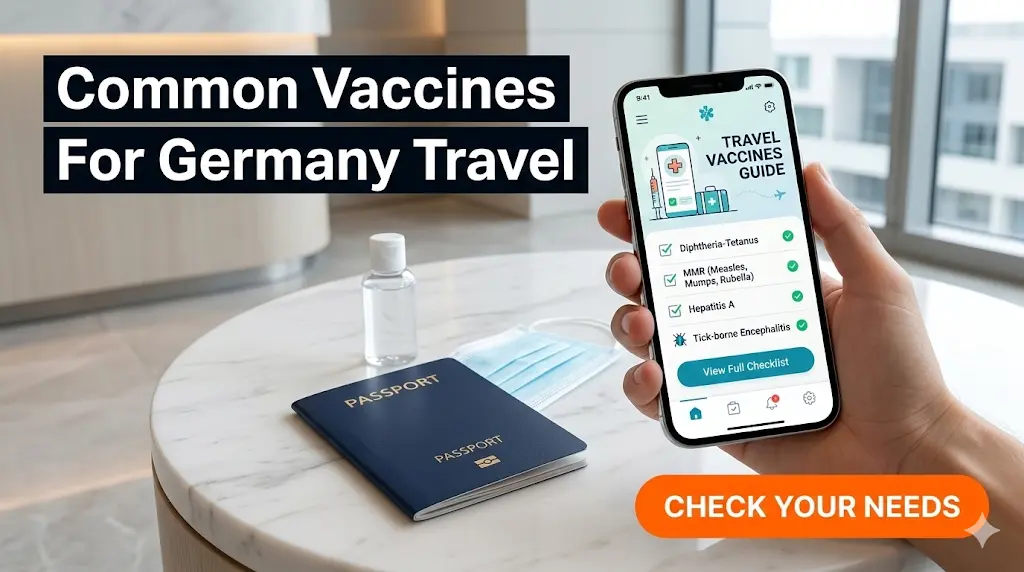
Beyond measles, STIKO strongly recommends that adults keep up with their standard booster shots. This includes the 3-in-1 or 4-in-1 boosters for Tetanus, Diphtheria, Pertussis (whooping cough), and Polio. Tetanus boosters are recommended every ten years. If you suffer a deep cut while gardening or step on a rusty nail while renovating your new German apartment, the very first question the emergency room doctor will ask is to see your Impfpass to check your tetanus status. Getting registered with a primary care doctor early on makes keeping track of these boosters effortless. If you haven’t found one yet, read Finding a Doctor in Germany: How to Choose a Hausarzt.
The Hidden Threat of Ticks and the FSME Vaccine
One of the biggest medical culture shocks for expats moving from North America or the UK to Central Europe is the severe threat posed by ticks (Zecken). If you plan to hike in the Black Forest, camp in Bavaria, or take a weekend trip to the Austrian or Swiss Alps, you are entering high-risk territory for Tick-Borne Encephalitis, known locally as FSME (Frühsommer-Meningoenzephalitis).
FSME is a viral infection that attacks the central nervous system, potentially leading to severe meningitis, brain inflammation, and long-term neurological damage. Because it is a virus, antibiotics are completely useless against it. The only effective protection is the FSME vaccine. The Robert Koch Institute continuously updates a map of FSME risk areas (Risikogebiete), which currently blankets almost the entire southern half of Germany and is slowly creeping northward due to climate change.
If you are moving to Munich or Stuttgart, your doctor will likely recommend this vaccine during your very first visit. The tricky part is the schedule: the basic immunization requires three separate doses spread over several months to achieve full immunity. You cannot simply get a shot the day before your hiking trip and expect to be protected. You must plan ahead. We cover the physical preventative measures for this in our guide on Mosquitoes and Ticks: Preventing Bites and Diseases in Germany.
To help you understand the two primary tick-borne threats in Europe, here is a breakdown:
| Disease | German Name | Pathogen | Is there a Vaccine? | Primary Treatment |
| Tick-Borne Encephalitis | FSME | Virus | Yes (Highly recommended) | Symptom management only |
| Lyme Disease | Borreliose | Bacteria | No | Antibiotics if caught early |
Navigating German Clinics and Insurance for Shots
Actually getting a vaccine in Germany involves navigating a highly specific, and sometimes frustrating, bureaucratic process. If you need a standard STIKO-recommended routine vaccine, such as a tetanus booster or the annual flu shot, your Hausarzt usually keeps these stocked in a small refrigerator at the clinic. You make an appointment, roll up your sleeve, and it is done.
However, if you need a specialized travel vaccine—for instance, if you are planning a vacation from Germany to Southeast Asia and need Typhoid or Rabies shots—the process changes. The doctor will write you a prescription (Rezept). You must then walk to a local pharmacy (Apotheke), purchase the vaccine vial out of pocket, ensure it stays perfectly cold (the pharmacist will often give you an ice pack), and immediately walk it back to the doctor’s office so they can inject it.
The financial aspect depends entirely on your health insurance. If you are enrolled in the statutory public health insurance system (Gesetzliche Krankenversicherung or GKV), all standard STIKO-recommended vaccines are fully covered. You simply hand over your electronic health card, and you pay nothing. This includes the FSME vaccine if you live in or travel to a designated risk area.
If you require elective travel vaccines for international holidays, public insurance usually will not cover them. This is where premium private health insurance (Private Krankenversicherung or PKV) shines. Premium expat-focused insurers like Ottonova frequently cover a wide array of global travel vaccines. The beauty of Ottonova is the digital interface; you pay for the travel vaccine at the pharmacy, snap a photo of the receipt, and upload it to the app for rapid reimbursement.
If you are currently confused by the paperwork or trying to figure out which insurance system fits your lifestyle, specialized expat brokers like Feather Insurance are an absolute lifesaver. Using Feather Insurance to set up your public or private coverage means you get dedicated English-language support to help you decode what vaccines are covered under your specific tariff.
Pre Trip Health Prep and Wellness Support
Preparing for a trip around Europe is not just about getting jabbed; it is about fortifying your immune system against the inevitable travel exhaustion, crowded trains, and drastic changes in diet. Once you have your vaccinations sorted, your next step is building a proactive travel health kit.
The immediate reality expats face in Germany is that local pharmacies (Apotheken) are incredibly conservative and expensive when it comes to over-the-counter wellness products. If you are accustomed to buying massive, affordable bottles of high-dose Vitamin C, specific international probiotic strains for travel diarrhea, or your favorite brand of melatonin to combat jet lag, you will likely be shocked by the local prices and limited selection.
To bypass this frustrating retail hurdle, I highly recommend using global platforms before you travel. By ordering through iHerb, you can effortlessly source your preferred international immune support supplements, high-quality travel probiotics, and holistic wellness items, having them delivered right to your German apartment. Stocking your travel kit via iHerb ensures you are fully prepared for your European getaway without draining your wallet at a local pharmacy. For a complete list of what you should keep on hand, read First Aid Kit for Your Home: Must-Have Items in Germany.
Finally, if you are inviting family from overseas to visit you in Germany before embarking on a European road trip together, do not forget that they need temporary medical coverage. The German government and Schengen border control are incredibly strict about incoming visitors possessing adequate health insurance. Without it, a sudden medical emergency could leave you, the host, financially liable. Digital brokers like Feather Insurance offer specific, Schengen-compliant incoming travel policies that you can secure in minutes.
Traveling around Europe from your new German home base is one of the greatest perks of expat life. By understanding the STIKO recommendations, protecting yourself against local threats like FSME, optimizing your coverage with partners like Ottonova and Feather Insurance, and sourcing your wellness essentials via iHerb, you can explore the continent with complete peace of mind.
References
Primary sources official
- Robert Koch Institute (RKI): The official STIKO (Standing Committee on Vaccination) recommendations and schedules in English.https://www.rki.de/EN/Topics/Infectious-diseases/Immunisation/STIKO/STIKO-recommendations/stiko-recommendations-node.html
- Federal Ministry of Health (BMG): Official information detailing the legal requirements and enforcement of the Measles Protection Act.https://www.bundesgesundheitsministerium.de/en/en.html
Other helpful sources
- Make it in Germany: The federal government’s official portal for international professionals, offering an overview of routine vaccinations and pediatric care.https://www.make-it-in-germany.com/en/
- Feather Insurance Expat Guide: A comprehensive breakdown of how vaccinations work in Germany, including pharmacy regulations and insurance coverage.https://feather-insurance.com/blog/vaccination
Disclaimer
The information provided in this article is for general informational and educational purposes only and does not constitute professional medical, legal, or financial advice. Vaccination requirements, such as the Measles Protection Act, and the specific coverage limits for travel vaccines provided by statutory health funds or private insurers are highly complex and subject to continuous legislative updates. Always consult directly with a qualified medical physician (Hausarzt) or a certified insurance broker regarding your unique vaccination needs and coverage options before traveling.