How to Visit Oktoberfest in Munich for the First Time
Most first-time visitors to Munich assume that the world’s largest folk festival is just a giant beer party where you can stroll into any tent at your leisure. In reality, the logistical hurdles—from securing a place to sleep to understanding the unwritten social rules of the beer benches—can be overwhelming. This guide solves the confusion by providing a battle-tested strategy for navigating the crowds, the tents, and the traditions like a seasoned local.
Disclosure: This post may contain affiliate links. We may earn a commission at no extra cost to you if you make a purchase through these links. Read full disclosure.
Planning Your First Oktoberfest Trip
The first thing you need to realize is that Oktoberfest actually begins in mid-September and ends on the first Sunday of October. It is not, as the name suggests, primarily in October. If you show up on October 15th, you will find nothing but a very empty field known as the Theresienwiese and perhaps a few lingering construction crews. For a first-timer, the timing of your visit dictates your entire experience. Weekends are absolute chaos, often resulting in tents being "closed for overcrowding" by 11:00 AM. If you have the flexibility, aim for a Tuesday or Wednesday. The atmosphere is still electric, but you actually stand a chance of finding a seat without a professional-grade sprinting ability.
When it comes to logistics, booking is the dragon you must slay early. Munich’s hotel prices triple during these two weeks. I’ve seen budget hostels charging the price of a luxury suite in Berlin just because they are within walking distance of the U-Bahn. Using tools like Booking.com early in the year is non-negotiable. If you find everything in the city center is sold out or offensively expensive, look toward Pasing or even Augsburg. The regional train system is incredibly efficient, and a 30-minute commute is a small price to pay for saving hundreds of euros.
Transport within the city is equally strategic. You do not want to drive anywhere near the Theresienwiese. Instead, use the U-Bahn lines U4 or U5 to the "Theresienwiese" station, or the U3/U6 to "Goetheplatz." If you are traveling from other parts of Europe or Germany to get here, comparing your options on Omio is the smartest way to see if a high-speed ICE train or a long-distance bus fits your budget better, as flight prices into Munich Airport (MUC) during the fest are notoriously steep.
Navigating the Wiesn: Tents and Traditions
Once you step onto the fairgrounds, the sheer scale of the "Wiesn" (as locals call it) will hit you. There are 14 large tents and dozens of smaller ones. Each has a distinct personality. The Schottenhamel is where the "tapping of the first keg" happens and tends to attract a younger, high-energy crowd. The Augustiner-Festhalle is often cited by locals as the most traditional because they still serve beer from wooden barrels. For a first-timer, the Hacker-Pschorr tent with its famous "Heaven of the Bavarians" ceiling is a visual masterpiece.
The biggest stressor for newcomers is the table reservation. Let me be clear: you do not strictly need a reservation to get beer. Every tent is required by law to keep a certain percentage of tables unreserved for walk-ins. However, "unreserved" does not mean "available." To snag one of these, you need to be at the tent doors by 9:00 AM on weekdays or 7:30 AM on weekends. If you see a table with a yellow sticker or a sign saying "Reserviert," you can still sit there until the reservation time begins—usually 4:00 PM or 5:00 PM. Just be prepared to move when the rightful owners arrive.
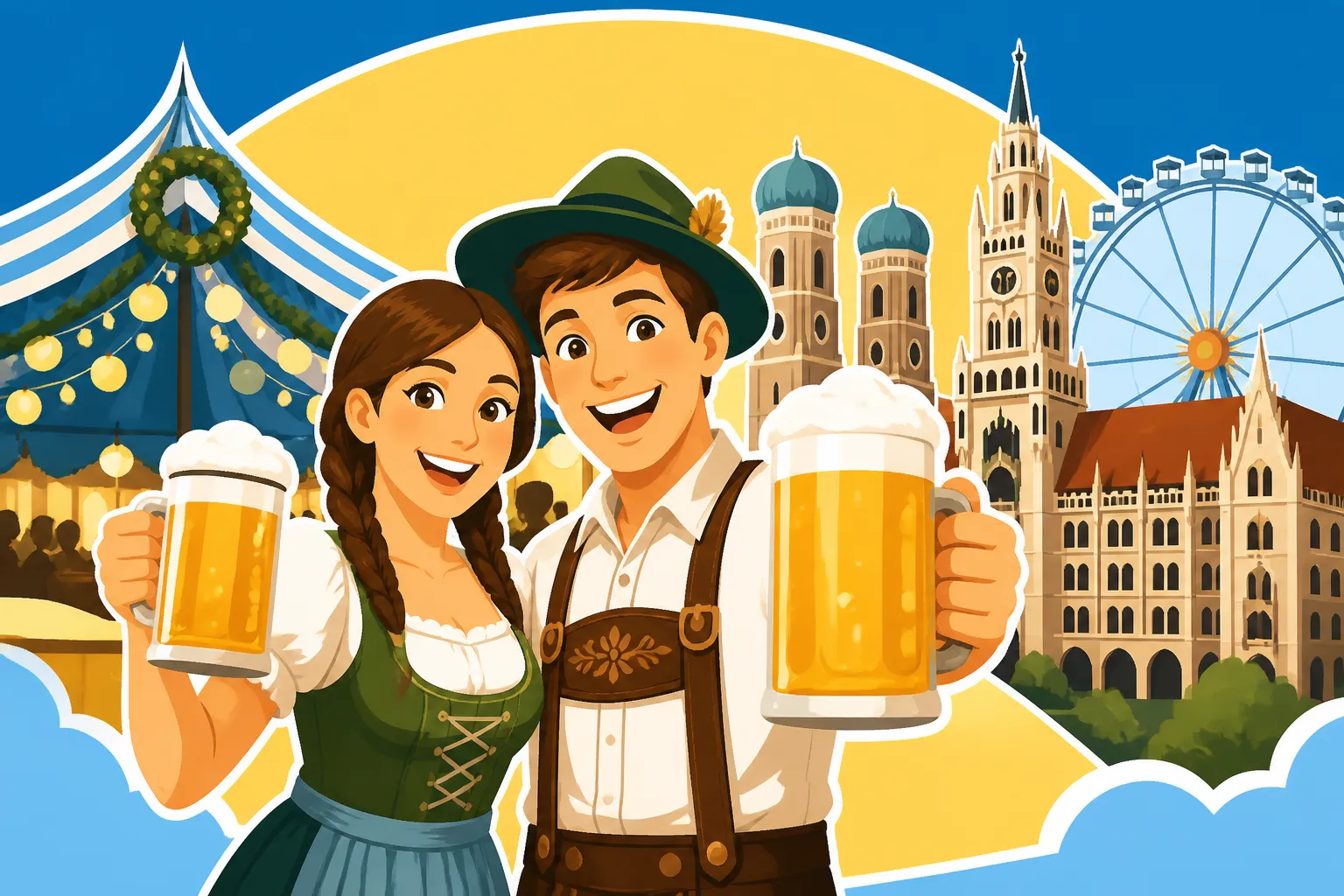
Cultural immersion is part of the fun, and this usually involves "Tracht" (traditional clothing). While it’s not mandatory, you will feel like the odd one out if you show up in jeans and a t-shirt. For men, this means Lederhosen (leather breeches), a checkered shirt, and Haferlschuhe. For women, it’s a Dirndl. A massive word of caution: avoid the cheap, shiny polyester "costumes" sold at the train station. They are the hallmark of a tourist and are generally looked down upon. If you want a more authentic experience, look for shops that sell actual cotton or linen sets. Also, pay attention to the bow on the Dirndl apron. Tied on the left means you are single; tied on the right means you are taken or married. Tying it in the middle or back has other meanings (traditionally virginity or widowhood/waitress status), and locals do pay attention to this. If you are interested in the deeper history of these garments or want a guided walk-through of the grounds, booking a tour via GetYourGuide can help you understand German Etiquette and Social Life for Visitors before you make a social faux pas.
Food, Beer, and Financial Realities
The beer served at Oktoberfest is not your average lager. It is a specific "Wiesn-Märzen" style, which is higher in alcohol content (usually around 6%) and slightly sweeter, making it dangerously easy to drink. It is served only in a "Maß"—a one-liter glass mug. Do not try to order a "small beer"; it simply doesn't exist in the large tents. Pace yourself. The "Bierleiche" (beer corpses) you see passed out on the grassy hill behind the tents are people who forgot that three liters of this stuff is equivalent to a bottle of wine and a half.
The prices are another reality check. Expect to pay between €14 and €15 per liter, plus a tip for the server. In Germany, tipping is common but different than in the US. You usually round up or add a Euro or two per round. If you don't tip your waitress, don't be surprised if she takes a very long time to come back for the next round. For more on how to manage your cash, check out Tipping and Service Charges in Germany: Who and How Much to Tip. Speaking of cash, while some tents are slowly moving toward card payments, Oktoberfest remains a cash-heavy environment. The ATMs on-site often have massive lines and high fees, so bring more than you think you need.
Eating is your best defense against the potency of the beer. The food is heavy, salty, and delicious. You must try the "Wiesn-Hendl" (half a roasted chicken), which is buttery and crisp in a way that’s hard to replicate. The "Brezen" (pretzels) are the size of a dinner plate and are meant to be shared. If you want a full sit-down meal, the "Schweinebraten" (roast pork with potato dumplings) is the gold standard of Bavarian comfort food. If you are worried about the cost, Budgeting for Life in Germany: Tips to Save Money as an Expat offers some broader context, but specifically for the fest, eating a large breakfast before you arrive can save your wallet.
| Feature | Large Beer Tents | Oide Wiesn (Old Wiesn) |
|---|---|---|
| Atmosphere | High energy, loud brass bands, standing on benches | Traditional, nostalgic, seated folk dancing |
| Beer Brands | The Big Six (Paulaner, Spaten, etc.) | Often served in traditional stone mugs (Keferloher) |
| Entry Fee | Free (but hard to get into when full) | €4 entry fee to the historic area |
| Crowd | International, younger, party-focused | Families, locals, history buffs |
| Music | Mix of traditional and "Schlager" party hits | Strictly traditional Bavarian folk music |
Survival Tips and Cultural Nuances
One of the best-kept secrets for first-timers is the "Oide Wiesn." This is a separate, fenced-off section of the grounds that charges a small entry fee (€4). It focuses on the history of the festival, with vintage rides that cost only €1 and tents that are much calmer than the main ones. It is the perfect place to go if the main tents become too claustrophobic. If you are traveling with family, this is where you will spend most of your time. For more tips on family logistics, see Family Travel in Germany: Kid-Friendly Cities and Activities.
Safety at the fest is generally high, but with six million people and a lot of alcohol, things can get messy. The "Wiesn-Wache" (police station) and the Red Cross station are located at the Service Center behind the Schottenhamel tent. If you lose your friends or your phone, that is the place to head. Also, be aware of the "Quiet Hours." According to Munich’s Quiet Hours and Sundays in Germany (Ruhezeit) traditions, the tents are required to play only "quiet" brass music until 6:00 PM to keep the atmosphere family-friendly. After 6:00 PM, the party hits take over and everyone stands up.
Finally, remember that the festival is a marathon, not a sprint. The tents close their taps at 10:30 PM, and everyone is cleared out by 11:30 PM. The party often continues in the city center at "After-Wiesn" clubs, but if you have a train to catch the next morning, it’s best to head home. If you find yourself needing a break from the beer entirely, there are plenty of Best Day Trips From Munich that can get you into the fresh mountain air to clear your head.
Before you go, make sure your health insurance is in order just in case you have a literal run-in with a heavy glass mug. Newcomers should review Health Insurance in Germany: Understanding Public vs Private Coverage to ensure they know how to access care if needed. Navigating the fest is about balance—embracing the chaos while keeping your wits about you. Prosit!
Detailed Logistics for the First-Timer
To make your trip seamless, you should also consider the "Mittagswiesn." On weekdays between 10:00 AM and 3:00 PM, many tents and food stalls offer discounted lunch menus. This is a fantastic way to experience the high-quality food for a fraction of the evening price. If you are looking to Save Money in Germany: Budget Hacks for Expats, this is your single best strategy for Oktoberfest.
Regarding the "Big Six" breweries, remember that they are the only ones allowed to serve beer at the festival: Augustiner, Hacker-Pschorr, Hofbräu, Löwenbräu, Paulaner, and Spaten. Each brewery has its own tent. If you have a favorite German beer, find the tent that serves it. If you aren't sure, German Beer Culture: Styles, Beer Gardens, and Breweries can help you distinguish between a Helles and a Weissbier before you order.
Lastly, pay attention to the security rules. Large backpacks are strictly forbidden on the grounds. Small bags (under 3 liters in volume) are allowed but will be searched at the entrance. There are luggage storage lockers at the Hauptbahnhof and near the festival entrances, but they fill up fast. Traveling light is the only way to move through the crowds without losing your mind—or your belongings.
Disclaimer
The information provided in this guide is for informational purposes only. While every effort has been made to ensure the accuracy of the details regarding Oktoberfest, event rules, pricing, and local laws in Germany can change without notice. Always check the official Oktoberfest Munich (muenchen.de) website for the most current regulations and safety updates before your visit. This guide does not constitute legal or professional travel advice.