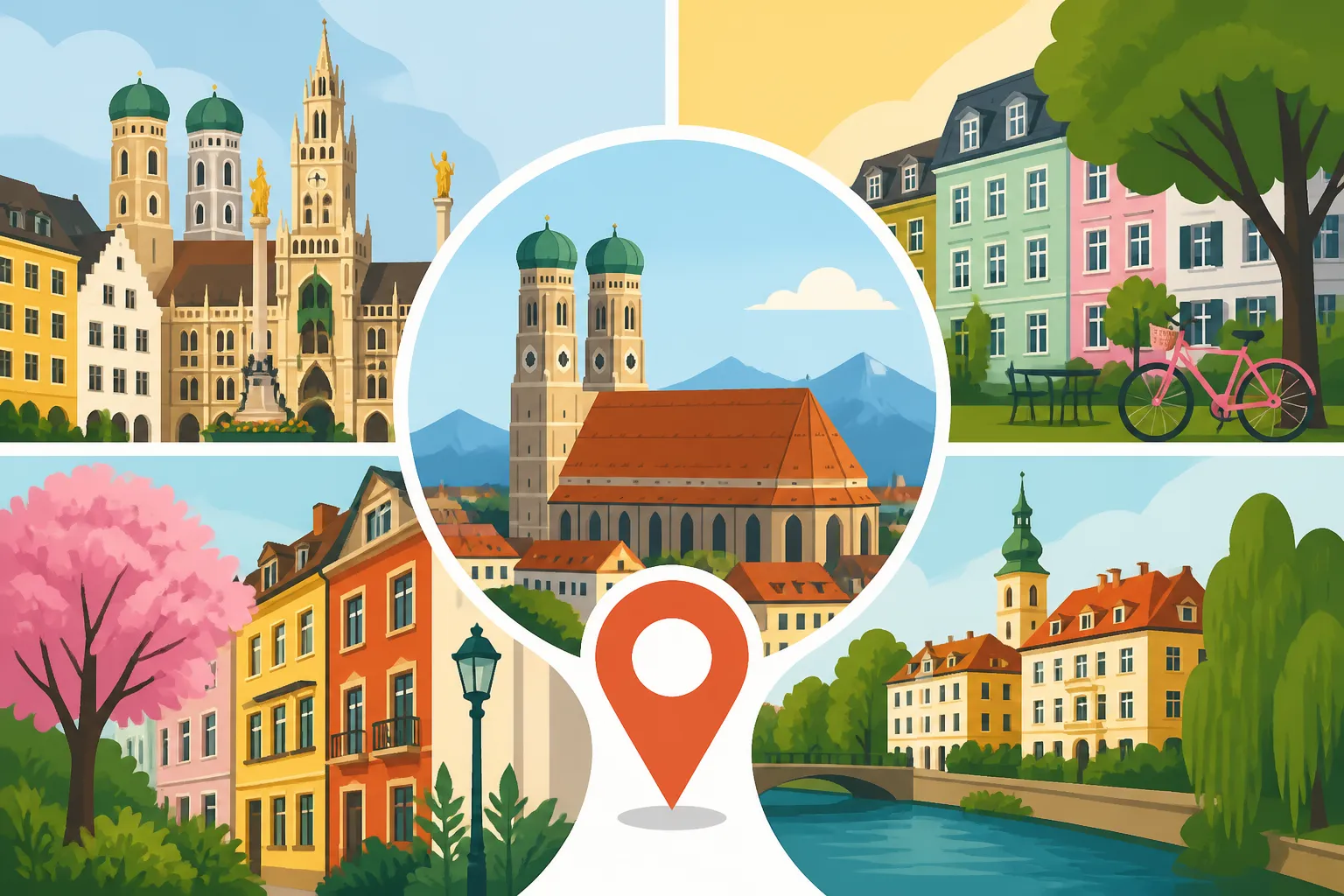
Where to Stay in Munich: Altstadt, Schwabing, Glockenbach, and Haidhausen
You land at Munich Airport, open a booking app, and get hundreds of hotels across a city you don’t know yet. Book the wrong district and you lose an hour a day to transit, sleep badly near a late-night bar strip, or pay old-town prices for a room you barely use. This guide compares four of Munich’s most popular neighborhoods, Altstadt, Schwabing, Glockenbach, and Haidhausen, and shows you how to book the right one.
Disclosure: This post may contain affiliate links. We may earn a commission at no extra cost to you if you make a purchase through these links. Read full disclosure.
Why Your Munich Neighborhood Matters
I made almost every Munich booking mistake there is before I learned the city properly. Once I booked a “central” apartment that turned out to be past the Mittlerer Ring, the ring road that marks where Munich stops feeling like a postcard. Another time I booked a gorgeous room above a bar in the Glockenbachviertel on a Friday night and slept through very little of it. Munich is compact compared with Berlin, but each of its districts has a very different personality. Getting that match right shapes your whole trip.
The Munich Geography Problem First-Timers Run Into
The center of Munich is roughly a ring of former city walls. The gates still stand: Karlstor at Stachus, Sendlinger Tor to the south, and Isartor to the east. Inside that ring is the Altstadt. North of it sit Maxvorstadt and Schwabing. South and southwest is the Ludwigsvorstadt-Isarvorstadt district, where the Glockenbachviertel lives. East, across the Isar river, is Haidhausen. On a map these areas look close together, and they are. But listings tend to stretch the word “central” until it means almost nothing.
Here is a typical scenario. You see a well-reviewed hotel described as “near the city center” with a pleasant price. You book it. Then you discover it sits next to an S-Bahn station two stops out, with nothing but office blocks and a petrol station within walking distance. Technically you can reach Marienplatz quickly. In practice you lose the evenings, because walking home from dinner becomes a train ride and a walk through an empty commercial street. I’ve had readers write to me about exactly this, and the frustration is real.
The fix is simple once you know it. Pick your district first, then look at hotels. In this guide I treat the four districts as four different trips, because that’s how they feel on the ground. For a wider overview of what to see once you’ve picked a base, my companion piece Munich for First-Time Visitors: What to See covers the sights in detail.
How Munich Hotel Pricing Behaves Around Events
Munich has a reputation as an expensive city to sleep in, and it’s partly deserved. What surprises visitors is how much rates swing depending on the calendar. During Oktoberfest, big trade fairs at the Messe in Riem, Christmas market season, and major football weekends, rooms that looked reasonable a month earlier can jump sharply or vanish altogether. Rooms in the Altstadt and the districts near the Theresienwiese go first.
A friend of mine visiting from Toronto learned this the hard way. She’d planned a relaxed autumn weekend and didn’t check the trade fair calendar. Every hotel in her budget near the Hauptbahnhof was gone. She ended up in Haidhausen. As it turned out, she loved it so much that she now books there on purpose. The lesson is that Munich prices aren’t fixed. They’re a moving target, and your district choice should leave room for that.
If your trip overlaps with the Wiesn, read Where to Stay in Munich for Oktoberfest: Which Districts and What They Cost before you commit. Outside the big event weeks, the four districts in this guide each offer something at a range of price points, from simple Pensionen to boutique hotels and serviced apartments.
Why I Book My Munich Stays on Booking.com
I’ve booked Munich rooms every way you can think of: calling family-run guesthouses, booking direct on hotel websites, and using various platforms. For a city where neighborhood matters this much, Booking.com is the tool I keep coming back to. The main reason is the map view. You can drag the map to frame exactly the streets you want, say the blocks around Gärtnerplatz or the squares of the Franzosenviertel in Haidhausen, and see only what’s available there.
The second reason is the depth of guest reviews. Munich hotels vary a lot in ways a star rating can’t capture: thin walls on Müllerstraße, a creaky lift in an old Altstadt building, a quiet courtyard room in Schwabing. Reading what previous guests say about noise, beds, and breakfast saves me from nasty surprises. The free cancellation filter is the third reason, and it matters more in Munich than almost anywhere else. I’ll explain why in the booking section below.
This isn’t about loyalty to a brand. It’s about having one place to compare a family Pension, a design hotel, and an apartment side by side, with filters that reflect what Munich actually demands.
Staying in the Altstadt: Munich’s Historic Heart
The Altstadt is the Munich of postcards. The Neues Rathaus glockenspiel at Marienplatz, the twin onion domes of the Frauenkirche, the food stalls of the Viktualienmarkt, and the Hofbräuhaus are all inside a walkable ring. If you have limited time and want to step outside and be somewhere, this is your district.
What It Feels Like to Wake Up Near Marienplatz
On a weekday morning in the Altstadt, you hear the delivery vans and bakery shutters before the tour groups arrive. Walk to the Viktualienmarkt early and you’ll see locals buying cheese, flowers, and Weißwurst before noon, as tradition demands. By mid-morning the pedestrian zone between Karlsplatz and Marienplatz fills with shoppers, and the Kaufingerstraße and Neuhauser Straße become a slow-moving river of people.
The Altstadt’s real advantage is walking distance. From a hotel near the Frauenkirche you can reach the Residenz, Odeonsplatz, the Hofgarten, and the start of the English Garden on foot. Evenings work the same way. You can finish a meal at one of the traditional Wirtshäuser, stroll past the illuminated Rathaus, and be back in your room without checking a timetable. For many first-timers, that ease is worth paying for.
The Altstadt also sits on top of the main S-Bahn trunk line, the Stammstrecke. Marienplatz, Karlsplatz, and Isartor all have stations. Most day trips and the airport connection start from here or from the Hauptbahnhof just west of the ring. For ideas on where to go from this base, see Best Day Trips From Munich.
Pros and Cons of an Altstadt Base
The big pro is obvious: proximity to almost everything a short-stay visitor wants. The second pro is choice. The Altstadt and its edges have everything from grand historic hotels near the Maximilianstraße luxury boutiques to compact modern hotels tucked behind the Sendlinger Straße. If you’re traveling with older relatives who don’t want long walks or transit changes, the Altstadt removes a lot of stress.
The cons are just as real. Rooms are typically smaller and more expensive than in the surrounding districts. Many buildings are historic, or reconstructed after the war, so lifts can be small and room layouts unusual. Read Reading German Hotel Listings: Room Types, Bed Sizes, and Terms Decoded before you assume a “double room” means what it does at home. The area around the Hofbräuhaus and Platzl can get loud late at night, especially on weekends and during Oktoberfest, when the beer-hall crowd spills into the lanes.
The other downside is that the Altstadt empties of locals after shops close. It doesn’t feel dead, but it feels like a stage set more than a neighborhood. If you want to see how Münchner actually live, you’ll be taking the U-Bahn out to Schwabing or Glockenbach for dinner anyway.
Who the Old Town Suits Best
The Altstadt is ideal for a short trip of one to three nights, especially your first visit. If you’re working out how long to stay, How Many Days Do You Need in Munich? helps you plan. It also suits travelers with limited mobility who want to minimize transit, and anyone on a tight schedule who wants to pack a lot of sightseeing into each day.
Consider a couple arriving on a Friday evening and leaving Sunday afternoon. With an Altstadt base, they can drop their bags, walk to the Augustiner beer hall on Neuhauser Straße for dinner, and spend Saturday on the Residenz, the Viktualienmarkt, and a stroll to the English Garden. On Sunday morning they can catch the glockenspiel before heading to the station. No transit planning required.
When I search the Altstadt on Booking.com, I usually filter by guest review score first, then read reviews that mention “quiet” or “street noise.” Courtyard-facing rooms are the hidden gems of this district, and guests tend to mention them by name.
Staying in Schwabing: Leafy Streets and the English Garden
Schwabing is where I’d send anyone who wants Munich to feel like home for a few days. North of the Altstadt, it’s a district of elegant old apartment buildings, wide boulevards, university life, and direct access to the Englischer Garten, one of the largest urban parks in Europe. It has a reputation as Munich’s old bohemian quarter. Today it’s more polished than wild, but it still has a relaxed charm that the Altstadt lacks.
The Character of Schwabing Day to Day
The spine of Schwabing is the Leopoldstraße, which runs north from the Siegestor victory arch toward Münchner Freiheit. In summer the cafés along it put tables out and the street feels almost Parisian. Side streets like Hohenzollernstraße are good for independent shops, and the area around Elisabethplatz has a small daily market that feels like the Viktualienmarkt’s quieter cousin.
The English Garden runs along Schwabing’s eastern edge. On a warm afternoon you can watch surfers riding the standing wave on the Eisbach near Haus der Kunst, join the crowds at the beer garden by the Chinesischer Turm, or walk further north to the calmer Seehaus on the Kleinhesseloher See. Locals jog, cycle, and lie on the lawns. Living next to all this, even briefly, changes the rhythm of your trip.
Schwabing also borders Maxvorstadt, home to the Ludwig-Maximilians-Universität and Munich’s museum quarter. The Alte Pinakothek, Pinakothek der Moderne, Museum Brandhorst and the Königsplatz are within a short walk or tram ride of the southern part of Schwabing. Art lovers often find this the most rewarding base of all.
Pros and Cons of a Schwabing Base
The pros: Schwabing is calm at night, green, and genuinely residential. You’ll share the bakery queue with locals rather than tour groups. The U3 and U6 lines run underneath the Leopoldstraße, and you can reach Odeonsplatz and Marienplatz quickly from stations like Giselastraße, Münchner Freiheit, and Universität. For families, the park access is a gift. Kids can run, and parents can sit in a beer garden without guilt.
The cons: hotel stock is thinner than in the Altstadt or around the Hauptbahnhof, so the best-reviewed places book out early. Schwabing is large, and the northern parts toward the Petuelring feel suburban. A listing that says “Schwabing” might be a pleasant walk from the park, or it might be a long way from anything interesting. The map view on Booking.com is essential here. I keep my search box framed between the Siegestor and Münchner Freiheit, and as close to the English Garden as my budget allows.
Nightlife is also limited. There are good bars and restaurants, but if you want late nights out, you’ll be heading south to Glockenbach.
Who Schwabing Suits Best
Schwabing suits travelers staying four nights or more who want to feel like temporary residents. It also suits families who value space and greenery, museum fans, and anyone who finds the Altstadt crowds draining. Remote workers on longer stays like it too, because many cafés are laptop-friendly and the atmosphere is studious thanks to the university.
Picture a family of four on a week-long summer trip. Mornings start with a walk to the Kleinhesseloher See. Afternoons are for the Deutsches Museum or a day trip to the lakes. Evenings end at a beer garden where the kids play while the parents relax. That’s a much gentler trip than one spent pushing through the Marienplatz crowds every day. Families should also read Why German Hotels Cap Rooms at Three: Booking for Families of Four Plus, because room occupancy rules catch many parents out in Schwabing’s older hotels.
Staying in Glockenbach: Munich’s Creative and Nightlife Quarter
The Glockenbachviertel is my personal favorite. It sits just south of the Altstadt, between Sendlinger Tor and the Isar, and blends into the Gärtnerplatzviertel. Together these streets form Munich’s most stylish, creative, and liveliest quarter. It’s also the historic heart of the city’s LGBTQ+ scene, with a welcoming, open atmosphere that runs through its bars and cafés.
The Vibe Around Gärtnerplatz and Müllerstraße
Start at Gärtnerplatz, a round square with a flower bed at its center and the Staatstheater am Gärtnerplatz on one side. On summer evenings people sit on the edge of the flower bed with drinks from nearby kiosks and bars, and the square becomes an open-air living room. From there, streets like Reichenbachstraße, Klenzestraße, Hans-Sachs-Straße, and Müllerstraße are lined with independent boutiques, natural wine bars, cocktail spots, and small restaurants.
During the day Glockenbach is relaxed and residential. Locals walk dogs and take long brunches. Then the Isar pulls everyone toward it. Walk a few minutes east and you reach the riverbanks near the Reichenbachbrücke, where Münchner sunbathe on the gravel beaches in summer, barbecue, and swim in the cold, fast-flowing water. Nothing makes you feel more like a local than an evening on the Isar.
The quarter has excellent transit links too. Sendlinger Tor is a major U-Bahn hub, and Fraunhoferstraße station sits right in the middle of the neighborhood. The Altstadt is close enough to walk. The Theresienwiese, home of Oktoberfest, is reachable on foot from the western edge of the district.
Pros and Cons of a Glockenbach Base
The pros: food, drink, and atmosphere. Glockenbach has the highest concentration of interesting restaurants and bars of any district in this guide, and the walk to the Altstadt takes you through lively streets rather than traffic arteries. Boutique hotels and design-led apartments dominate here, so if you care about the look and feel of where you sleep, you’ll find plenty.
The cons: noise. Some streets, especially around Müllerstraße and Gärtnerplatz, stay busy late on weekends. If you’re a light sleeper, a room facing the street on a Friday night can be frustrating. Germany’s quiet hours apply to residents, but they don’t stop people chatting outside bars. Summer heat is a related problem. Opening the window lets in the noise, and many older buildings don’t have cooling. My piece on Air Conditioning in German Hotels: Why It’s Rarer Than You Expect explains what to look for.
Hotels here also tend to be small, with fewer rooms per property, so availability can tighten quickly. During Oktoberfest, Glockenbach’s closeness to the Theresienwiese makes it one of the most in-demand districts in the city.
Who Glockenbach Suits Best
Glockenbach suits couples, solo travelers, and friend groups who care about food and nightlife, and who want a base that feels lived-in and current. It’s an obvious choice for LGBTQ+ travelers who want to be close to the community’s bars and events. It also works well for people who like to walk everywhere, because both the Altstadt and the Isar are on your doorstep.
Here’s a scenario. Two friends visiting for a long weekend want good meals, a few cocktails, and a slow Sunday by the river. From a Glockenbach apartment, they can do all of it on foot and only use the U-Bahn for a morning trip to Nymphenburg Palace. They’d be wise to look for “quiet room” or “courtyard” in guest reviews, and to filter by review score so they don’t land above a noisy bar.
When I search this district on Booking.com, I always read the most recent reviews rather than the highlighted ones, because nightlife patterns shift and the latest guests give the most honest picture of street noise.
Staying in Haidhausen: The Village Across the Isar
Haidhausen is the district I recommend most often to people who say they want “the real Munich.” It sits on the eastern bank of the Isar, up a gentle slope from the river, and feels like a self-contained small town within the city. Its cobbled corners, old Herbergen (tiny former laborers’ cottages), and leafy squares make it one of the most charming places to stay in Munich. It’s also often overlooked by first-time visitors.
Exploring the Franzosenviertel and Wiener Platz
The heart of Haidhausen is the Franzosenviertel, the French Quarter. It’s a grid of handsome late-19th-century buildings around squares named after places linked to the Franco-Prussian War, like Pariser Platz, Orleansplatz, and Weißenburger Platz. Weißenburger Platz has a fountain and a summer flower garden, and its surrounding streets are full of cafés, Italian restaurants, wine bars, and small bakeries.
Further north, Wiener Platz feels like a village green with its permanent market stalls and maypole. Nearby, the Hofbräukeller beer garden fills on warm evenings with locals rather than tourists. Walk toward the river and you’ll pass the Maximilianeum, home of the Bavarian state parliament, which looks across the Isar toward the Altstadt along the grand Maximilianstraße.
Haidhausen also has a modern edge. Next to the Ostbahnhof, the Werksviertel has turned a former industrial area into a mix of offices, venues, street food, and the big Umadum observation wheel. It’s a fun contrast to the old streets just a few blocks away.
Pros and Cons of a Haidhausen Base
The pros start with transit. The Ostbahnhof and Rosenheimer Platz are on the S-Bahn trunk line, and many S-Bahn services go straight through the Altstadt to the Hauptbahnhof. The S8 airport line also runs through the Ostbahnhof, which makes Haidhausen one of the easiest bases for arrivals and departures. The U4 and U5 lines stop at Max-Weber-Platz. You can also walk to the Altstadt across the Ludwigsbrücke in a pleasant stroll past the Deutsches Museum on its island in the Isar.
Value is another pro. In my experience, a room in Haidhausen often costs less than an equivalent one in the Altstadt, and you tend to get more space and quieter nights. The neighborhood is also safe, relaxed, and well suited to longer stays, with supermarkets, pharmacies, and laundromats all within reach.
The cons: there are fewer big-name sights right on your doorstep, so you’ll travel for the major museums and the English Garden. The hill up from the river can feel steep at the end of a long day, especially with luggage. Some hotels near the Ostbahnhof are business-focused and lack character, so it pays to search carefully.
Who Haidhausen Suits Best
Haidhausen suits repeat visitors, travelers on longer stays, and anyone who wants calm evenings with a local flavor. Business travelers heading to events at the Messe in the east of the city often find it a practical compromise between convenience and atmosphere. It’s also a strong choice for families who want space without paying Altstadt prices.
Think of a solo traveler on a ten-day trip combining Munich with excursions to the Alps and Salzburg. Haidhausen’s S-Bahn connections make early departures easy. The Franzosenviertel offers a different dinner spot every night, and the walk across the Isar into the Altstadt never gets old. Apartments with kitchens are common here, which suits longer stays.
On Booking.com, I filter Haidhausen searches for apartments and guesthouses when I’m staying a week or more. I zoom the map onto the Franzosenviertel and Wiener Platz rather than accepting anything tagged “near Ostbahnhof.”
Comparing the Four Districts Side by Side
Once you’ve seen each neighborhood up close, it helps to line them up and compare them directly. Your trip length, travel style, and tolerance for noise should drive the decision more than anything else.
Neighborhood Comparison Table
| Factor | Altstadt | Schwabing | Glockenbach | Haidhausen |
|---|---|---|---|---|
| Overall feel | Historic, busy, tourist-focused | Leafy, residential, elegant | Trendy, creative, lively | Village-like, local, relaxed |
| Walk to Marienplatz | Already there | Longer walk or short U-Bahn ride | Easy walk | Pleasant walk over the Isar |
| Main transit | S-Bahn trunk line, U-Bahn hubs | U3 and U6 | U-Bahn at Sendlinger Tor and Fraunhoferstraße | S-Bahn trunk line, U4 and U5 |
| Night noise | Moderate to high near beer halls | Low | High on some streets | Low to moderate |
| Green space | Hofgarten and nearby English Garden | English Garden on the doorstep | Isar riverbanks | Isar slopes and local squares |
| Relative price level | Highest | Mid to high | Mid to high | Often better value |
| Best for | First-timers and short stays | Families and museum lovers | Foodies, nightlife, LGBTQ+ travelers | Longer stays and repeat visitors |
| Airport access | Easy via S-Bahn | Change needed | Change needed | Direct S8 from Ostbahnhof |
The table is a starting point, not a verdict. A quiet courtyard room in Glockenbach can beat a street-facing room in Schwabing, and a characterful family Pension in the Altstadt can be a better deal than a bland Haidhausen business hotel. Use the districts to narrow your search, then let individual property reviews decide.
Matching the District to Your Trip Type
The weekend first-timer. With two nights and a long list of sights, pick the Altstadt. The time you save on transit is worth the higher price. Choose a courtyard room if possible, and avoid the lanes immediately around the Hofbräuhaus if you want sleep.
The family on a summer week. Choose Schwabing or Haidhausen. Schwabing gives you the English Garden and the museum quarter. Haidhausen gives you value, apartments with kitchens, and easy S-Bahn access for day trips to the lakes and mountains. Check occupancy rules carefully when you search.
The couple who lives for good food. Glockenbach is the answer. Book a boutique hotel or apartment on a side street rather than directly on Müllerstraße or facing Gärtnerplatz, and spend your evenings working through the neighborhood’s restaurants.
The business traveler during a trade fair. Haidhausen and Glockenbach both offer reasonable access toward the Messe in the east. Book early, because trade fair weeks fill the city fast, and favor flexible rates in case your plans shift.
The repeat visitor or slow traveler. Haidhausen rewards repeat stays more than any other district here. If you’ve done the Altstadt sights before, you’ll enjoy waking up somewhere that feels like an ordinary Munich morning.
Common Mistakes When Choosing a District
The most common mistake is trusting the word “central.” In Munich listings, it can mean anything from the Marienplatz itself to a station in an office park. Always check the exact address on a map before booking.
The second mistake is ignoring the calendar. A district that’s quiet in March can be packed and noisy during Oktoberfest, when the streets near the Theresienwiese fill with revelers in Lederhosen and Dirndl. If you’re in town for the beer halls, How to Experience a Beer Hall in Munich will help you plan your evenings around your base.
The third mistake is booking a non-refundable rate too early, then discovering a better-located option later. I’ll cover how to avoid this below.
How to Book Your Munich Stay on Booking.com Step by Step
This is the process I use every time I book Munich accommodation, whether for myself, visiting friends, or family coming over from abroad. It takes a little longer than clicking the first result, but it consistently produces better stays.
Setting Up Your Search the Smart Way
- Enter your dates and party size first, including children’s ages. Occupancy rules in German hotels are strict, and accurate numbers keep you from seeing rooms you can’t actually book.
- Switch to the map view straight away rather than scrolling the list.
- Drag and zoom the map to frame your chosen district. For the Altstadt, keep inside the ring between Karlstor, Sendlinger Tor, and Isartor. For Schwabing, frame the area between the Siegestor and Münchner Freiheit. For Glockenbach, center on Gärtnerplatz and Fraunhoferstraße. For Haidhausen, center on Weißenburger Platz and Wiener Platz.
- Apply the free cancellation filter, at least for your first search, so you can lock in a room without committing.
- Filter by guest review score to drop the weakest options.
- Choose property type based on trip length. Hotels and Pensionen work for short stays, while apartments with kitchens often suit longer ones.
- Save promising options to a list so you can compare them side by side before choosing.
This approach cuts a sprawling list of options down to a handful of places that actually fit your trip. It also stops you from being swayed by a low price on a property that’s in the wrong part of town.
Reading Munich Listings Like a Local
Once you have a shortlist, slow down and read. I look for a few specific things in every Munich listing on Booking.com. First, does the room face the street or the courtyard? Guests often mention this, and in Glockenbach or near the Platzl it makes a huge difference. Second, is there a lift? Many older buildings have narrow stairwells, which matters if you’re carrying a big suitcase. Third, what’s the breakfast like? German hotel breakfasts can be wonderful, with fresh rolls, cheeses, and cold cuts. Whether it’s worth paying extra is covered in Breakfast Included in Germany: When the Fruhstucksbuffet Is Worth It.
Also check bed configurations. A German “double bed” is often two mattresses pushed together in a single frame, sometimes with separate duvets. Most couples find it perfectly comfortable, but it’s worth knowing. Look for mentions of heating and cooling, too. In winter Munich rooms are cozy, but summer heat waves can make some top-floor rooms stuffy.
Finally, read the house rules. Some properties have reception desks that close in the evening and require self check-in via a key box or code. That’s convenient if you’re arriving late from the airport, but you’ll want to know it in advance. If you’re torn between a hotel and a private apartment, Booking.com vs Airbnb in Germany: Registration Rules, Fees, and Cancellation goes into the trade-offs in detail.
Cancellation, Payment, and Check-In Details
Flexible rates are, in my experience, the single most useful tool for Munich bookings. Because the city’s prices move around events, I often book a flexible room as soon as my dates are set. Then I keep checking. If a better-located option opens up closer to the time, I can switch without losing money. For a deeper look at when it pays to lock in a cheaper, stricter rate, see Refundable vs Non-Refundable Rates in Germany: When the Discount Is Worth It.
Pay close attention to the payment terms on each listing. Some properties take payment at the time of booking, others at the property, and some take a deposit or pre-authorization on your card. Always confirm the final total on the checkout screen, including any local taxes. Some German cities levy an accommodation tax, and the rules differ by city. Germany’s City Tax by Region: Kurtaxe, Bettensteuer, and What You Pay explains how these charges work.
At check-in, German hotels usually ask for identification and may ask you to fill out a registration form. This is normal and legally required, not a sign of mistrust. Why German Hotels Ask for Your Passport: Meldeschein Registration Explained covers what’s involved. If you book regularly, it’s worth understanding how the Booking.com Genius loyalty program works in practice. I’ve written a separate breakdown in Booking.com Genius Levels in Germany: What the Discounts Are Actually Worth.
Practical Tips for Your First Days in Munich
Choosing and booking your district is the big decision. These final tips will help you settle in quickly once you arrive.
Getting From the Airport to Your District
Munich Airport sits well north of the city, and the S-Bahn is the most common way into town. The S1 and S8 lines both serve the airport. For Haidhausen, the S8 is the obvious choice because it runs through the Ostbahnhof and continues along the trunk line through Rosenheimer Platz into the Altstadt. For the Altstadt itself, you can ride either line to stations like Marienplatz or Karlsplatz, depending on routing.
For Schwabing and Glockenbach, you’ll usually ride the S-Bahn into the center and change to the U-Bahn. That means the U3 or U6 north to Schwabing, or the U-Bahn from Sendlinger Tor into Glockenbach. It’s a simple change, but with heavy luggage you may prefer a taxi or a bus. The Lufthansa Express Bus runs between the airport and the Hauptbahnhof, and some travelers find it easier than the train when they’re tired. For a full comparison of options, see Munich Airport Transfers: S-Bahn, Lufthansa Express Bus, and Taxi Compared.
Always buy and validate your ticket before boarding. Munich’s transit system relies on random checks, and inspectors aren’t sympathetic to jet-lagged visitors who forgot to stamp a paper ticket. The MVV app makes buying a ticket in English straightforward.
Living Like a Local in Your Chosen Neighborhood
Wherever you stay, remember that Germany is a Sunday-quiet country. Most supermarkets and shops close on Sundays and public holidays. Stock up on Saturday, or use the shops inside major stations, which tend to keep longer hours. Bakeries sometimes open on Sunday mornings, so a fresh pretzel is rarely out of reach.
Make the most of your district’s local rituals. In the Altstadt, get to the Viktualienmarkt before the crowds. In Schwabing, take an evening walk through the English Garden toward the Seehaus. In Glockenbach, join the locals by the Isar on a summer evening. In Haidhausen, browse the stalls at Wiener Platz and finish with a drink at a Franzosenviertel wine bar. These small habits turn a hotel stay into a real Munich experience.
Carry some cash. Card acceptance has improved enormously, but some beer gardens, market stalls, and traditional places still prefer cash. Learn a few German phrases, too. Most people in central Munich speak English, but a “Grüß Gott” when you walk into a shop earns warm smiles.
Making Your Final Decision
If you’re still undecided, go back to the comparison table and be honest about what matters most to you: sights, sleep, food, or value. Then open Booking.com, frame your chosen district on the map, filter for free cancellation, and save a shortlist. You’ll quickly see which neighborhood offers the best combination of location and quality for your dates.
Munich is a city that rewards a well-chosen base. Get the district right, and every morning starts in the kind of Munich you came for, whether that’s the glockenspiel at Marienplatz, a jog through the English Garden, brunch on Gärtnerplatz, or a fresh pretzel on Wiener Platz. Start your search on Booking.com today, while the best-reviewed rooms in your favorite district are still available.
Disclaimer
This article is for general informational purposes only and does not constitute professional advice. Laws, prices and regulations vary by location and change over time. Consult a qualified professional for guidance on your specific situation.