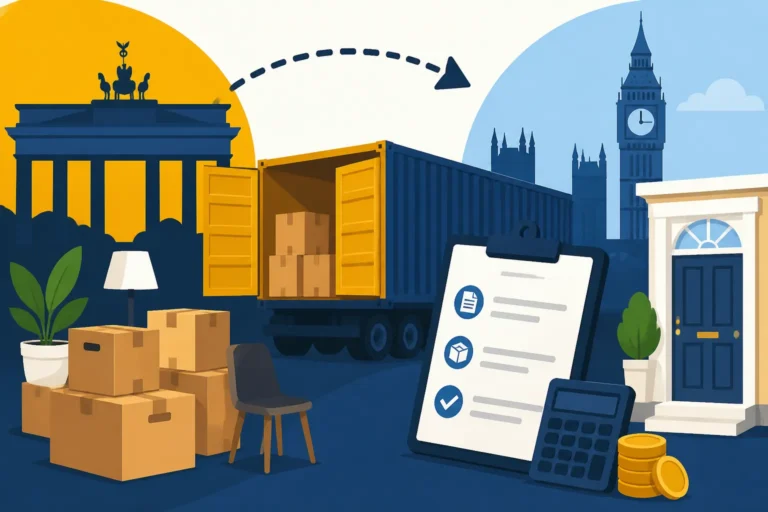
Moving to Germany from Australia and New Zealand: The Longest Route Priced Out
Your quote from a Sydney or Auckland removalist has arrived, and the total looks like a deposit on a small car. You stare at it and wonder whether shipping a sofa halfway around the planet is madness. This guide explains what actually drives the price on the Australia and New Zealand to Germany route, where the money goes, and how to compare movers properly before you sign anything.
Disclosure: This post may contain affiliate links. We may earn a commission at no extra cost to you if you make a purchase through these links. Read full disclosure.
Why the Australia and New Zealand Route Costs More Than Any Other
I shipped a three-bedroom life from Melbourne to Hamburg. What surprised me was not the total. It was how little of that total was the ocean voyage itself. People assume distance is the whole story, but distance is only one layer in a cost cake with half a dozen layers. Once you see those layers, you can negotiate, trim and compare. That is the only way to avoid overpaying on what really is the longest standard household removal route into Germany.
The Geography Problem Nobody Explains Properly
There is no direct container service that leaves Brisbane and parks your boxes on the quay at Bremerhaven. Your shipment almost always travels on a feeder vessel to a transshipment hub first. Singapore, Port Klang and Colombo are the usual suspects. There it waits to be loaded onto a larger mainline ship heading west, either through the Suez Canal or around the Cape of Good Hope when shipping lines reroute.
Every handover is a point where your timeline can slip and your container can sit. If a hub is congested or a mainline sailing is cancelled, your container may wait for the next one. That wait is not usually billed to you directly. But it is one reason movers on this route build generous buffers into their quoted transit windows.
New Zealanders often have an extra leg on top. Shipments from Lyttelton, Tauranga or Wellington frequently route via Auckland, or across the Tasman via an Australian port, before they even reach Asia. A Christchurch family I helped plan a move for was startled to learn their container would effectively visit two countries before leaving the Southern Hemisphere. Nothing was wrong. That is just how the network is built.
Where the Money Actually Goes
Think of your quote as three separate bills that happen to be stapled together:
- Origin services: packing, export wrapping, crating fragile items, loading, the truck to the port, origin terminal handling and export documentation.
- Freight: the ocean leg itself, plus surcharges that move with fuel prices, currency swings and seasonal demand.
- Destination services: port handling in Germany or the Netherlands, customs clearance, unloading, trucking to your new address, carrying everything up the stairs, unpacking and debris removal.
On long-haul routes the origin and destination labour can easily rival the freight line. Australian and New Zealand labour costs are high. German destination services in a city like Munich or Frankfurt are not cheap either. So the expensive parts of your move happen on dry land at both ends.
The Currency Layer
Your Australian or New Zealand mover quotes in local dollars. Destination services in Germany are paid in euros, usually through a partner agent. Some quotes lock the exchange rate. Others pass currency movements on to you. Always ask which kind you are looking at. Two quotes that look similar today can drift apart by the time your container lands.
Your Shipping Options Compared Side by Side
Before you request a single quote, decide roughly what kind of shipment you are. Movers will price you very differently depending on volume and on how much you value speed and control.
Full Container, Shared Container or Air Freight
| Option | Best suited to | Cost shape | Speed and control | Main risk |
|---|---|---|---|---|
| Full 20ft container | One to two bedroom homes with some furniture | Fixed price for the whole box, no matter how full | You control the departure date | Paying for empty space if you underfill |
| Full 40ft container | Three bedrooms or more, families, bulky furniture | Higher fixed price, much lower cost per cubic metre | Same as 20ft, more room for awkward items | Some German streets cannot take the truck |
| Groupage or shared container | Small loads, students, couples shipping boxes and a few pieces | Pay only for your cubic metres, plus consolidation handling | Departure waits until the container fills | Extra handling and less predictable timing |
| Air freight | Essentials you need in the first weeks | Priced by weight or volume, very steep per kilogram | Fastest by far | Cost climbs quickly beyond a few boxes |
| Sell and rebuy in Germany | Cheap flat-pack furniture, white goods, mattresses | Lost resale value plus German replacement costs | Instant, no waiting | Rebuying quality items can cost more than shipping |
The choice between box sizes is rarely obvious. I go through the volume maths in more detail in 20ft vs 40ft Container to Germany: Which Load Size Fits Your Home. If you sit in that awkward middle zone of a few dozen boxes and a dining table, Full Load vs Groupage to Germany: Cost Break-Even by Cubic Metre walks through where sharing stops making sense.
A Realistic Scenario for a Perth Family
Take a family of four in Fremantle with a three-bedroom house. They have a solid timber dining table, children’s bikes, a piano they adore and a garage full of camping gear. Their first instinct is a 40ft container. When they walk through the house honestly, they notice that the laundry appliances run on Australian plugs and the outdoor furniture is weathered beyond saving. The kids will outgrow half their toys before the container arrives.
After a ruthless cull, they fit into a well-packed 20ft container. The piano goes in the middle, the bikes and camping gear go around it, and a few suitcases of school essentials go as excess baggage on the flight. The saving is not only on freight. A smaller container is also easier to deliver into a German residential street, and that shrinks the destination bill too.
A Realistic Scenario for an Auckland Couple
A couple in Ponsonby is moving into a one-bedroom flat in Berlin. They own a few heirloom pieces, a lot of books, and a record collection they refuse to part with. A full container would mostly be air. Groupage suits them better: they pay for the cubic metres they actually use. They accept that departure waits for the shared box to fill, so they ship a couple of boxes of winter clothing separately to bridge the gap.
For that “first weeks” bundle, it is worth reading Excess Baggage vs Air Freight vs Courier: Sending 50-200kg to Germany before booking anything. The cheapest choice changes sharply depending on weight.
Customs, Paperwork and the Rules That Save You Money
This is the section where Australians and New Zealanders get caught out most. We are used to being on the strict end of biosecurity when goods come in. We tend to assume that leaving home is the hard part. In reality, the Germany-side customs process decides whether you pay duty and import VAT on your entire household, or nothing at all.
Household Goods Relief for New Residents
Germany offers duty and import VAT relief on used household goods when you move your normal residence there from outside the EU. That covers both Australia and New Zealand. The relief has conditions. Your goods must have been in your possession and used before the move, and you must actually be establishing residence in Germany. The details are laid out in Ubersiedlungsgut: Germany’s Duty Exemption for Household Goods Explained. The ownership-period requirement, and how to prove it with receipts and photos, is covered in The Six-Month Ownership Rule: Proving Your Goods Qualify for Exemption.
Here is what this means in practice. That new television you planned to buy at JB Hi-Fi the week before you leave? Buy it in Germany instead. Brand-new items can fall outside the relief. They invite awkward questions at the Zollamt.
The Order of Operations That Prevents Storage Fees
Customs clearance normally requires proof that you live in Germany. That usually means your Anmeldung confirmation. If your container lands before you have registered your address, it can sit at the port racking up storage and demurrage charges while you hunt for a Bürgeramt appointment. On a route this long, those charges come right after you have already paid the most expensive freight in the world.
The fix is sequencing. I explain the timing in Sequencing Anmeldung and Customs Clearance Before Your Container Lands. The short version: secure an address and a registration appointment before your ship reaches European waters, not after.
A Practical Paperwork Sequence
- Build a detailed, numbered inventory as you pack, room by room, with approximate values.
- Keep purchase receipts or dated photos for higher-value items to show prior ownership and use.
- Copy your passport, visa or residence documents, and your German employment contract or proof of reason for moving.
- Register your address in Germany as soon as you have a lease, and keep the registration certificate ready.
- Send the customs declaration documents to your mover’s German partner agent well before arrival.
- Respond quickly if customs requests clarification, because every idle day at the port costs money.
Items to Leave Behind
Some things are simply not worth the hassle. Weapons, certain knives, large quantities of medication, alcohol beyond personal use, and food products can trigger delays or seizure. Ask your mover for their restricted-items list before you pack. Keep anything questionable out of the container entirely.
Remember the reverse journey too. If you ever head home, Australian biosecurity will inspect your returning goods far more aggressively than German customs inspected them on arrival. Pack for an eventual return by keeping outdoor gear and furniture clean from day one. Moving From Germany to Australia: Biosecurity Checks and What Gets Rejected explains what gets flagged.
Comparing Quotes Without Getting Burned
This is where most people lose money. It rarely happens because a mover is dishonest. It happens because international removal quotes are not written in a standard format. One quote includes destination unpacking, another leaves out port handling in Hamburg, a third assumes your new flat has a lift. You end up comparing apples, oranges and a pineapple.
Why Sirelo Fits This Route So Well
On a route as long and as layered as Australia or New Zealand to Germany, you need several quotes from movers who actually handle this corridor. Plenty of local removalists do brilliant work within Queensland or across the Tasman, then subcontract the international part to someone else. That is why I point friends straight to Sirelo.
Sirelo is a moving comparison platform. You describe your move once, with origin, destination, rough volume and the services you want, and it connects you with international removal companies that work on that kind of route. It also publishes mover reviews from previous customers. On an intercontinental move, that is worth a great deal: you cannot pop round to inspect a mover’s depot in Bremen from your kitchen in Adelaide.
The real value of Sirelo is not that it finds one magic cheap price. It puts several comparable offers in front of you at the same time. That lets you spot an outlier immediately, whether it is a quote that is suspiciously low or one that quietly leaves out destination services. For the current details of how the service works, check Sirelo’s own pages rather than relying on anyone’s summary, mine included.
Line Items to Check on Every Quote
When the quotes arrive, line them up against each other. The common hiding spots are covered in Comparing International Removal Quotes for Germany: Line Items That Hide Costs. Check each one for the following:
- Whether origin packing and export wrapping are included, or whether you pack yourself.
- Whether the quote is door to door or stops at the German or Dutch port.
- Whether destination terminal handling and customs clearance fees are included.
- Whether fuel and currency surcharges are fixed or variable.
- Whether delivery assumes ground-floor access or includes carrying items up several flights of stairs.
- Whether the parking permit for the moving truck in Germany is included or extra.
- What insurance is included, on what valuation basis, and with what excess.
A mover who is happy to answer all seven clearly is usually a mover you can trust. Using Sirelo to collect the quotes first means you are asking these questions of several firms at once, instead of one at a time over a frustrating few weeks.
The Destination Surprises That Hit Hardest
Germans live in apartments. Many are in older buildings with steep, narrow stairwells and no lift. In cities like Berlin, Hamburg and Munich, the moving truck usually needs a temporary no-parking zone, the Halteverbotszone, arranged with the local authority in advance. Trucks that cannot get close incur long-carry fees. Some streets also need a smaller shuttle vehicle because a full container lorry cannot get in at all.
The detail on these extras is in Hidden Costs in German Moving Quotes: Halteverbotszone Permits and Access Fees. What happens on the day itself is covered in Delivery Day in a German Building: Stairs, Lifts, and Street Permits. Ask every mover, ideally through your Sirelo request, to price delivery against your actual building, not an imaginary suburban driveway.
Insurance on the Longest Leg
The more handovers your shipment goes through, the more chances for a scuff, a crushed box or water damage. Standard carrier liability is usually limited. Proper transit insurance is valued against your inventory. Read what is excluded for owner-packed boxes, because many policies cover only items the mover packed. Moving Insurance for Shipments to Germany: Coverage, Valuation, and Claims goes through valuation and claims in depth.
Cutting the Total Without Cutting Corners
You cannot shorten the distance between Wellington and Bremerhaven. You can make sure every cubic metre you pay for is worth it.
Decide What Deserves the Journey
German apartments tend to be smaller than Australian and New Zealand homes. Many rentals come without a kitchen and even without light fittings. Before you ship a king-size bed frame or a huge modular lounge, measure it against typical German room sizes and stairwell widths. See Will Your Furniture Fit a German Flat? Room Sizes, Doorways, and Ceiling Heights for the dimensions that trip people up.
Appliances are a separate trap. Australian and New Zealand plugs differ from German sockets. Large white goods rarely justify their volume. Should You Ship Appliances to Germany? Voltage, Plugs, and Fitted Kitchens explains what to keep and what to sell on Facebook Marketplace or Trade Me before you go.
Pick the Right Arrival Port
Hamburg and Bremerhaven are the natural German gateways. Rotterdam and Antwerp are often just as practical for southern or western Germany, with the final leg completed by truck. Your mover will usually choose based on their partner network. It is still worth asking why, especially if you are moving to Cologne, Düsseldorf or Frankfurt. Hamburg, Bremerhaven, or Rotterdam? Choosing a Port of Entry for Germany breaks down the trade-offs.
Timing and Flexibility
Flexibility saves money on this route. If you can move outside the busiest relocation periods, can accept a slightly wider delivery window, or can store goods briefly while you settle into temporary accommodation, movers have more room to give you a sharper price. Mention your flexibility upfront when you submit your details on Sirelo. Several movers competing for a flexible job will often price more keenly than a single mover pricing a rigid one.
My Honest Checklist Before You Sign
- Get several comparable door-to-door quotes. Sirelo is the simplest way to collect them in one go.
- Cull hard, then measure what remains against a realistic German flat.
- Choose your container type or groupage based on your real volume, not your fears.
- Line up your German address and registration before the ship arrives.
- Confirm destination access details, including stairs, lift and parking permit.
- Insure on a proper valuation basis and read the exclusions.
- Keep a survival kit of documents, clothing and essentials in your suitcase or by air freight.
The longest route will never be the cheapest. With the right comparison, it does not have to be painful. Start by describing your move on Sirelo, line up the quotes it brings back, and question every line item until the numbers make sense. Your future self, unpacking in a Hamburg Altbau with a cup of tea and a jar of Vegemite you packed in your checked bag, will be grateful.
Disclaimer
This article is for general informational purposes only and does not constitute professional advice. Laws, prices and regulations vary by location and change over time. Consult a qualified professional for guidance on your specific situation.