Keeping Your Home Number Active While Using an eSIM in Germany
One of the trickiest things about moving to or traveling around Germany, or any new country really, is figuring out how to stay connected without getting completely disconnected from your life back home. You want affordable local data for maps, train times, and WhatsApp, but you really can't afford to lose access to your old phone number, especially with banks constantly demanding two-factor authentication. This guide is all about solving that exact headache, showing you how to harness the power of an eSIM, specifically through services like Airalo, to keep your home number active for those crucial calls and texts while enjoying blazing fast data in Germany.
Disclosure: This post may contain affiliate links. We may earn a commission at no extra cost to you if you make a purchase through these links. Read full disclosure.
The Expat Dilemma: Why Keep Your Home Number Active?
When you first arrive in Germany, there’s so much to juggle: finding an apartment, battling bureaucracy at the Bürgeramt, and just generally trying to figure out how to order a coffee. The last thing you want is to lose touch with your previous life, or worse, get locked out of essential services. It’s a common frustration, and believe me, I’ve heard countless stories (and lived a few myself!) about the panic that sets in when you realize your home number is critical for more than just family chats.
Maintaining Connections for Banks and Two-Factor Authentication
This is, hands down, the biggest reason why people cling to their old phone numbers. In our digital age, almost every financial institution, social media platform, and secure online service relies on two-factor authentication (2FA). This usually means a text message (SMS) with a code sent to your registered phone number. Imagine trying to log into your home country bank account, your PayPal, or even your Google account, only to find the SMS code is being sent to a SIM card that’s either completely inactive or racking up outrageous roaming charges.
It’s a nightmare scenario. You might be trying to pay for something online with a credit card linked to your home bank, and suddenly, you can't complete the transaction because the 2FA SMS isn't coming through. Or perhaps you’re setting up your new German bank account – if you’re following a guide like Opening a Bank Account in Germany: Step-by-Step for Newcomers – and need to transfer funds from your old account, only to find yourself in a digital deadlock. Many expats have had the terrifying experience of being unable to access vital funds or services because their home number was effectively dormant. Even using popular fintech solutions like those covered in Using Wise, TransferWise and Revolut: Fintech Solutions for Expats often requires initial verification or ongoing 2FA with your original banking institution. This isn’t just about convenience; it’s about financial security and maintaining continuity with your economic life.
Personal and Professional Contacts
Beyond the nitty-gritty of banking, there’s the human element. Your family, your friends, and even some professional contacts back home will naturally still have your old number. While WhatsApp and other messaging apps bridge a lot of these gaps, not everyone is on them, or they might try to call you directly in an emergency. Constantly having to inform everyone about a new German number, especially if you’re only in Germany for a short stint or undecided about staying long-term, is a monumental pain.
Think about it: holidays, family emergencies, or even just casual catch-ups. Explaining to your aging aunt that she needs to download a new app or remember a completely different international number for you is often more trouble than it’s worth. For some, there might even be professional reasons, such as maintaining a client base from your home country or having a number linked to a business back there. Keeping that line active, even if just for receiving calls and messages, means less administrative overhead for you and uninterrupted communication for those who matter. It just simplifies so much of that initial transition period when you're already swamped with new information, from Money Matters in Germany: Complete Financial Guide for Expats to figuring out public transport.
Avoiding Roaming Charges and SIM Card Swapping
The traditional way of staying connected abroad was often a trade-off: either suffer exorbitant roaming charges for data and calls or constantly swap physical SIM cards. Neither is ideal. Roaming charges can easily deplete your budget faster than a month's rent in Berlin. I've known people who came back from a short trip with a phone bill that made their eyes water – all because they forgot to turn off data roaming for a few hours. It’s a financial trap many fall into.
Then there’s the physical act of switching SIM cards. It’s fiddly, you risk losing the tiny card, and it means you can only use one number at a time. If you need to switch between local data and receiving an urgent text on your home number, you'd be constantly fumbling with a SIM ejector tool. This isn't just annoying; it's impractical. Imagine being in a foreign city, trying to find your way using a map app (which needs data), and then realizing you need to confirm a payment via SMS to your home number. Having to power down your phone, swap SIMs, power up, receive the message, then reverse the process just to get data back? No thank you! This is precisely the kind of modern problem that eSIM technology was designed to solve, letting you enjoy your trip or new life without these digital headaches.
Enter the eSIM: Your Dual SIM Solution in Germany
The world of mobile connectivity has evolved so much, and honestly, it’s a huge relief for us expats. The days of hunting down obscure phone shops immediately upon arrival are becoming a thing of the past, thanks to eSIMs. This technology is a game-changer, especially for anyone who needs to juggle two phone numbers without carrying two phones or performing daily SIM card surgery.
What Exactly Is an eSIM?
An eSIM, short for embedded Subscriber Identity Module, is essentially a digital SIM card. Instead of a tiny piece of plastic that you physically insert into your phone, the eSIM is built directly into your device's hardware. Think of it like a blank slate that can be programmed and reprogrammed with different mobile network profiles. This means you can have multiple "SIMs" on one phone without ever touching a physical card.
Most modern smartphones – primarily iPhones (XS, XR and newer), Google Pixels (3 and newer), and many Samsung Galaxies (S20 and newer), along with other flagship Android devices – come with eSIM compatibility. It's a technology that's rapidly becoming the standard, offering immense flexibility. When you buy an eSIM plan from a provider like Airalo, you're not getting a physical package in the mail; you're downloading a profile directly onto your phone, often via a QR code or an app. It's truly a seamless, digital experience.
How Dual SIM Works with an eSIM
The beauty of an eSIM, particularly for expats and frequent travelers, lies in its dual SIM capability. Most eSIM-compatible phones are designed to support at least two active lines simultaneously: one physical SIM (the traditional plastic card) and one eSIM. Some devices can even store multiple eSIM profiles, allowing you to switch between them as needed, though typically only one eSIM can be active at a time alongside your physical SIM.
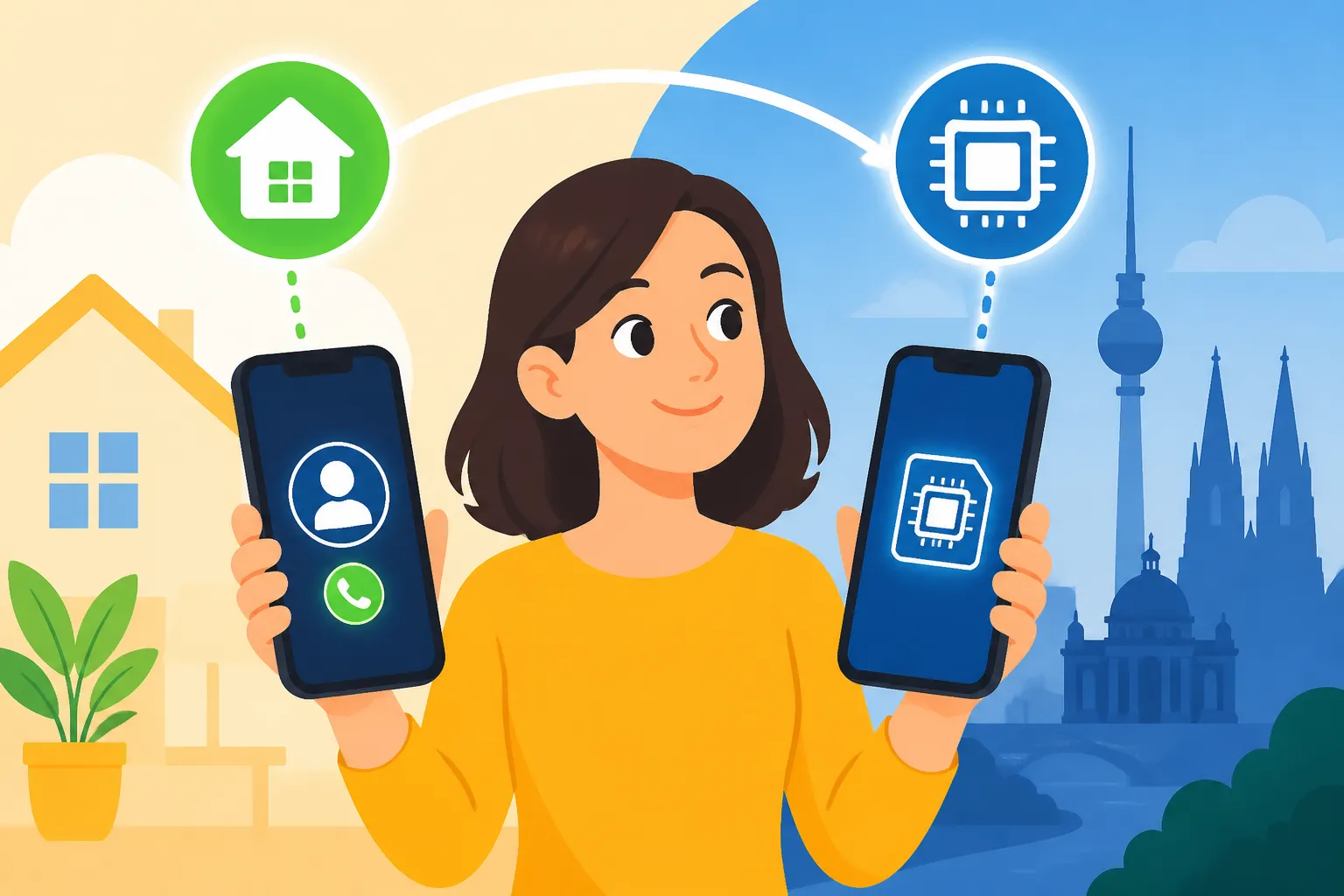
Here’s the magic trick: You can keep your existing physical SIM card, which holds your home country number, right where it is in your phone. This number remains active for calls and texts. Simultaneously, you can install an eSIM for Germany. You then configure your phone’s settings to designate the eSIM as the primary line for mobile data when you’re in Germany. Your physical SIM, with your home number, can still receive calls and texts, and you can even make calls or send texts if your home provider offers reasonable roaming rates, or if you leverage Wi-Fi calling. This means you get the best of both worlds: local, affordable data and continued access to your vital home number.
The Key Advantage: Seamless Data Without Ditching Your Home Line
This is where the eSIM truly shines. You arrive in Germany, activate your German eSIM (let’s say, with Airalo), and within minutes, you have affordable, high-speed mobile data. Your phone automatically connects to a local German network, and you can browse, navigate, and communicate online just as if you had a local physical SIM. All this happens while your primary, physical SIM from your home country remains active in the phone, ready to receive those crucial 2FA SMS messages or calls from loved ones.
No more expensive roaming bills for data, no more fiddling with tiny plastic cards, and no more being out of touch with your home life. Your German eSIM handles all your data needs – Google Maps, WhatsApp messages, checking Deutsche Bahn Guide: Using Trains for City and Long-Distance Travel, streaming music – while your home number sits quietly in the background, specifically for those moments when someone needs to call you directly or a service sends you a verification code. This setup dramatically simplifies connectivity when you’re navigating the complexities of a new country. It’s truly the modern solution for staying globally connected without losing your local footing.
Airalo: Your Go-To for Seamless German Connectivity
Navigating the world of mobile plans in a new country can feel like solving a Rubik's Cube blindfolded, especially when German is not your strongest language. That’s why services like Airalo have become such a lifesaver for so many expats and travelers in Germany. It’s not just about getting data; it’s about getting it easily, reliably, and without the commitment or complexity of a full-blown German contract.
Why Airalo Stands Out for Expats and Travelers
Airalo is a pioneer in the eSIM marketplace, offering local, regional, and global data plans. For Germany, they provide various packages designed to suit different durations and data needs, whether you're here for a short trip or settling in for a few months. What makes Airalo particularly appealing for someone wanting to keep their home number active is its singular focus on data. This means you’re not signing up for a new German phone number, which simplifies things immensely. You get what you need: fast, reliable internet access.
One of the biggest advantages is the sheer convenience. You can purchase and activate an Airalo eSIM from anywhere in the world before you even land in Germany. Imagine stepping off the plane, turning on your phone, and instantly having data without hunting for Wi-Fi or buying a physical SIM. This immediately reduces stress, allowing you to use navigation apps, call a taxi via an app, or inform friends of your arrival without any connection delays. Their app is incredibly user-friendly, making the entire process, from browsing plans to topping up, straightforward and transparent. There are no hidden fees, and the pricing is competitive, often much cheaper than traditional roaming from your home provider.
Step-by-Step: Activating Airalo in Germany While Keeping Your Home Number
Getting Airalo up and running while preserving your home number is surprisingly simple, but it requires a few specific settings tweaks on your phone. Here’s how you do it:
- Check Phone Compatibility: First things first, ensure your smartphone supports eSIM technology. As mentioned, most newer iPhones (XS, XR, 11, 12, 13, 14, 15 series), Google Pixel phones (3, 4, 5, 6, 7, 8 series), and many Samsung Galaxy flagships (S20, S21, S22, S23, S24 series, Fold, Flip) are compatible.
- Download the Airalo App: Head to your phone's app store and download the official Airalo app.
- Choose Your German eSIM Plan: Open the Airalo app and search for "Germany" or "Deutschland." You’ll see various data packages – typically ranging from 1GB for 7 days to 20GB for 30 days, or even longer-term regional Europe plans. Select the plan that best fits your travel duration and data consumption habits, then purchase it directly through the app.
- Install the eSIM: After purchase, the app will guide you through installation. You usually have two options:
- Direct/Automatic Installation: This is the easiest. The app will prompt you to install the eSIM profile directly. Just follow the on-screen instructions.
- Manual/QR Code Installation: If direct installation fails or isn’t an option, you’ll get a QR code (either in the app or via email). Go to your phone's settings (usually "Cellular," "Mobile Data," or "Connections"), look for "Add eSIM" or "Add Data Plan," and scan the QR code.
- Configure Your Phone Settings (Crucial for Dual SIM!): Once the eSIM is installed, your phone will recognize it as a new cellular plan. This is where you ensure your home number stays active for calls/texts while Airalo handles data:
- Label Your SIMs: Your phone will likely ask you to label your plans. Label your physical SIM something like "Home Number" or "Primary" and your Airalo eSIM as "Germany Data" or "Secondary." This helps immensely in managing them.
- Set Data Roaming OFF for Home SIM: For your "Home Number" (physical SIM), go into its settings and ensure "Data Roaming" is turned OFF. This prevents accidental, expensive data usage.
- Set Airalo eSIM for Mobile Data: Go to your phone's main cellular/mobile data settings. Select your "Germany Data" (Airalo eSIM) as the default line for Mobile Data.
- Set Default Line for Calls (Optional but Recommended): Your phone will also ask you to choose a default line for outgoing calls. You can select "Home Number" if you intend to make calls at roaming rates, or "Ask Every Time" if you rarely make calls and prefer to choose manually. Crucially, for incoming calls and texts (especially 2FA SMS), both lines will remain active to receive them.
- Enable Data Roaming for Airalo eSIM: For your "Germany Data" (Airalo eSIM), ensure "Data Roaming" is turned ON. This might seem counterintuitive, but it's necessary for the eSIM to connect to local networks in Germany. (Airalo bundles the roaming charge into their plans, so it's not extra cost to you).
- APN Settings: In rare cases, you might need to manually enter APN (Access Point Name) settings for your Airalo eSIM. Airalo provides these in their installation instructions if needed, but usually, they configure automatically.
And that's it! Your phone now has two active lines. Your "Home Number" is ready to receive calls and essential SMS messages (like those 2FA codes), while your Airalo eSIM provides all your data needs within Germany, keeping you seamlessly connected without ever swapping a physical card.
Managing Your Data and Staying Connected with Airalo
Once your Airalo eSIM is active, managing your data is straightforward through the Airalo app. The app typically displays your remaining data balance and the expiry date of your current package. This makes it easy to monitor your usage and avoid being caught off guard without data when you need it most.
If you find yourself running low on data, or if your plan is about to expire, topping up is just as simple as the initial purchase. You can buy another data package for Germany directly through the app, extending your connectivity without any interruption. Airalo's robust network, which partners with major German carriers, ensures you get reliable data speeds across most of the country. This means whether you're navigating the bustling streets of Berlin, checking train schedules from Travel Logistics in Germany: Money, Safety, and Connectivity, or simply looking up nearby restaurants, Airalo has you covered. It's truly designed to keep your digital life running smoothly so you can focus on enjoying your time in Germany.
Practical Scenarios and Tips for Dual SIM Usage
Living with a dual SIM setup, combining your home number on a physical SIM and an Airalo eSIM for data, offers incredible flexibility. However, it’s worth understanding the nuances to avoid any unexpected costs or communication hiccups. It's all about mastering those phone settings!
Handling Calls and SMS on Your Home Number
With your physical SIM still active for your home number, you'll continue to receive incoming calls and SMS messages, even while you’re physically in Germany. This is fantastic for those crucial 2FA codes, which are almost universally free to receive when roaming internationally. So, your banking apps, email services, and social media accounts will still be able to send you verification codes without incurring charges. This is the primary reason many expats choose this dual SIM strategy.
However, a big caveat: if you answer an incoming call or send an SMS on your home number while abroad, your home carrier’s international roaming rates will almost certainly apply. These can be very expensive. To avoid this, consider leveraging Wi-Fi calling if your home carrier supports it. When connected to Wi-Fi (perhaps in your apartment or a café, as discussed in Staying Connected to Wi-Fi While Traveling in Germany), calls and texts over Wi-Fi are often billed at your domestic rates, effectively bypassing international roaming charges. If Wi-Fi calling isn't an option, and you need to make an outgoing call to your home country, consider using VoIP apps like WhatsApp, Google Meet, or Skype over your Airalo data connection, or simply use your Airalo number if it comes with call/text features (though Airalo typically focuses on data). For immediate responses to incoming calls from your home number, it’s often best to let them go to voicemail and then return the call via a data-based app.
Optimizing Settings for Cost-Effectiveness
To truly get the most out of your dual SIM setup and keep costs down, a careful review of your phone's cellular settings is essential. Here’s a quick guide and a table to help you manage your lines:
| Feature/Setting | "Home Number" (Physical SIM) | "Germany Data" (Airalo eSIM) | Rationale |
|---|---|---|---|
| Mobile Data | OFF (Data Roaming OFF) | ON (Data Roaming ON) | Prevents exorbitant roaming data charges; uses eSIM for cheap local data. |
| Voice Calls | ON (Receives calls) | OFF (Unless Airalo offers a specific call plan) | Essential for receiving important calls; consider Wi-Fi calling for outgoing. |
| SMS Messages | ON (Receives & sends SMS) | OFF (Unless Airalo offers a specific SMS plan) | Crucial for 2FA SMS; sending SMS will likely incur roaming charges. |
| Default Line for Calls | Set to "Ask Every Time" or "Home Number" (with caution) | N/A (unless a specific voice plan) | Gives control over outgoing calls; "Ask Every Time" avoids accidental roaming. |
| Wi-Fi Calling | ON (If supported by home carrier) | N/A | Allows domestic rates for calls/texts when on Wi-Fi, saving on roaming. |
By setting your physical SIM's data roaming to OFF, you guarantee that your phone won't accidentally connect to a German mobile network for data via your home provider, racking up huge bills. Instead, all data traffic will be routed through your Airalo eSIM, giving you predictable and affordable costs. Regularly checking these settings, especially after software updates or traveling to other countries, is a good habit to prevent any surprises. For those considering a full German mobile contract later, it’s worth comparing these costs with what's offered in Internet and Mobile Phone Plans in Germany: Getting Connected Fast or Setting Up a Phone Plan in Germany: Prepaid vs Contract.
Troubleshooting Common Issues
Even with the best intentions, technology can sometimes be a bit finicky. Here are a few common issues you might encounter with a dual SIM setup and how to tackle them:
- "No Service" on eSIM: If your Airalo eSIM isn't connecting, first double-check that "Germany Data" (your eSIM) is selected as the mobile data line in your phone's settings and that "Data Roaming" is enabled for that specific eSIM. Sometimes, the phone might default to your physical SIM or need a manual network selection. Go to your eSIM settings, then "Network Selection," and try toggling "Automatic" off, then manually selecting a German network (like Telekom, Vodafone, or O2, whichever Airalo partners with). A quick restart of your phone can also work wonders.
- Home Number Still Using Data: This is a classic one! If you see unexpected data usage from your "Home Number," go immediately to its cellular settings and ensure "Data Roaming" for that physical SIM is unequivocally switched OFF. It's easy to overlook this step, but it's vital for cost control.
- Difficulty with 2FA SMS: If you're not receiving 2FA messages to your home number, first check that the physical SIM is still active. Receiving SMS usually doesn't require data roaming. If it still doesn’t work, confirm with your home carrier that SMS roaming is active on your plan. Sometimes, a network refresh (toggling Airplane Mode on and off) can help your phone reconnect to the local roaming partner network for SMS reception.
- Slow Data Speeds: If your Airalo data feels sluggish, it could be a temporary network issue or a sign of poor coverage in your specific location. Try moving to a different spot. Also, ensure you haven't exhausted your high-speed data allowance (some plans throttle speeds after a certain limit).
Remember, troubleshooting often starts with the simplest steps: check settings, restart the phone, and if all else fails, consult Airalo's excellent customer support through their app. They're usually very responsive and can help diagnose specific connection issues.
Beyond the Basics: Long-Term Considerations
While Airalo and eSIMs are fantastic for immediate and short-to-medium term connectivity, it's worth thinking about your long-term needs in Germany. The dual SIM approach is brilliant for flexibility, but there might come a point where a full German presence, including a local number, makes more sense.
When to Consider a German Physical SIM
For many expats, the Airalo eSIM acts as a perfect bridge. It gets you settled, allows you to find an apartment, set up your bank account, and navigate daily life. However, if your stay in Germany extends, or if you plan to integrate more deeply into local life, getting a permanent German physical SIM with a local number becomes increasingly beneficial.
Here are a few scenarios where it might be time to take the plunge:
- Job Hunting: Many German employers and recruiters prefer to call a local German number. It signals a stronger commitment to staying in the country and simplifies communication during the interview process.
- Extensive Local Calls: If you find yourself making frequent calls to German businesses, doctors, or new friends, having a local German number with a call package will almost certainly be more cost-effective than using VoIP apps or incurring roaming charges on your home number.
- Long-Term Stay & Integration: For bureaucratic appointments (like the Ausländerbehörde for your visa, though not directly related to phone plans, these offices prefer local contact), signing up for local services, or simply receiving calls from your Hausarzt (family doctor), a German number simplifies things. People expect a local number for most things.
- Better Bundled Deals: German providers like Deutsche Telekom, Vodafone, or O2 offer comprehensive plans that include not just data, but also unlimited calls and SMS within Germany, and often EU roaming. These can be more economical in the long run if you need a full-service package.
The decision often comes down to how long you plan to stay and how deeply you want to integrate. A good rule of thumb: if you're here for less than 3-6 months, an eSIM like Airalo is probably perfect. Beyond that, start looking into local options, which we discuss more in German SIM Card for Tourists vs Residents: What’s the Difference?.
Data Speeds and Network Coverage
The quality of your data connection, even with an Airalo eSIM, fundamentally depends on the underlying network infrastructure in Germany. Airalo partners with major local carriers (often a combination of Telekom, Vodafone, and O2, though this can vary by specific plan and location). This means your data speeds and coverage will be as good as the network Airalo is piggybacking on.
Germany boasts generally excellent mobile network coverage, particularly in urban areas. However, as with any country, there can be "dead zones" in very rural regions, tunnels, or deep inside certain buildings. If you're relying heavily on fast internet, especially for work or streaming, it's worth checking the coverage maps of major German providers. Websites like "Breitbandatlas.de" (German broadband atlas) can give you an idea of coverage quality across different regions. Generally, Telekom is often cited as having the best coverage and speeds, followed by Vodafone, and then O2. An Airalo eSIM will connect to one of these, ensuring you're usually well-connected.
Impact on Battery Life
Running two active cellular lines simultaneously – your physical SIM for calls/SMS and your eSIM for data – does consume slightly more battery power than running just one. Your phone's radio has to maintain a connection to two different networks, even if one is just passively receiving signals.
However, for most modern smartphones, this increased drain is quite minimal and manageable. Manufacturers have optimized dual SIM functionality to be as energy-efficient as possible. You might notice your battery depleting a little faster than if you only had one SIM active, but it's unlikely to be a significant inconvenience for typical daily use. Carrying a portable power bank, especially when traveling or during long days out, is always a good practice regardless of your SIM setup, but don't let battery concerns deter you from the convenience of dual SIM. The benefits of seamless connectivity and avoiding roaming charges far outweigh this minor impact.
Disclaimer
Please remember that I'm sharing information based on general knowledge and common expat experiences in Germany. While I strive for accuracy, specific visa regulations, tax laws, banking policies, or phone plan details can change. Always consult official sources, legal professionals, or service providers for the most current and personalized advice relevant to your individual situation.