Settling in Quickly: A Newcomer’s Checklist for Your First Weeks in Germany
Your flight has landed, your suitcase is open on a borrowed bed, and nobody can tell you which task comes first. The bank asks for a registered address. The landlord wants a bank account. Your phone plan needs both. This checklist puts your first weeks in Germany in the order that works, so each task opens the door to the next one.
Disclosure: This post may contain affiliate links. We may earn a commission at no extra cost to you if you make a purchase through these links. Read full disclosure.
Week One: Getting a Legal Address and Registering It
Almost every newcomer underestimates week one. You expect jet lag and maybe a few awkward supermarket moments. What actually happens is that you find out how much of German daily life depends on one piece of paper: proof that you officially live somewhere. If you get this part right, the rest of the list gets much easier.
Why Your First Accommodation Decides Everything
Before your move, you probably judged temporary housing on price, location and whether the photos looked clean. In Germany, there is a fourth factor that matters more than the other three: can you register your address there? Registration, the Anmeldung, is a legal duty for anyone who moves into a home. It is also the key that opens bank accounts, tax identification, and most contracts.
Here is a typical first-week mistake. Priya arrives in Frankfurt and books a lovely hotel near the Main for three weeks while she looks at flats. In her second week she walks into a bank branch to open an account, and they ask for her registration certificate. She goes to book a Bürgeramt appointment and finds she needs a landlord confirmation form, which a hotel will generally not issue for a guest stay. Two weeks are gone and she has not started the process. I made a version of this mistake myself in my first month, and the frustration of being “stuck in the lobby” of German life is real.
The usual fix is to book a furnished, registrable rental for your first one to three months. Platforms like Wunderflats focus on medium-term furnished apartments, and many listings say explicitly whether the landlord will provide the paperwork you need to register. Always confirm this in writing before you pay anything. A friendly “Yes, of course you can register” in a chat message is worth screenshotting. To understand which housing types support registration and which ones quietly don’t, read Accommodation That Supports an Anmeldung: What Hotels Cannot Provide before you book. For a wider look at the options themselves, including serviced apartments and sublets, see Short-Term and Furnished Rentals in Germany.
The Landlord Form You Cannot Skip
The document that makes registration possible is the Wohnungsgeberbestätigung, a short form in which the person giving you the flat confirms that you have moved in. It lists the address, your name, the move-in date, and the landlord’s details. Without it, the Bürgeramt will usually turn you away, however perfect the rest of your documents are.
What newcomers find hard is the timing. Many landlords fill this form out only once you physically have the keys, and some take their time sending it. If you are subletting from a tenant, the main landlord or a property manager may need to sign. Ask about this on the day you agree the rental, not on the day you need the form. One small trick that has saved several friends of mine: show up at the key handover with a printed blank copy of the form and a pen. Most landlords will sign on the spot instead of “sending it next week.”
Check the details carefully before you leave. A misspelled name, a missing apartment number in a large building, or a move-in date that doesn’t match your rental contract can all cause a rejection at the counter. If you want to know what each field means and what to do when a landlord refuses, our breakdown in The Wohnungsgeberbestätigung Explained covers the awkward edge cases.
Booking the Bürgeramt Appointment
This is the step where expats compare war stories. In big cities, particularly Berlin, Munich and Hamburg, online appointment slots at the Bürgeramt or Kreisverwaltungsreferat can look fully booked for weeks. Smaller towns are often far easier. Some let you walk in, and some offer slots within days.
A few things help:
- Check the booking portal early in the morning. Cancelled slots are often released overnight or first thing in the day, and they go quickly.
- Widen your search to every office in your city. In most cities you can register at any branch, not only the one nearest your flat. A tram ride across town is a small price for an appointment this week instead of next month.
- Refresh often over several days. It is tedious, but people really do snag slots this way.
- Ask about walk-in hours. Some offices keep limited same-day capacity. Arrive before opening, bring something to read, and expect a queue.
- Prepare a complete document folder in advance so that one appointment is enough.
Registration is required within a short legal window after you move in. If you truly cannot find an appointment in time, keep screenshots or printouts of your booking attempts. Offices generally understand when their own system is the bottleneck, but they appreciate evidence that you tried. For the full playbook on getting through the booking system, read How to Get an Anmeldung Appointment at the Bürgeramt.
What Happens at the Counter and the Letters That Follow
The appointment itself is usually anticlimactic, sometimes as short as ten minutes. Bring:
- Your passport or national ID card, plus your visa or residence permit if you have one
- The signed landlord confirmation form
- The registration form, filled in, if your city asks for it in advance
- Passports and, where relevant, marriage or birth certificates for family members registering with you, with translations if your office requires them
The clerk will enter your data and hand you a Meldebescheinigung, your registration certificate. Guard this sheet like a passport. Make copies, photograph it, and store a digital version somewhere safe. Banks, employers, insurers, phone companies and sometimes even gyms will ask for it.
Your registration also starts things moving behind the scenes. The most important is that the Federal Central Tax Office posts your tax identification number to your registered address, which is the main reason your name must be on the mailbox from day one. German post carriers will not deliver to a name that isn’t on the box or the bell. Your employer needs that number to run payroll correctly, so if it hasn’t arrived by your first payday, ask about it. Getting Your Tax ID (Steuer-ID) and Tax Number in Germany explains what to do if the letter goes missing and how a tax number differs from a tax ID.
Getting Connected and Paying for Things Before the Paperwork Lands
The cruel part of the early weeks is that you need a phone number and a way to pay before the bureaucracy has caught up with you. Here is how to bridge that gap without overpaying or getting stuck.
Phone and Data From Day One
Your home phone plan may work in Germany through roaming, but for many non-EU arrivals that gets expensive fast. A travel eSIM is often the simplest stopgap. Airalo is one of the better-known options. You install the plan before you fly, and data starts working as soon as you land, so you can navigate from the airport, message your landlord, and load booking portals. Check the provider’s own page for current plan sizes and prices, and confirm that your phone is unlocked and supports eSIM before you rely on it.
The catch is that most travel eSIMs are data-only, and you will soon need a German phone number. Banks send verification codes to it, delivery drivers call it, doctors’ offices ring it to confirm appointments, and prospective landlords take you more seriously with a local number on your application. German prepaid SIMs are widely sold in supermarkets, drugstores and phone shops, but identity verification is mandatory. That is usually done by video call or in a shop with your passport, and sometimes it asks for an address.
For a step-by-step look at what you can sign up for before registration and what is easier after it, read Connectivity Before Your Anmeldung: What You Can Buy Without a Registered Address. Long-term contracts with big carriers usually come later, once you have a registration certificate and a local bank account. Don’t let a salesperson in a shopping mall lock you into a long minimum term during your first jet-lagged weekend.
The Bank Account Chicken-and-Egg Problem
Here is the loop that frustrates almost everyone. Your employer wants a German IBAN to pay your salary. Your landlord wants rent by bank transfer or direct debit. Traditional branch banks often want your registration certificate before they open an account. And you can’t register until you have a flat.
The practical way out is to treat your banking in two stages:
- Stage one, the bridge. Use what you already have: a foreign card that works abroad with low fees, a multi-currency account, or an app-based bank that lets you open an account by video identification with just your passport. Some online banks are more flexible than branch banks about proof of address at sign-up, but policies change, so check each bank’s current requirements.
- Stage two, the long-term account. Once your registration is done, choose the account you actually want to keep. Some people like a local branch bank they can walk into. Others are happy staying app-only.
Be ready for card refusals. Germany is far more card-friendly than it used to be, but smaller bakeries, market stalls, some cafés and the occasional doctor’s practice still prefer cash or only accept the domestic girocard. Carry a modest amount of cash in your first weeks while you learn which local spots are card-friendly. Your First Two Weeks in Germany: Paying for Things Before You Have a Local Account goes through the payment situations that catch newcomers out, from vending machines to deposits. When you’re ready for stage two, How to Open a Bank Account in Germany as a Newcomer walks through documents, identity checks and choosing between account types.
Health Insurance Card and Your First Doctor
If you start a job in Germany, you’ll usually choose a public health insurer, or private cover if you qualify, and give your employer the membership confirmation. The insurer then asks for a photo and sends you an electronic health card by post. Until it arrives, insurers can usually issue a temporary confirmation of cover that you can show at a practice. Ask for one if you need to see a doctor in the meantime. How to Get Your Gesundheitskarte After Registering in Germany explains the photo upload, the waiting period and what to do if the card goes to the wrong address.
Don’t wait until you are ill to find a general practitioner. Make a note of two or three nearby practices in the first month, check whether they take new patients, and save their phone numbers. It feels like a low-priority errand until the week you wake up with a fever and every practice in your district says it isn’t accepting new patients.
Weeks Two to Four: Turning a Flat Into a Home
Once you have registration, a working phone and a way to pay, the focus moves from “being allowed to exist” to “living comfortably.” This is where Germany’s quirks show up, especially if you are moving into an unfurnished long-term rental after your bridge accommodation.
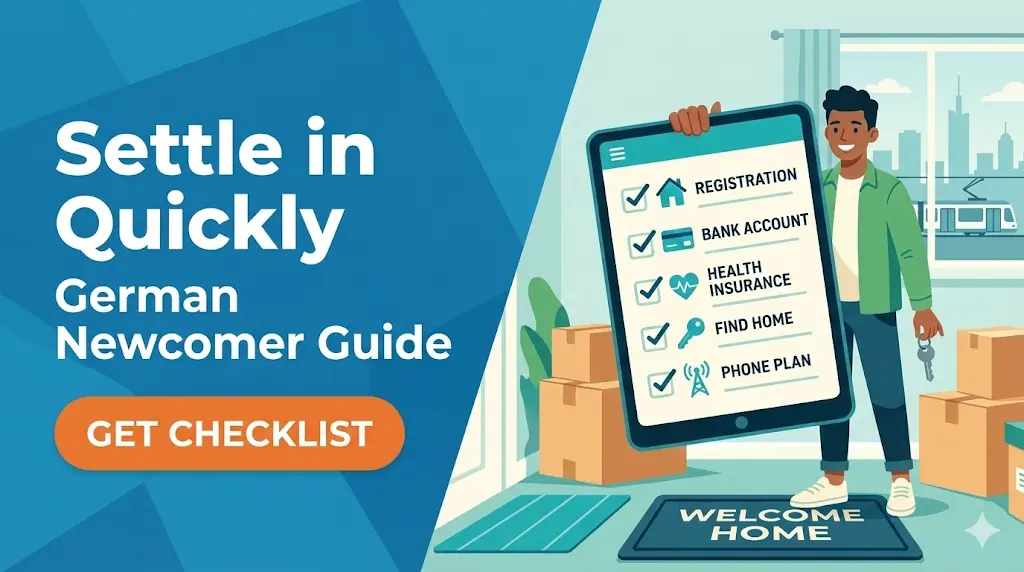
Your First-Month Master Checklist
Pin this table to the fridge, or keep it in your phone notes. The order matters more than the exact timing, because each row tends to unlock the next.
| Timing | Task | What You Need | What It Unlocks |
|---|---|---|---|
| Before arrival | Book registrable temporary housing | Written confirmation the landlord provides the move-in form | The ability to register at all |
| Before arrival | Set up data for landing | Unlocked, eSIM-capable phone | Navigation, messages, booking portals |
| Days 1 to 3 | Collect the landlord confirmation form | Printed form, landlord signature | Your Bürgeramt appointment |
| Days 1 to 7 | Book and attend registration | Passport, visa if applicable, signed form | Registration certificate, tax ID letter |
| Week 1 | Put your name on mailbox and doorbell | A small label or the building’s name strip | Delivery of official letters |
| Weeks 1 to 2 | Get a German phone number | Passport for identity check | Bank codes, deliveries, appointment calls |
| Weeks 1 to 2 | Open your long-term bank account | Passport, registration certificate | Salary, rent, direct debits |
| Weeks 1 to 3 | Confirm health insurance and card | Insurer membership, photo upload | Doctor visits without hassle |
| Weeks 2 to 4 | Arrange electricity, internet, broadcast fee | Meter number, bank details, registration | A functioning home |
| Weeks 2 to 4 | Learn waste sorting and building rules | A copy of the house rules | Peace with your neighbours |
Utilities, Internet and the Broadcast Fee
Depending on your rental, some utilities are bundled into the monthly service charges and others are your job. Heating and water are often handled through the landlord’s charges. Electricity is very often a separate contract you sign yourself. When you move in, photograph the electricity meter with the reading and meter number clearly visible. You’ll need both to start a contract, and the photo protects you if there’s ever a dispute about consumption before your move-in date.
Internet is where expectations collide with reality. In some buildings, a new fixed-line connection is activated within days. In others, especially where a technician has to visit or a line has to be switched over from a previous tenant, it can take weeks. Order as early as your contract allows, even before you physically move into your long-term flat if the provider lets you pick an activation date. In the meantime, a generous mobile data plan used as a hotspot gets you through video calls and streaming. Read the minimum contract term and cancellation conditions before signing. German contracts are often stricter than newcomers expect, and you usually have to cancel actively rather than just stop paying.
Then there’s the broadcast fee, the Rundfunkbeitrag. It is charged per household, not per person or per device. You owe it whether or not you own a TV or ever listen to the radio. Your registration usually triggers a letter asking you to sign up. If you live in a flatshare, only one person in the household needs to pay, and the others can register under that person’s contribution number so they don’t get billed twice. Many newcomers ignore the first letter, thinking it’s junk mail or a scam. It isn’t, and the reminders get firmer. How to Register and Pay the Rundfunkbeitrag in Germany explains how to sign up, share the fee in a flatshare, and apply for an exemption if you qualify.
The Empty Kitchen and Basic Furnishing
If your long-term flat is unfurnished, “unfurnished” can mean more than you expect. Many German rentals come with no kitchen at all: no cabinets, no stove, no sink unit, sometimes not even a ceiling lamp, just bare wires sticking out of the ceiling. The first time I walked into an apartment like that, I honestly thought the previous tenant had robbed the place. They hadn’t. They had simply taken their kitchen with them, which is completely normal here.
Your options roughly break down like this:
| Approach | Best For | Upside | Downside |
|---|---|---|---|
| Buy the previous tenant’s kitchen | People moving into a flat where the outgoing tenant offers it | Immediately usable, often fitted to the room | Negotiating price, inheriting wear and tear |
| Buy a new modular kitchen | Those staying several years | Choose your layout and appliances | Delivery and installation lead times |
| Buy second-hand from classifieds | Budget-conscious newcomers | Lower cost, fast pickup | Transport, measuring, assembly |
| Stay longer in a furnished rental | People unsure how long they’ll stay | No setup, flexible move-out | Typically higher monthly cost than an unfurnished flat |
That last row is worth taking seriously. If your job contract is short, or you’re not sure which neighbourhood you want, extending your stay in a furnished place through a platform like Wunderflats can cost less overall than buying and later selling a whole kitchen. Do the sums honestly: furniture, appliances, delivery, installation, and the hassle of reselling everything when you leave.
For the small, essential items, such as a kettle, bedding, a toilet brush, extension cords and shower curtain rings, online ordering through Amazon Germany is a lifesaver in the first fortnight. You can get the basics delivered while you’re still learning which shops are where. Make sure your name is on the doorbell first, because parcels for unknown names often end up at a post office or a neighbour’s flat. Collecting a parcel from a neighbour is completely normal in Germany. You’ll often find a card in your mailbox telling you which flat has it.
Watch out for electrical items from abroad. Germany uses 230-volt power and type F plugs, so a kitchen appliance shipped from North America may need more than a plug adapter. Furnishing a German Apartment and the Empty-Kitchen Problem covers measuring, budgeting and getting light fixtures and kitchens installed without upsetting your landlord.
Getting Around With the Right Ticket
In your first days, you’ll probably buy single tickets from machines or apps. Within a couple of weeks, a monthly pass or subscription almost always works out better for daily commuting. Many cities run their buses, trams, U-Bahn and S-Bahn under one regional transport association, so one ticket covers all of them inside your zone.
Two habits will save you stress. First, on systems with paper tickets, validate them in the stamping machines where they’re required. An unstamped ticket can count as no ticket during a spot check, and inspectors are not known for their sympathy. Second, check which zones your ticket covers before taking a trip to the outskirts or the airport. Fare zones catch a lot of newcomers out. The full overview of passes, subscriptions and regional systems is in Public Transport Tickets and Passes: Navigating German Transit Systems.
Living Like a Neighbour: The Unwritten and Written Rules
Paperwork is only half of settling in. The other half is getting on with the people who live above, below and beside you. German residential buildings run on a shared sense of order, and newcomers who learn the basics early tend to be welcomed rather than tolerated.
Waste Sorting and Bottle Deposits
On your first trip to the bins, you’ll probably see three, four or even five different containers. Typically there’s a bin for paper and cardboard, one for packaging such as plastic and metal (often yellow, sometimes yellow bags instead), one for organic waste, and one for everything else. Glass usually goes to public containers on the street, sorted by colour: white, brown and green. Throwing bottles into those containers late at night or on Sundays is frowned on in many areas because of the noise, and there are often posted times.
Many bottles and cans carry a deposit, called Pfand. You pay it when you buy the drink and get it back when you return the empty container. Most supermarkets have return machines near the entrance that print a voucher you can redeem at the till. Pfand bottles don’t belong in the household bins at all, which is why you’ll sometimes see people carefully setting them next to public bins so collectors can take them.
Sorting rules differ between cities, and sometimes between districts in the same city, so don’t assume your friend’s advice from another town applies to you. Look for a notice in your building’s bin area or a leaflet from your local waste authority. To learn which item goes where, including the confusing ones like greasy pizza boxes and coffee capsules, read How to Sort Waste Correctly in Germany.
Quiet Hours and House Rules
Many buildings have a Hausordnung, a set of house rules that is often attached to your rental contract or posted in the stairwell. It might cover cleaning duties for the stairs, where bicycles and strollers may be kept, whether you can grill on the balcony, and when noise is restricted. Read it in your first week. These rules are taken seriously, and a polite note from a neighbour taped to your door is the usual first sign that you’ve broken one.
Quiet hours are the rule that trips newcomers up the most. Night-time quiet is widely observed, many buildings expect a quiet midday period, and Sundays and public holidays are traditionally quiet days. Vacuuming, drilling holes for shelves, or a loud housewarming on a Sunday afternoon can upset neighbours who have lived there for decades. If you need to drill for curtain rails or lamps, do it on a weekday during normal daytime hours. Better still, knock on a neighbour’s door beforehand and say you’ll be making some noise. That small gesture buys a lot of goodwill.
If you plan a housewarming party, consider leaving a short note in the stairwell a few days ahead with the date and an apology for any noise. It may feel overly formal if you come from a culture where that would be strange, but here it’s a recognised courtesy, and it often earns smiles in the stairwell for months. The reasoning behind these customs, and how they differ from what you may be used to, is explained in What Are Quiet Hours (Ruhezeit) and Why Do They Matter?.
Sundays, Shop Hours and Planning Your Week
Your first Sunday in Germany can come as a shock: supermarkets closed, high streets silent, only a few bakeries open for a few morning hours. Shops in major train stations and some airports are exceptions, and petrol stations stock basic groceries, but at higher prices and with limited choice.
A simple routine helps. Do your main grocery shop on Saturday, keep a few non-perishable basics in the cupboard, and learn which station shop or late-opening convenience store near you is your emergency option. Public holidays work the same way, and some of them vary by federal state. A holiday in Bavaria may be a normal working day in Berlin. Check the local calendar for your state so you don’t arrive at a locked supermarket with an empty fridge on a long weekend.
Reading the Letters That Will Keep Arriving
Over your first month, your mailbox will fill with official-looking envelopes: your tax ID letter, your health insurance correspondence, the broadcast fee sign-up, utility contract confirmations, and sometimes a request from your local authority for more information. Germans still communicate a great deal by post, and deadlines in these letters are real.
Make a habit of opening every letter the day it arrives. Run it through a translation app if needed, and write any deadline in your calendar straight away. Keep a simple folder, physical or digital, sorted by topic: housing, work, insurance, tax, utilities. You’ll be amazed how often someone asks for a document months later. Learning the recurring vocabulary of official letters, such as Bescheinigung, Antrag, Frist and Bescheid, makes the whole process far less intimidating. Bureaucracy Basics: Understanding Bescheinigung, Anträge, and Other Paperwork works through these terms one by one.
Give Yourself Permission to Be New
Last, and I mean this sincerely: the first weeks are exhausting, and nearly everyone has at least one day when the systems feel built to defeat them. You will stand in the wrong queue. You will put a pizza box in the wrong bin. A clerk will tell you, very directly, that your form is incomplete. None of this means you’re failing. It means you’re doing the work that every newcomer does, and that most Germans do only once in their lives, at home, in their own language, with their parents’ help.
Work through the list in order. Celebrate the small wins, like the day the registration certificate is in your hand, or the evening your internet finally connects. And keep notes on what you learned, because sooner or later a friend will move here and ask you where to start.
Disclaimer
This article is for general informational purposes only and does not constitute professional advice. Laws, prices and regulations vary by location and change over time. Consult a qualified professional for guidance on your specific situation.