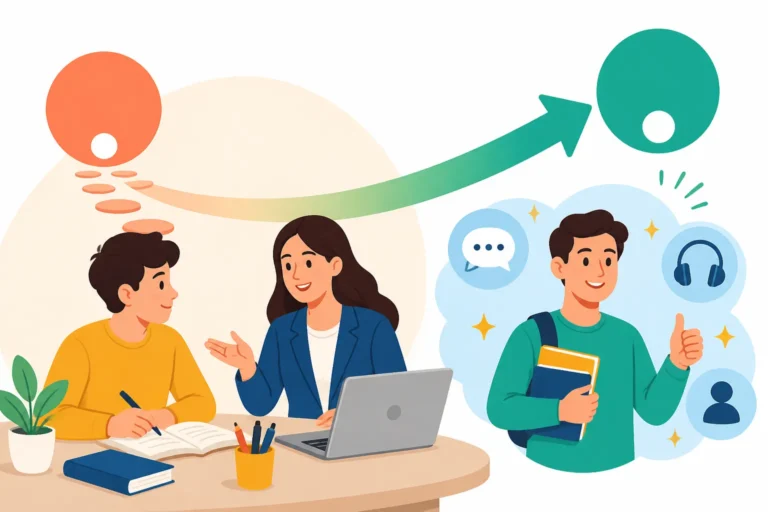
Business German With a Tutor: Meetings, Emails, and Formal Register
Your German is good enough for the supermarket and the Bürgeramt. Then your team lead adds you to a Thursday Besprechung and you freeze. Or you spend forty minutes on a three-line email because you can’t tell whether “Hallo” will sound rude. This guide shows how to fix that with one-on-one tutoring: formal register, meetings, emails, and a lesson plan you can start this week.
Disclosure: This post may contain affiliate links. We may earn a commission at no extra cost to you if you make a purchase through these links. Read full disclosure.
Why Business German Trips Up Even Fluent Expats
Most of us arrive in Germany with a language certificate, a decent vocabulary, and a quiet confidence that the office part will sort itself out. Then the first real week happens. A colleague writes “Wie verbleiben wir?” at the end of an email and you have no idea whether you’re being asked a question, given a deadline, or politely dismissed. A department head says “Das sehen wir uns nochmal an” in a meeting, and only later do you learn it usually means the idea is dead.
None of this means you’re bad at German. Business German is a dialect of its own. It has its own grammar habits, phrases, and unwritten rules about distance and hierarchy. Textbooks barely touch it, and colleagues rarely explain it.
The Gap Between B2 Certificates and Real Office German
Here is a scenario I’ve watched play out more times than I can count. Priya, a data engineer from Bangalore, moves to Munich to work for a Mittelstand automotive supplier in the suburbs. She passed her B2 exam with a good score. Her small talk is fine and her reading is excellent. But in her second month, her manager hands her a task in a meeting with “Könnten Sie das bis Ende der Woche aufbereiten und an die Kollegen aus dem Einkauf weiterleiten?” Priya catches “Ende der Woche” and “Einkauf” and nods. She has no idea that “aufbereiten” means preparing the data in presentable form, not simply sending the raw export.
The exam taught Priya to understand German. It did not teach her the compressed, slightly bureaucratic, highly conventional German that offices actually run on. Certificates test whether you can talk about your hobbies, discuss environmental policy, and write a complaint letter to a fictional landlord. They do not test whether you can push back on a deadline without sounding defiant, or summarize a decision in a way your Abteilungsleiter will accept.
That gap can feel humiliating, because you know you’re competent. You just can’t show it fast enough in German. Many expats respond by retreating into English wherever they can, which works in Berlin startups and some Frankfurt banks. Elsewhere it slowly caps your career. If you’re weighing how much the language actually matters for promotion, our piece on Leveraging German Language Skills: How Much Does Speaking German Boost Your Career goes deeper into that question.
Formal Register Is a Social Signal, Not Just Grammar
In many English-speaking workplaces, formality is a dial you can turn down almost to zero. Everybody is “Hi Mike” by day two, and the CEO signs off emails with “Cheers.” German offices often work differently. Register isn’t decoration. It signals respect, distance, competence, and your place in the organization. Using the wrong register doesn’t just sound odd. It can be read as presumptuous, sloppy, or naive.
Take the opening line of an email. “Hallo Herr Becker” might be perfectly normal in a Hamburg agency. Sent to an external supplier you’ve never met, or to a senior partner at a law firm in Düsseldorf, it can land as overly casual. “Sehr geehrter Herr Becker” is safe but can feel stiff internally once a relationship exists. “Guten Tag Herr Becker” sits in the middle. These are the micro-decisions that eat your time, and they depend on industry, region, company culture, and the relationship.
This is why office German makes people anxious in a way supermarket German doesn’t. The stakes feel social and professional at once. A tutor who knows German workplaces can tell you which choices are actually risky and which ones nobody will notice. For a wider view of these unwritten norms, Work Culture in Germany: Etiquette, Hierarchy, and Office Norms is a helpful companion read.
Why Generic Classes Rarely Fix This
Group courses are wonderful for building a foundation. I owe a lot of my early German to a slightly chaotic evening class with eleven other tired adults. But a group class has to serve everyone. One person needs German for a nursing job, another for university, another to talk to their in-laws. A whole lesson on internal escalation emails in a manufacturing context would bore most of the room.
Business German is personal in a way general German isn’t. Your industry has its own vocabulary. A logistics coordinator in Duisburg needs different phrases than a UX designer in Berlin-Kreuzberg or a controller at an insurance company in Cologne. Your company has its own culture. Your specific weak spots matter too: maybe you write well but freeze when spoken to, or speak fluently but your emails read like translated English. A curriculum built for a group can’t reach these details.
The usual result is that expats in group classes improve their general German and keep struggling at work. The fix is targeted practice with someone who can work with your real material: your actual emails, your actual meeting agenda, your actual job. That’s what one-on-one tutoring offers, and why online platforms have become the default route for working professionals.
Mastering Formal Register With a Tutor
Formal register is the foundation everything else rests on. Once you have it, emails get faster, meetings get less frightening, and you stop second-guessing every sentence. The good news is that formal business German follows patterns, and patterns can be drilled.
Sie, Du, and the Gray Zone in Between
The Sie and Du question is where most people start, and with good reason. The textbook answer says to use Sie with strangers and superiors and Du with friends. Real workplaces are messier. Plenty of Berlin startups put Du in their onboarding documents. Many traditional firms in Stuttgart or Munich still use Sie between colleagues who have shared an office for fifteen years. And there’s a large gray zone: teams that say Du in person but write Sie in client-facing emails, or departments where the boss duzt everyone but nobody dares duzen the boss back.
The rule that saves you is simple. The more senior or older person usually offers the Du, and you don’t switch until it’s been offered. A tutor can rehearse what that offer sounds like, which is easy to miss in practice. “Wollen wir uns duzen?” is the direct version. Often it’s buried in something like “Ich bin übrigens der Markus” at the end of a meeting. If you keep saying Sie after that, you’ll seem cold. If you switch before it, you’ll seem pushy.
Tutoring helps with something less obvious: mixed-register situations. Maybe you’re on Du with a colleague in person, but they CC their department head on an email to you. Do you reply with Du? Usually yes, because the relationship governs the address, but your phrasing should tighten up. A good tutor will role-play these situations with you until the choices feel natural. We have a full guide on this, Du or Sie? Navigating Formal and Informal German Address, if you want the background before your first lesson.
Konjunktiv II and the Art of Polite Requests
If formal business German has a secret weapon, it’s Konjunktiv II, the subjunctive. In office German, direct imperatives sound blunt, even rude. Nobody writes “Schicken Sie mir den Bericht.” They write “Könnten Sie mir den Bericht schicken?” or “Wären Sie so freundlich, mir den Bericht zukommen zu lassen?” or, very commonly, “Ich wäre Ihnen dankbar, wenn Sie mir den Bericht bis Freitag schicken könnten.”
Most learners know Konjunktiv II in theory. Few can produce it fluently under pressure, especially out loud in a meeting. When Tom, a British risk analyst at a bank in Frankfurt, started working with a tutor, his biggest problem wasn’t vocabulary. Every request he made came out as a slightly aggressive imperative, because that’s what his brain could build fastest. His German colleagues didn’t complain, but he noticed they responded more warmly to his emails, which he had time to polish, than to his spoken requests.
His tutor gave him a set of ten polite request frames and drilled them until they became reflexes. Each lesson opened with five minutes of rapid-fire practice. The tutor would say “Bericht, Freitag, Kollegen” and Tom had to produce a full polite request instantly. Within a few weeks, “Würden Sie bitte…” and “Hätten Sie kurz Zeit für…” came out before the imperative did. This kind of repetitive, personalized drilling is nearly impossible to get anywhere other than one-on-one lessons.
Nominalstil and Office Vocabulary
German offices love nouns. Where English says “we need to decide quickly,” business German says “eine zeitnahe Entscheidung ist erforderlich.” Where English says “after we’ve checked it,” German writes “nach erfolgter Prüfung.” This is called Nominalstil, the nominal style, and it pervades emails, reports, and minutes. It can feel heavy and bureaucratic, and it partly is. But if you want to read and write professional German comfortably, you have to master it.
There’s a fine balance here. Overdo Nominalstil and your German sounds like a 1980s tax notice. Ignore it and your writing sounds childish in formal contexts. A skilled tutor will show you which nominal constructions are standard in your field and which ones you can safely unpack into verbs. Common workhorses include “Bezug nehmend auf,” “in Abstimmung mit,” “zur Kenntnisnahme,” “nach Rücksprache mit,” and “im Rahmen des Projekts.”
Alongside this comes office vocabulary that no textbook teaches properly: “Jour fixe” for the regular weekly meeting, “Abstimmung” for alignment, “Freigabe” for approval, “Ansprechpartner” for contact person, “Zuständigkeit” for responsibility. Then there’s the imported Denglisch: “committen,” “Deadline,” “Meeting,” “gecancelt.” Knowing which English loanwords your company uses, and which ones would sound affected, is real insider knowledge. For a vocabulary deep dive, browse German Corporate Buzzwords: Common Terms in Office Talk before you build your tutor’s word list.
Business Emails in German: Structure, Phrases, and Tutor Feedback
Emails are where most expats feel the strain first. You can hide in a meeting by staying quiet. An email has your name on it, sits in someone’s inbox, and may be forwarded to people you’ve never met. The upside is that email is also where you improve fastest, because you can practice it asynchronously and get detailed corrections.
Anatomy of a German Business Email
German business emails follow a predictable structure, and once you see it you can’t unsee it. First comes the greeting, which depends on the relationship. Then a short opening line, often referring to previous contact: “vielen Dank für Ihre Nachricht” or “wie besprochen sende ich Ihnen anbei…” Then the core content, which German writers tend to keep factual and well organized, sometimes with numbered points. Then a clear statement of the next step or request. Then a closing formula, and finally the signature.
Two features stand out to anyone used to Anglo-American emails. German emails often carry less emotional padding. There’s less “I hope you’re doing well!” and fewer exclamation marks, though warmth is still possible. They also make responsibilities and deadlines explicit. “Bitte geben Sie mir bis Mittwoch eine kurze Rückmeldung” isn’t rude. It’s helpful. Vague requests like “let me know when you get a chance” leave German readers unsure whether there’s a deadline at all.
Typical stumbling blocks include the capitalization of formal “Sie” and “Ihnen,” the comma after the greeting followed by a lowercase first word, the difference between “anbei” and “im Anhang,” and when to use “Betreff” lines that work well in a search. A tutor will catch these in seconds. You might stare at your own draft for twenty minutes and miss every one.
Openers and Closers by Relationship
The greeting and the closing formula cause more anxiety than anything else, so here is a practical reference. Treat it as a starting point, then ask your tutor how your industry and region differ.
| Situation | Typical Greeting | Typical Closing | Notes |
|---|---|---|---|
| First contact, external, formal industry | Sehr geehrter Herr Wagner, / Sehr geehrte Frau Yilmaz, | Mit freundlichen Grüßen | The safest choice for law, finance, public sector and first applications |
| Unknown recipient or general inbox | Sehr geehrte Damen und Herren, | Mit freundlichen Grüßen | Increasingly replaced by gender-neutral options such as “Guten Tag,” in some firms |
| Ongoing external contact, polite but established | Guten Tag Herr Wagner, | Freundliche Grüße / Beste Grüße | A comfortable middle ground once you’ve exchanged a few emails |
| Internal colleague on Sie | Hallo Frau Yilmaz, / Guten Morgen Frau Yilmaz, | Viele Grüße / Beste Grüße | Common in most modern offices; check what your colleagues use |
| Internal colleague on Du | Hallo Jana, / Hi Jana, | Viele Grüße / VG / LG | “LG” for “Liebe Grüße” is friendly; avoid it with superiors unless they use it |
| Senior manager on Du | Hallo Markus, | Viele Grüße / Beste Grüße | Keep the closing slightly more formal than with peers |
| Warm, long-standing relationship | Liebe Frau Yilmaz, / Lieber Markus, | Herzliche Grüße | Signals warmth; can feel too personal if the relationship is new |
One note about abbreviations: “MfG” for “Mit freundlichen Grüßen” can look lazy or even curt to some readers. Writing it out costs you two seconds. “VG” is common internally but not in external correspondence.
Turning Your Real Inbox Into Lesson Material
This is where one-on-one tutoring really pays off. With a good tutor, your lesson material is your own working life. Before each session, collect two or three emails you received and found hard to read, plus two or three drafts you wrote and felt unsure about. Remove anything confidential: names, figures, client details. Then send them to your tutor or bring them to the lesson.
Here’s what a typical session can look like. Your tutor reads your draft and highlights phrases that read like translated English, such as “Lassen Sie mich wissen” used where “Geben Sie mir bitte Bescheid” is more natural. They explain why a sentence feels too direct and suggest a Konjunktiv II version. They point out that your request has no deadline. Then, crucially, you rewrite it yourself during the lesson instead of just accepting their corrections.
After a few weeks of this, patterns appear. You notice you always make the same three mistakes, and your tutor gives you a personal checklist. Some learners keep a running document of “my phrases,” a personal phrasebook of tutor-approved sentences for the email types they write most: meeting requests, status updates, gentle reminders, escalations, thank-you notes after a project closes. Within a couple of months, writing a routine email takes minutes instead of most of an afternoon.
Speaking Up in German Meetings
If emails are where you feel exposed, meetings are where you feel invisible. The conversation moves quickly, people interrupt in ways that feel aggressive to some outsiders, and by the time you’ve built your perfect sentence the agenda has moved on. Many expats sit silently through months of meetings and then feel overlooked when promotions come around. Speaking skills can be trained just like writing skills. It takes rehearsal with real feedback.
Agendas, Turn-Taking, and Interrupting Politely
German meetings, especially in traditional companies, tend to be structured. There’s a Tagesordnung, an agenda, often sent in advance. People are expected to come prepared, discuss items in order, and leave with clear decisions. Many expats find this comforting once they understand it, because it means you can prepare. If you know item four is the Q3 rollout and you have an opinion, you can rehearse your point with a tutor beforehand. Our guide German Business Meetings: Why Agendas and Minutes Matter explains the cultural logic behind this in more detail.
What you need are entry phrases, the verbal handles that let you take the floor. “Darf ich kurz etwas ergänzen?” (may I add something briefly?), “Wenn ich da kurz einhaken darf…” (if I may jump in here…), “Ich hätte dazu eine Frage” (I’d have a question about that), “Um auf den Punkt von Frau Schulz zurückzukommen…” (to come back to Ms. Schulz’s point…). These signal politely that you’re about to speak, and they buy you a few seconds to organize your thoughts.
A tutor can simulate the pace of a real meeting, which is the hardest thing to practice alone. One effective exercise: your tutor delivers a short monologue as if presenting an agenda item, and you have to break in at a natural point with an entry phrase and make a short contribution. Then you swap roles, and you present while they interrupt you. Do this five or six times across a few lessons and the panic of jumping into a fast German conversation starts to fade.
Disagreeing Without Burning Bridges
German directness is famous, and partly true. In many German offices it’s normal to say “Das sehe ich anders” (I see that differently) to a colleague’s face, and nobody takes it personally. But directness has its own rules. It targets the substance, not the person, and it often comes wrapped in qualifiers. Learners who copy only the bluntness, without the framing, can come across as harsh, even by German standards.
Useful frames for respectful disagreement include “Ich verstehe den Punkt, allerdings…” (I understand the point, however…), “Da wäre ich etwas vorsichtiger, weil…” (I’d be a bit more careful there, because…), “Haben wir schon bedacht, dass…?” (have we already considered that…?), and “Aus meiner Sicht spricht dagegen, dass…” (from my perspective, what speaks against it is…). Each one makes your objection clear while keeping the conversation on the facts.
Here’s a realistic rehearsal scenario. Ana, a Brazilian project manager in Leipzig, knew her team was about to agree to a timeline she thought was unrealistic. The night before the meeting, she booked a short lesson and asked her tutor to play the role of the overly optimistic team lead. They ran the conversation three times. On the first run Ana’s objection came out apologetic and vague. On the second it was too blunt. On the third it was clear, constructive, and backed by numbers. The next morning she made her point. The deadline moved, and her manager thanked her afterwards. That’s what tutoring can do that no app can: rehearse tomorrow’s exact conversation tonight. For more context on how directness and authority interact, see Company Hierarchies in Germany: Titles and Decision-Making Process Explained.
Follow-Up Actions and the Protokoll
German meetings rarely end with a vague “great, let’s keep in touch.” They end with Maßnahmen (action items), Verantwortliche (owners), and Termine (deadlines). Someone usually writes a Protokoll, the minutes, and circulates it afterwards. Sooner or later you’ll be asked to write it yourself, which is both a test and a chance to show competence.
Minutes have their own language. They usually use present tense or a neutral reporting style, lean heavily on Nominalstil, and follow conventional structures: “Teilnehmer,” “Tagesordnungspunkt,” “Ergebnis,” “Nächste Schritte,” “Verantwortlich,” “Bis wann.” Phrases like “Es wurde beschlossen, dass…” (it was decided that…), “Herr Klein übernimmt die Abstimmung mit der IT” (Mr. Klein takes over coordination with IT), and “Offene Punkte werden im nächsten Jour fixe besprochen” (open points will be discussed at the next regular meeting) come up constantly.
Practicing minutes with a tutor is especially effective because it trains both listening and writing. One method: your tutor plays or reads a short simulated meeting discussion, and you write the Protokoll from it. Your tutor then corrects both content and form. Did you capture the decision accurately? Is every action item assigned to a person with a deadline? Does the register fit? After a handful of these exercises, the first time your boss says “Können Sie heute das Protokoll übernehmen?” you’ll say yes with confidence.
There’s also the spoken side of follow-up. At the end of a meeting, a quick “Dann fasse ich kurz zusammen…” (let me briefly summarize…) is one of the most professional things you can say. It shows you were following, confirms the decisions, and positions you as someone who gets things done. Rehearse that summary with your tutor until it flows.
Why iTalki Works for Business German
By now the case for one-on-one practice should be clear. The next question is where to find the right tutor without spending weeks searching. After years of trying various routes myself, and watching friends and colleagues do the same, I keep recommending iTalki to working professionals who need business German specifically. It isn’t the only option, but its structure fits what busy professionals need: a large pool of German tutors, filtering by teaching focus, flexible scheduling, and the freedom to switch tutors whenever you want.
Finding a Tutor With Real Corporate Experience
The single most important factor in business German tutoring is the tutor’s own background. A brilliant grammar teacher who has never worked in a German office can teach you Konjunktiv II, but they may not know that “zeitnah” in your manager’s email really means “today, please.” The ideal business German tutor has either worked in a German company, ideally in your sector, or has years of experience teaching professionals in corporate settings.
On iTalki you can browse tutor profiles, read their self-descriptions, watch introduction videos, and look for mentions of business German, professional German, interview preparation, or specific industries. Many tutors list previous careers, and you’ll find former HR managers, engineers, bank employees, and consultants who now teach full time. Before booking, send a short message describing your job and your goals, and watch how they respond. A strong tutor will ask follow-up questions about your industry and your specific pain points, not just send a generic welcome.
There’s also the choice between community tutors, who focus on conversation practice, and professional teachers, who usually have formal teaching qualifications and structured materials. For business German, a mix often works: a professional teacher for systematic work on register and writing, and perhaps a community tutor for extra speaking practice. Our guide Community Tutor vs Professional Teacher on iTalki: Which for Your Level? breaks this decision down. To avoid common mistakes when screening profiles, read How to Choose a German Tutor on iTalki: Screening Questions and Red Flags before you shortlist anyone.
Comparing iTalki With Other Learning Routes
To be fair, there are several ways to improve your business German, and each has a place. Here’s how they compare for a working professional who needs office-ready German, not general fluency.
| Learning Route | Personalization to Your Job | Flexibility Around Work | Speaking Practice Volume | Best For |
|---|---|---|---|---|
| One-on-one tutor on iTalki | Very high; lessons built around your emails, meetings and industry | Very high; book evenings, lunch breaks or weekends | High; the whole lesson is your speaking time | Professionals with specific workplace goals |
| Group business German course at a language school | Medium; fixed syllabus shared with other participants | Low to medium; fixed weekly times | Low to medium; shared among the group | Learners who want structure and classmates |
| Volkshochschule evening course | Low to medium; often general rather than business-specific | Medium; set term schedule | Medium; varies with class size | Building a foundation on a modest budget |
| Company-provided in-house trainer | High within the company context | Medium; tied to company scheduling | Medium to high depending on group size | Employees whose employer offers it |
| Self-study apps and textbooks | Low; generic content | Very high | Very low; little real conversation | Vocabulary review between lessons |
Costs vary widely. Tutors on iTalki set their own rates, so you’ll see a broad range depending on experience, qualifications, and specialization, and many offer trial lessons and lesson packages. Check the platform’s own pages for current pricing rather than relying on general estimates. If you’re weighing platforms against each other, our comparison iTalki vs Preply for German: Tutor Pool, Pricing, and Booking Compared walks through the differences in detail.
The key point from the table is personalization. Every other route makes you adapt to the course. With a private tutor, the course adapts to you, and that matters enormously when what you need is the exact German your Wednesday meeting demands.
Scheduling Around a Full Workweek
The biggest obstacle for most working expats isn’t motivation. It’s time. Between commuting, overtime, family life, and the endless admin of living in Germany, a fixed twice-weekly evening class across town can be impossible to sustain. This is where online tutoring really wins. You can book a lesson at 7 a.m. before work, during a long lunch break from home, or on a Sunday morning with a coffee.
A few scheduling tips from experience. First, book lessons for the same time each week where you can. Consistency matters more than intensity, and a recurring slot protects your learning from the chaos of your calendar. Second, schedule ad hoc lessons strategically. If you have an important presentation or a tricky performance review coming up, book a session a day or two before to rehearse. Third, keep lessons focused. Many professionals find that shorter, more frequent lessons beat one long session a week, because the material stays fresh.
If you’re unsure how much time you can realistically commit, our guide Fitting German Lessons Around Work: Realistic Weekly Study Schedules offers sample weekly plans for different workloads. The aim is a rhythm you can sustain for months, not a heroic two-week sprint followed by burnout.
A Practical Lesson Plan for Your First Months
Knowing what to practice is half the battle. Here’s a lesson plan that has worked well for many professionals I know. Adapt it to your level, your job, and your tutor’s style, but use it as a skeleton so your lessons have direction from the start.
First Lessons: Diagnosis and Priorities
Your first lessons should be about diagnosis, not drilling. Your tutor needs to understand your level, your job, and the situations that cause you the most stress. Come to your trial lesson prepared with concrete examples. Our guide Your First iTalki Trial Lesson in German: What to Prepare covers this in depth, but here’s the core process:
- Write down the five workplace situations where your German fails you most often, for example “asking my manager for an extension,” “presenting status updates in the weekly Jour fixe,” or “replying to supplier complaints.”
- Collect two or three anonymized emails you’ve written and two or three you found hard to understand.
- During the first lesson, describe your role and company culture in German, even imperfectly. This gives the tutor a natural sample of your spoken level.
- Ask the tutor to identify your three most frequent mistakes, both in the sample emails and in the conversation.
- Agree on two or three priority goals for the next eight weeks, for example “write routine emails without help” and “make at least one contribution in every meeting.”
- Set a recurring lesson slot and agree on how you’ll share materials between lessons.
- Start a personal phrasebook document that you and your tutor update after every session.
This diagnostic phase usually takes one to three lessons. Resist the temptation to rush it. Learners who skip diagnosis often spend weeks practicing things they’re already good at while their real weak spots go untouched.
Weeks Five Through Twelve: Rehearsal and Real Tasks
Once your priorities are clear, lessons should shift to a rhythm of input, practice, and real-world application. A typical lesson in this phase might open with five minutes of rapid-fire drills on polite request frames or meeting entry phrases. Then comes twenty to thirty minutes on a main task: rewriting one of your real emails, role-playing an upcoming meeting, or writing a Protokoll from a simulated discussion. The last few minutes go to recording new phrases in your phrasebook and setting a small homework task.
Here’s a sample sequence of lesson themes across this phase:
| Lesson Theme | Main Activity | Real-World Homework |
|---|---|---|
| Polite requests and Konjunktiv II | Drill ten request frames, then rewrite three of your direct requests | Use at least two new frames in real emails this week |
| Greetings, closings and register | Review your recent emails and choose the right register for each recipient | Adjust your email signature and greeting habits |
| Status update emails | Write a weekly update with clear structure and next steps | Send one real update using the new structure |
| Meeting entry phrases | Interruption role-play at increasing speed | Make one contribution in your next team meeting |
| Respectful disagreement | Role-play a debate on a real work issue | Express one well-framed objection or alternative at work |
| Writing a Protokoll | Write minutes from a simulated meeting, then correct them | Volunteer to write minutes once |
| Phone and video calls | Simulate a call with an external partner, including small talk | Make one work call in German instead of English |
| Review and consolidation | Revisit your phrasebook and test yourself on weak areas | Choose new priority goals for the next phase |
The homework column is the secret ingredient. Lessons build skill, but using that skill at work builds confidence. Every time you send an email with a new phrase and nothing bad happens, or you speak up in a meeting and someone nods, the anxiety shrinks a little. Tell your tutor how these real-world attempts went at the start of the next lesson. Those stories make the best lesson material.
As the weeks go on, you can bring in more specialized topics. Some learners rehearse annual review conversations. Others practice salary or contract negotiations, or prepare presentations for leadership. If a job change is on your horizon, interview practice fits naturally into this phase. Practicing German Job Interviews Before You Apply shows how to structure those sessions.
Measuring Progress at Work
Progress in business German is easy to underestimate because it’s gradual. You won’t wake up one day speaking perfect office German. Instead, you’ll notice small changes: an email that used to take forty minutes now takes ten, you followed an entire meeting without losing the thread, a colleague forwarded your message to a client without editing it. Track these moments deliberately, because they’re the evidence that your investment is working.
A few concrete ways to measure progress:
- Time how long routine emails take you at the start, then again after eight and twelve weeks.
- Count your contributions in meetings each week, even small ones like a question or a summary.
- Every few weeks, ask your tutor to compare a current email with one from your first lesson.
- Note when colleagues start switching to German with you, or stop switching to English. That’s one of the clearest signs your German is working.
- Record yourself giving a short status update now and again later, then listen to both.
If you plateau, and most people do at some point, it’s usually a sign that your lessons need fresh material or a different focus. Change it up. Bring a new type of task, try a different tutor for a few sessions, or set a concrete goal like presenting in German at the next all-hands. Learners at the intermediate stage often find it helpful to follow a longer-term structure, such as the one in From B1 to B2 With a Tutor: A 12-Month Online Study Plan, to keep their direction clear.
The reward for sticking with it is real. Business German changes how you experience your job. You stop feeling like a guest in your own team and start feeling like a full participant. You get pulled into conversations instead of being left out of them. Over time, that shapes the opportunities that come your way. If you’ve been putting this off, take the first step this week: open iTalki, shortlist three tutors with business German experience, message them about your job, and book a trial lesson with the one whose reply shows they actually understand your workplace. Your future self, the one who writes a confident email in five minutes and speaks up in the Thursday Besprechung without a racing heart, will be grateful.
Disclaimer
This article is for general informational purposes only and does not constitute professional advice. Laws, prices and regulations vary by location and change over time. Consult a qualified professional for guidance on your specific situation.