Dining Etiquette in Germany for Visitors
Ah, the delightful adventure of dining out in Germany! It can be a truly wonderful experience, filled with hearty food and excellent beer or wine. But let's be honest, for us expats and visitors, it can also feel like navigating a minefield of unspoken rules and cultural nuances. From making a reservation to knowing how much to tip, the German way of dining can sometimes leave you scratching your head, worried you might accidentally cause offense. This guide is here to untangle all those little intricacies, equipping you with the insider knowledge you need to enjoy every meal out in Germany with confidence and ease.
Disclosure: This post may contain affiliate links. We may earn a commission at no extra cost to you if you make a purchase through these links. Read full disclosure.
Before You Even Sit Down: Reservations and Arrivals
One of the first things you'll notice in Germany is that dining out often involves a bit more planning than you might be used to back home. Spontaneity is charming, but a little foresight goes a long way here, especially in popular establishments or during peak hours.
Making a Reservation (Reservierung)
Making a reservation, or a "Reservierung," isn't just a suggestion in Germany; it's often a necessity, especially for dinner, weekend meals, or if you're dining with a larger group. Many restaurants, particularly in bigger cities like Berlin or Munich, and even charming smaller towns, can fill up surprisingly quickly. Just walking in and expecting a table, especially on a Friday or Saturday night, can lead to disappointment and sometimes even a slightly bewildered look from the host.
To make a reservation, a phone call is usually the most straightforward method. Don't worry if your German isn't perfect; many restaurant staff, especially in tourist-friendly areas or larger cities, will speak at least some English. A simple "Ich möchte einen Tisch reservieren" (I would like to reserve a table) followed by your name, the number of people, date, and time is often enough. For example: "Guten Abend, ich möchte einen Tisch für zwei Personen am Samstag, den 22. Juni, um 19 Uhr reservieren. Mein Name ist [Your Name]." You might also find that some restaurants, especially the more modern or upscale ones, offer online booking systems directly through their website or via platforms like TheFork. If you're exploring different regions, perhaps planning a trip via Omio and looking for the perfect restaurant in each city, checking their individual websites for booking options is always a good idea. Always confirm the details before hanging up, just to be sure.
Arriving at the Restaurant
When you arrive at a German restaurant, resist the urge to simply walk in and choose any open table. This is a common faux pas. Instead, wait at the entrance, just inside the door, for a member of staff to greet you. They will then either lead you to your reserved table or inquire if you have a reservation ("Haben Sie reserviert?") or how many people ("Wieviele Personen?"). Even if you don't have a reservation, it's polite to wait to be seated rather than just taking a table.
If you arrive a few minutes late for your reservation, don't fret too much, but it's generally good practice to be punctual. If you expect to be significantly delayed (say, more than 15-20 minutes), a quick phone call to inform the restaurant is highly appreciated. It shows respect for their time and helps them manage their tables effectively. On the flip side, arriving too early might mean your table isn't quite ready, so aiming for right on time is the sweet spot. German punctuality, as you might have heard, is more than just a stereotype; it's often a deeply ingrained cultural value that extends to dining. You can read more about it in our guide to German Social Etiquette for Visitors: Greetings and Punctuality.
Seating Arrangements
Once you've been greeted, the staff will show you to your table. If you have a preference (e.g., by the window, a quieter corner), you can politely ask when being seated, but be prepared that it might not always be possible. Sometimes, especially in smaller, more traditional Gasthäuser (inns), you might find yourself sharing a larger table with other guests, particularly if you're a smaller party during busy times. This is completely normal and not considered rude; it's just a way to maximize seating and create a communal atmosphere. It's a fantastic opportunity to observe local life, though direct conversation with your table-mates isn't expected unless someone initiates it.
Don't be surprised if the tables are arranged quite closely together in some restaurants. Personal space can sometimes feel a bit more compressed than you might be used to, especially in bustling city eateries. However, Germans are generally respectful of privacy, so while you might be physically close, you're not expected to eavesdrop or engage with neighboring tables unless there's a specific reason.
At the Table: Ordering, Eating, and Conversing
Once you're settled, the real fun begins: exploring the menu and enjoying your meal. But even here, there are a few things to keep in mind to blend in seamlessly.
Decoding the Menu and Ordering
German menus can sometimes be a bit intimidating with their long compound words and regional specialties. Most restaurants in tourist areas will offer English menus, so don't hesitate to ask for "die englische Speisekarte, bitte." If not, a quick translation app on your phone can be a lifesaver. Keep an eye out for daily specials, often written on chalkboards or separate inserts, which are called "Tagesgerichte" or "Empfehlungen des Tages." These are usually fresh and delicious. To get a better grasp of the culinary landscape, check out our guide on German Regional Dishes Every Visitor Should Try.
When the server comes to take your order, they'll typically address each person individually. It's polite to give your order clearly and concisely. If you have any questions about ingredients or preparation, it's perfectly fine to ask. For those with specific dietary needs, such as being vegetarian or vegan, Germany has become much more accommodating. Many restaurants will explicitly mark vegetarian (vegetarisch) and vegan options (vegan) on their menus. You can find more detailed advice in our Vegetarian and Vegan Dining in Germany guide. If you don't see anything, you can always ask "Haben Sie auch vegetarische/vegane Optionen?" (Do you also have vegetarian/vegan options?).
Table Manners and Utensil Use
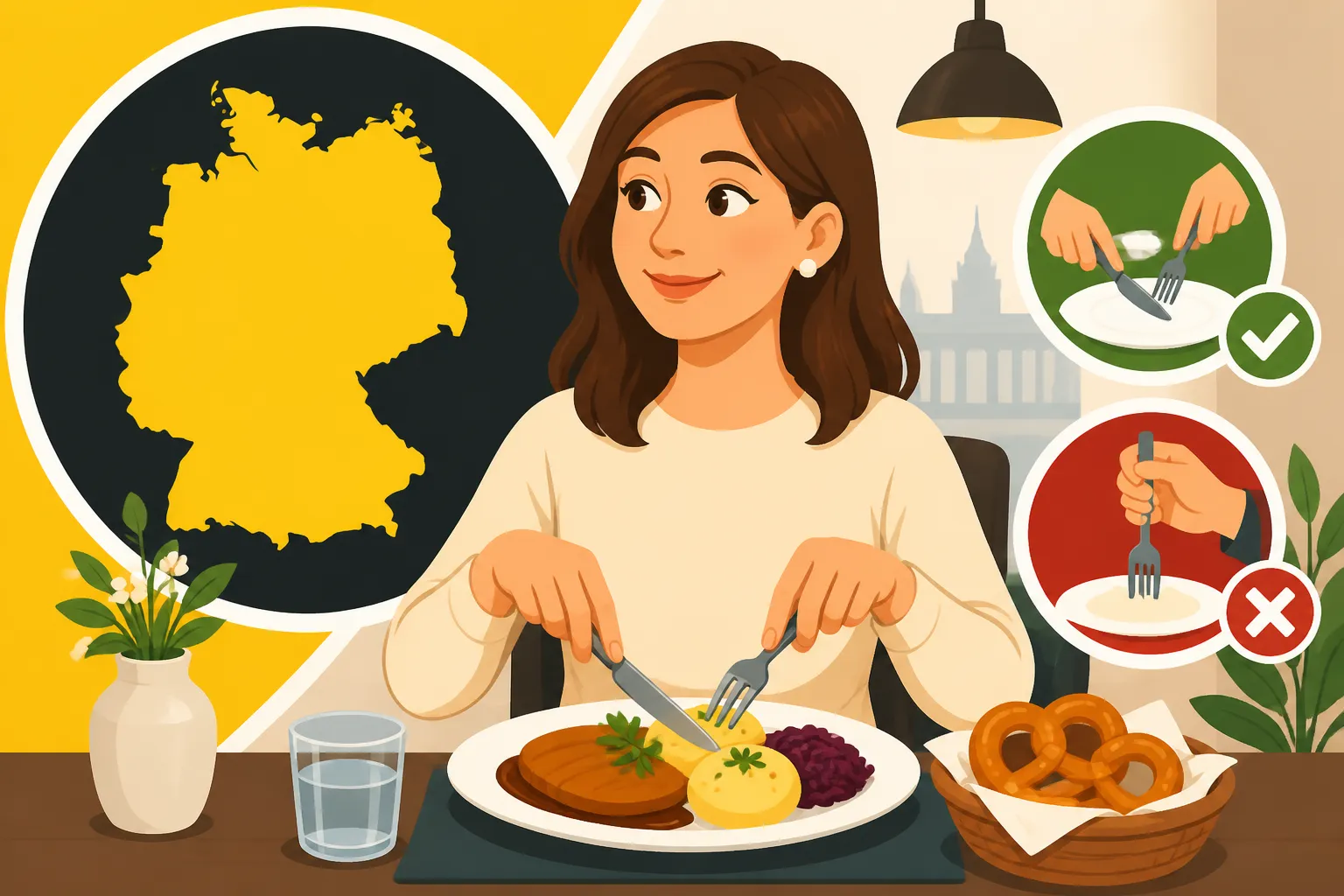
German table manners are generally continental, meaning you'll typically hold your fork in your left hand and your knife in your right throughout the meal. Cutting your food into bite-sized pieces and then bringing the fork directly to your mouth is the norm. It's considered good etiquette to keep your hands (but not your elbows!) above the table, resting your wrists on the edge.
It's also generally considered polite to finish everything on your plate. Wasting food isn't looked upon favorably. If you're struggling to finish a large portion, you can sometimes ask for a "Doggy Bag" or "zum Mitnehmen" (to take away), though this is less common in more upscale establishments and more prevalent in casual eateries or Asian restaurants.
When you're finished with your course, place your knife and fork parallel to each other on the plate, with the handles pointing to the right (or at 4 o'clock, if you imagine the plate as a clock face). This signals to the staff that you're done and your plate can be cleared. Slurping, chewing with your mouth open, or making loud eating noises are definitely frowned upon.
Toasts and Conversation
If you're dining with friends or family, especially when drinks are served, a toast is a common ritual. The most common toast is "Prost!" for beer or "Zum Wohl!" for wine. When toasting, it's customary to make eye contact with everyone at the table and clink glasses. Don't immediately drink after clinking; take a moment for the eye contact. It's a small but significant gesture of camaraderie.
During the meal, conversation is usually kept at a moderate volume. While Germans can be expressive, loud chatter that might disturb other diners is generally avoided. Keep in mind that directness is a common communication style in Germany, and this extends to casual conversation. Don't interpret it as rudeness; it's often just a straightforward approach. If you're with a group, try to engage everyone in conversation rather than having exclusive side chats.
Speaking of drinks, Germany is, of course, famous for its beer culture. If you're interested in exploring the different types and how to enjoy them, our guide on German Beer Culture: Styles, Beer Gardens, and Breweries is an excellent resource. Ordering a "Weinschorle" (wine spritzer) or a "Spezi" (cola and orange soda mix) is also very typical, especially with younger crowds or during lunch. For after-dinner, many Germans enjoy a strong coffee or a schnapps, perhaps a Obstler (fruit brandy). You can dive into the rich world of German coffee culture with our article on German Coffee Culture: Cafés and Kaffee und Kuchen Culture.
The Bill Please: Payment and Tipping Culture
This is often where many visitors feel a bit of anxiety. The German system for requesting, paying, and tipping for the bill can differ quite a bit from other countries.
Getting and Paying the Bill (Die Rechnung)
Unlike in some cultures where the bill is brought to your table automatically after your meal, in Germany, you almost always have to explicitly ask for it. Waving your hand wildly or making eye contact from across the room might work in a pinch, but the most polite way is to simply say "Die Rechnung, bitte" (The bill, please) to your server. They will then bring the bill to your table.
Payment is typically handled directly with your server. In smaller, traditional establishments, it's still quite common for people to pay in cash. While card payments are becoming more widespread, especially in larger cities and modern restaurants, some smaller places might still only accept EC-Karte (German debit card) or cash, rather than international credit cards like Visa or Mastercard. It's always a good idea to carry some cash, just in case. Our article on Cash vs Card in Germany: What Visitors Should Know offers more insight into payment habits.
When paying, the server will often come to your table with a small wallet or a portable card terminal. You'll tell them the total amount you want to pay, including your tip.
Understanding German Tipping (Trinkgeld)
Tipping in Germany is different from the generous gratuities often expected in North America. Here, service charges are already included in the price of your meal by law. So, tipping is a way to show appreciation for good service, rather than compensating for a low base wage.
The general rule of thumb for tipping (Trinkgeld) is to round up the bill or add 5-10% for good service. If your bill is €28.50, you might say "30 Euro, bitte" (30 Euros, please) to the server. If it's €45, you might say "50 Euro, bitte." For exceptional service, especially in an upscale restaurant, you might go up to 10-15%, but this is less common for everyday dining. You rarely leave the tip on the table after you've left; instead, you tell the server the total amount you wish to pay, and they will give you back the correct change. This direct interaction is key. Our in-depth guide, Tipping in Germany: When, Where, and How Much, provides all the nuances you'll ever need.
Splitting the Bill (Getrennt Zahlen)
One of the most expat-friendly aspects of German dining culture is how readily restaurants accommodate splitting the bill. If you're dining with friends, it's perfectly normal to ask the server to split the bill individually. Simply say "Wir möchten getrennt zahlen, bitte" (We would like to pay separately, please). The server will then come to each person and ask what they had, calculating their individual share. This avoids the awkward math and fumbling with change at the end of the meal.
However, a word of caution: if you're a very large group (say, 8+ people), splitting individually might take a bit more time and patience from the server. In such cases, it might be more courteous to nominate one or two people to pay the main bill and then sort out the finances amongst yourselves afterwards, perhaps via a mobile payment app. But for smaller groups, don't hesitate to ask for "getrennt zahlen."
Beyond the Restaurant: Other Dining Scenarios
Dining etiquette isn't just about formal restaurants; it extends to casual spots and even private homes.
Eating at a German Home
If you're lucky enough to be invited to a German home for a meal, consider it a wonderful opportunity to experience authentic German hospitality. Punctuality is paramount here – arriving on time is expected, not just fashionably late. A small gift for the host, such as a bottle of wine, a bouquet of flowers (unwrapped, please, and avoid red roses unless it's for a romantic partner), or some high-quality chocolates, is always appreciated.
At the table, wait for the host to indicate where you should sit and when to start eating. Don't begin until the host says "Guten Appetit!" or takes their first bite. Table manners are generally similar to restaurant etiquette: keep your hands above the table, use cutlery correctly, and avoid loud chewing. Offer to help clear the table or wash dishes afterwards; even if the host declines (which they often will, politely), the gesture is noticed and appreciated. It's a wonderful way to foster deeper connections beyond what you might experience on a GetYourGuide food tour.
Beer Gardens and Casual Dining
Beer gardens (Biergärten) are a quintessential German experience, especially in Bavaria. The atmosphere is much more relaxed than in a formal restaurant. Here, it's often self-service for food and drinks. You queue up, order your food and beer at separate counters, pay immediately, and then carry your selections back to your chosen table. Shared tables are the norm, and it's perfectly acceptable to sit down at a table that already has other people. A polite "Entschuldigung, ist hier noch frei?" (Excuse me, is this seat free?) is all you need to ask.
In beer gardens, you might even see people bringing their own food (but never their own drinks, that's a big no-no!). This tradition dates back centuries. However, it's usually only cold snacks like sandwiches or salads, not elaborate picnics. It’s also common to clear your own table when leaving, placing empty glasses and plates in designated areas or stacking them neatly for staff. The vibe is friendly and communal, so relax and enjoy the lively atmosphere.
Casual eateries, like snack stands (Imbiss) offering Currywurst or Döner, also have their own rhythm. You typically order at the counter, pay, and then either eat standing up or take your food to a casual seating area. Speed and efficiency are often key here, so have your order ready and your payment method handy.
Special Dietary Needs and Requests
Germany has come a long way in accommodating various dietary needs. As mentioned, vegetarian and vegan options are increasingly common. For allergies, stating "Ich habe eine Allergie gegen [Ingredient]" (I have an allergy to [Ingredient]) is usually understood, and staff will often be helpful in guiding you. However, it's always best to be clear and concise, as some smaller establishments may not have as much experience with severe allergies.
For things like gluten-free (glutenfrei) or lactose-free (laktosefrei), you'll often find these indicated on menus, especially in health-conscious cafes or larger supermarket chains. Don't expect every little bakery to have a wide array of gluten-free pastries, but major supermarkets will stock suitable products. If you are staying at a Booking.com hotel with breakfast included, you can often inform them beforehand about your dietary needs.
Navigating Common Misunderstandings and Cultural Nuances
Understanding these broader cultural points will make your dining experiences in Germany even smoother.
Punctuality is Key
We touched on this earlier, but it truly bears repeating: Germans value punctuality. This isn't just about showing up on time for your reservation; it's also about the pace of service. Don't expect a quick, rushed meal, especially at dinner. Dining is often seen as a social event to be savored. Your server won't hover or rush you through courses. They'll give you space and privacy. If you need something, you'll need to catch their eye. Don't interpret this as inattentiveness; it's often a sign of respect for your dining experience. If you are in a hurry, it is perfectly acceptable to mention it when ordering "Ich habe es eilig" (I am in a hurry), but be prepared that some places might not be able to accommodate a super-fast turnaround.
Directness and Service Style
German service can often be perceived as direct, efficient, and sometimes, well, a little less effusive than you might be used to in other countries. Servers are there to do their job, take your order accurately, and deliver your food efficiently. They aren't typically trained to engage in lengthy pleasantries or over-the-top friendliness. This doesn't mean they're being rude; it's simply a different cultural approach to customer service. Don't take it personally if your server isn't overly chatty or doesn't smile constantly. It's about efficiency and competence, not a lack of warmth. If you have a problem, Germans appreciate direct, clear communication. Don't beat around the bush; state your issue politely but clearly.
Sunday Closures and Planning Ahead
This is a big one for anyone new to Germany: Sundays are generally considered a day of rest, and most shops, including supermarkets, are closed. While restaurants are typically open on Sundays, especially for lunch and dinner, it's wise to plan your grocery shopping accordingly if you're self-catering. This also ties into the concept of Quiet Hours and Sundays in Germany (Ruhezeit), where noise levels are expected to be kept low.
Always check opening hours ("Öffnungszeiten") for any restaurant you plan to visit, especially around public holidays. It's not uncommon for places to have slightly different schedules or be completely closed on certain holidays. A little planning can save you from a rumbling stomach!
Remember, these are general guidelines, and like any culture, there's always regional variation and individual differences. The most important thing is to be polite, observant, and open to new experiences. Enjoy the incredible food and drink Germany has to offer, from a hearty Schnitzel to a refreshing Apfelschorle!
Key German Dining Etiquette Summary
| Aspect | German Etiquette | Common Misunderstandings / Tips for Visitors |
|---|---|---|
| Reservations | Often necessary, especially for dinner/weekends. Phone or online booking. | Don't assume walk-ins are always possible. Call ahead ("Ich möchte einen Tisch reservieren"). |
| Arrival | Wait to be seated at the entrance. | Don't just pick a table. Wait for staff to greet you. |
| Punctuality | Aim to be on time for reservations. | Germans value punctuality; being significantly late without notice is frowned upon. |
| Table Manners | Hands above table (wrists on edge), use fork left/knife right, finish your plate. | Avoid elbows on the table, loud eating noises. Clearing your plate is polite. |
| Ordering | Ask for English menu if needed. Order individually. | Don't be shy about asking questions about ingredients. |
| Toast (Prost!) | Make eye contact with everyone when clinking glasses. | Eye contact is crucial. Don't drink until everyone has clinked and made eye contact. |
| Service Pace | Typically slower, relaxed. Server won't rush you. | Don't expect constant hovering. You'll need to catch their eye if you need something. |
| Getting the Bill | Always ask for it ("Die Rechnung, bitte"). | It won't be brought automatically. |
| Payment | Often directly with the server. Have cash ready, especially in smaller places. | Card acceptance varies; always carry some cash. Mention tip when paying. |
| Tipping | Round up or add 5-10% for good service, tell server the total amount when paying. | Not expected to be 15-20%. Don't leave cash on the table; tell the server the total you're paying including the tip. |
| Splitting Bill | Very common and easily accommodated ("Wir möchten getrennt zahlen, bitte"). | Perfectly normal for individual guests to pay only for what they ordered. |
| Home Invitations | Be punctual, bring a small gift, offer to help (even if declined). | Punctuality is even more critical here. |
| Beer Gardens | Self-service for food/drink. Can share tables. No outside drinks. | Bringing your own cold food is often allowed (check first!), but never your own drinks. |
| Directness | Service is efficient, direct, not overly effusive. | Don't interpret a lack of small talk as rudeness; it's just a different cultural norm for service. |
Disclaimer
Please note that while this guide offers comprehensive advice based on common experiences, cultural norms can evolve, and individual establishments or regions may have their own specific quirks. Always observe local behavior, remain polite, and when in doubt, a friendly "Entschuldigung" (excuse me) goes a long way. This information is for general guidance and not legal advice.