Understanding Cost of Living Index: How Does Germany Compare Globally?
Checking the online cost of living index before moving and realizing it completely ignores the massive German income tax bite is a brutal expat rite of passage. I thought my new Berlin salary would make me rich until my first payslip actually arrived. This guide decodes the reality behind global cost indexes and how to manage your localized expenses.
Disclosure: This post may contain affiliate links. We may earn a commission at no extra cost to you if you make a purchase through these links. Read full disclosure.
The Illusion of the Global Cost of Living Index
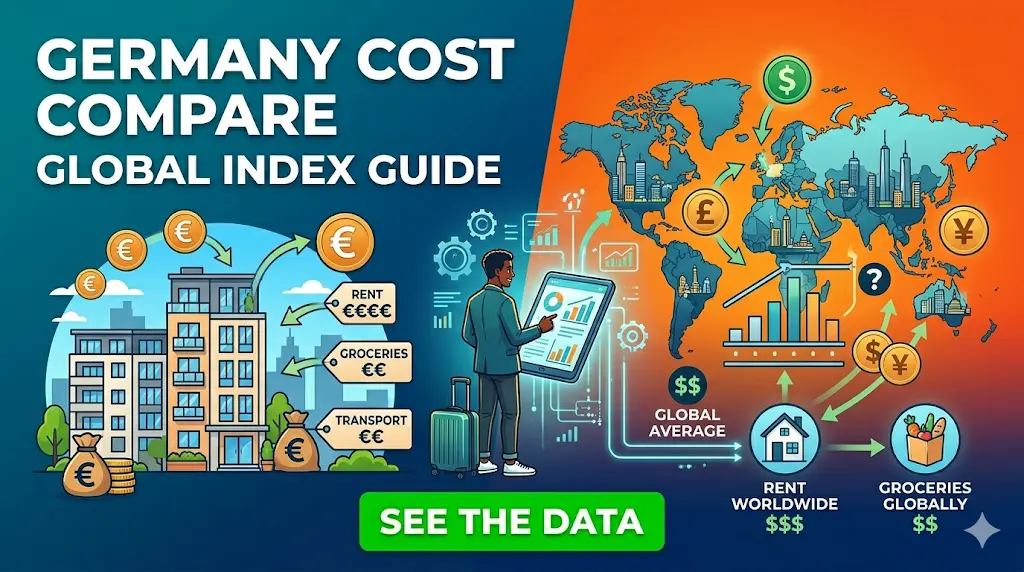
When you start researching your relocation, you will inevitably look at databases that assign numerical values to global cities, usually benchmarking them against New York City at 100. If Berlin sits at 65, your immediate assumption is that your life will be 35 percent cheaper. The fatal flaw of these indexes is that they purely measure consumer purchasing power based on gross salaries, completely ignoring the localized tax burden.
Gross vs Net Income Shock
In Germany, the social security deductions—which cover statutory health insurance, nursing care, unemployment, and your mandatory pension—will immediately consume roughly 20 percent of your paycheck. On top of that, progressive income taxes will take another massive chunk. It is entirely normal for a highly skilled expat to lose 40 to 45 percent of their gross salary before the money ever hits their bank account.
An online index telling you that a cappuccino costs three euros feels completely irrelevant when your disposable net income has been effectively cut in half by the state. Coming to terms with this mathematical reality is an essential step, a process decoded in Understanding Your Tax Assessment Steuerbescheid: After You File in Germany.
The actual metric you must care about is local purchasing power parity. If an American tech worker moves from Austin to Munich, the rent might actually look cheaper on a numerical index. However, because German salaries are historically lower than US salaries, and the tax burden is drastically higher, the percentage of their net income required to pay that Munich rent is substantially higher. The cost of living index gave them a false sense of security.
Hidden Bureaucratic and Setup Costs
Furthermore, aggregate global indexes fail to capture the massive, localized liquidity traps that expats face upon arrival. An index calculates the average cost of monthly rent, but it does not tell you that German landlords legally require a cash security deposit (Kaution) equal to three months of “cold” rent before you can move in.
If you rent an apartment for 1,500 euros a month, you must hand over 4,500 euros in pure cash on day one. Global indexes also fail to account for the fact that German apartments are frequently rented entirely bare—meaning no kitchen cabinets, no appliances, and no light fixtures. You have to buy and install the kitchen yourself. These hidden, upfront capitalization costs completely skew the monthly averages presented on standard financial comparison sites. If you do not have the liquidity prepared, these hurdles will bankrupt your first month, a scenario explored deeply in Cost of Living in Germany: Breakdown of Expenses Rent Food Transport.
You must also budget for bizarre local mandates, such as the Rundfunkbeitrag (the mandatory broadcasting fee) that costs 18.36 euros per month regardless of whether you own a television. Setting up your life requires navigating these invisible costs efficiently. If you do not understand the local credit algorithms judging your ability to pay these bills, you will struggle. Reviewing German Bureaucracy 101: Understanding the Anmeldung, Schufa, and Tax ID is mandatory to ensure you are not penalized by the system before you even begin.
How Germany Actually Compares to the US and UK
To truly understand the German cost of living, you must compare it to the major Anglo-Saxon economies where many expats originate or previously worked.
Housing Utilities and the Energy Crisis
In terms of raw housing costs, Germany generally outperforms the United States and the United Kingdom. Renting a standard apartment in Berlin or Frankfurt is mathematically cheaper than renting a comparable unit in London, New York, or San Francisco. Furthermore, Germany possesses incredibly strong tenant protection laws, heavily restricting how much landlords can raise your rent year over year.
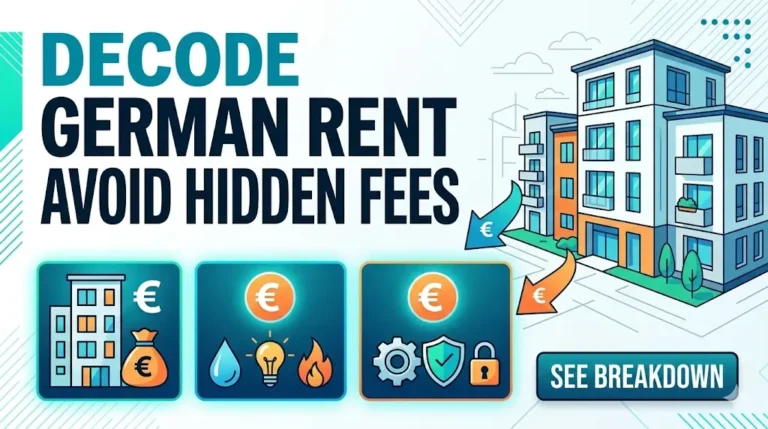
However, the major equalizer is energy. Germany has historically possessed some of the highest electricity prices in the developed world. When you look at an apartment listing, you will see the Kaltmiete (cold rent) and the Warmmiete (warm rent, which includes an advance payment for heating and basic building utilities).
Expats frequently budget based on the cold rent and are utterly destroyed by the annual utility reconciliation bill (Nebenkostenabrechnung) at the end of the year. If you run your heater constantly because you are used to warm American or British homes, your German utility provider will hit you with a massive back-payment demand. Knowing how to set aside a monthly buffer for these inevitable utility shocks is an administrative hurdle you must master, a reality covered in How to Pay Rent and Bills in Germany: Banking Tips for Expats.
Groceries Healthcare and Transport
Where Germany truly shines on the global cost of living index is at the supermarket. Germany essentially invented the hard-discount retail model. Because massive corporate chains like Aldi, Lidl, and Netto fiercely compete for market share, the cost of basic, high-quality food is phenomenally low compared to the UK and the US. If you adapt to cooking at home and shopping at these discount chains, your monthly food budget will plummet.
Healthcare is a highly debated cost metric. In the US, health insurance is often heavily subsidized by the employer but features high out-of-pocket deductibles. In the UK, it is effectively free at the point of service via the NHS. In Germany, it is a strict percentage of your gross income. If you are a high earner, you will pay the maximum statutory amount. While this feels incredibly expensive initially, there are virtually zero deductibles. If you break your leg or need surgery, you pay absolutely nothing at the hospital.
Public transport is another massive win for the German cost of living. The introduction of the federally subsidized Deutschlandticket allows you to travel on all local and regional transit networks across the entire country for a flat fee of roughly 50 euros per month. Compared to the staggering commuting costs of the London Underground or the mandatory car ownership required in the US, this represents thousands of euros in annual savings.
| Expense Category | Germany | United States | United Kingdom |
| Rent (Major Cities) | High, but highly regulated | Extremely High | Extremely High |
| Groceries | Very Low (Discount culture) | High | Moderate |
| Electricity & Heating | Extremely High | Moderate | High |
| Public Transport | Very Low (Subsidized) | High (Car-dependent) | Very High (Train fares) |
| Healthcare | High (Income % based) | Extremely High | Low (NHS funded via taxes) |
Financial Strategies to Beat the Local Cost of Living
Knowing the actual cost of living is only half the battle; the other half is structurally defending your money from unnecessary localized fees. Traditional German banks are notorious for charging monthly maintenance fees simply for the privilege of keeping an account open.
Optimizing Your Banking and Exchange Rates
Veteran expats aggressively trim these invisible costs by utilizing modern, mobile-first banking. Opening an account with N26 gives you a fully functional German IBAN without the archaic monthly fees of a legacy bank. Because the platform provides real-time push notifications, you can track exactly how much you are spending on groceries versus utility direct debits. By using the sub-accounts feature within your N26 app, you can instantly partition your monthly net salary—locking your rent money safely away from your disposable income, ensuring you never accidentally spend your utility buffer. Integrating these digital tools into your daily survival strategy is deeply explored in Mobile Banking Apps in Germany: N26, Revolut, and More.
Furthermore, if you are arriving in Germany and need to transfer bulk savings from your home country to pay that massive three-month apartment deposit, using a traditional bank wire will ruin your budget. Traditional banks apply terrible exchange rate markups. By utilizing Wise, you bypass the SWIFT network entirely. You simply initiate the transfer through Wise, which converts your dollars or pounds at the exact mid-market exchange rate for a tiny, transparent fee. You can then safely route those fully intact euros into your localized daily account. Understanding these essential capital flows prevents early financial bleeding, a concept mapped out in Moving Money to Germany: Declaring Savings and Large Transfers.
Protecting Your Wealth from Inflation
Once your budget stabilizes and you master the local discount supermarkets, you will likely generate surplus cash at the end of the month. If you leave this surplus sitting in a German savings account, it will silently lose value to European inflation.
Traditional German brokerages charge high execution fees and trap your assets in rigid domestic frameworks. If your career later moves you from Berlin to Singapore, German banks will force you to liquidate your portfolio, triggering massive capital gains taxes. To prevent this, smart expats decouple their wealth building from their geographic location.
Opening a globally compliant account with Interactive Brokers allows you to funnel your excess euros into a diversified ETF portfolio with phenomenally low fees. Because Interactive Brokers provides multi-currency support, you can invest in US or global equities without constantly paying heavy banking spreads. More importantly, if you leave Germany, your portfolio travels with you, avoiding forced liquidation. By keeping your core portfolio in Interactive Brokers, you build wealth that actually outpaces the localized cost of living index. Managing this global wealth while ensuring you remain fully compliant with the local tax authority is a sophisticated balancing act decoded in Taxing Worldwide Income: How Germany Taxes Foreign Income and Assets. To ensure your financial ledger stays perfectly legible while orchestrating all these platforms, rely on the strict accounting principles found in Understanding German Bank Statements: Fees and Transactions Explained.
Finally, remember that the true cost of living in Germany requires balancing digital integration with analog realities. Despite your perfectly optimized banking setup, you must always carry a few physical coins to navigate the independent merchants who stubbornly refuse terminals—a cultural quirk examined in Using Cash vs Card in Germany: Is Germany Going Cashless?.
References
Primary sources (official)
- Destatis (Federal Statistical Office) – European Comparison Programme: The official German government data providing exact price level indices for consumer goods and household expenditures compared across the European Union. https://www.destatis.de/EN/Themes/Economy/Prices/International-Comparison/Tables/pricelevel-consumption-private-households.html
- OECD – Price Level Indices: The definitive international baseline for comparing purchasing power parities to market exchange rates, showing the true relative cost of living across global economies. https://www.oecd.org/en/data/indicators/price-level-indices.html
Other helpful sources
- Numbeo – Cost of Living in Germany: The world’s largest crowdsourced database of living costs, useful for calculating raw aggregate prices for specific items like milk, internet, and transport in specific German cities. https://www.numbeo.com/cost-of-living/country_result.jsp?country=Germany
- Expatistan – Cost of Living Comparison: A highly practical tool that allows expats to directly compare the cost of living between their current home city and their specific target city in Germany. https://www.expatistan.com/cost-of-living/country/germany
Disclaimer
The information provided in this article is for general informational and educational purposes only and does not constitute professional financial or tax advice. Global cost of living indices frequently fluctuate based on macroeconomic factors, inflation rates, and geopolitical shifts in energy markets. The German tax burden, statutory social security contributions, and utility costs (Nebenkosten) vary drastically based on your individual tax class (Steuerklasse), federal state, and specific household usage. While utilizing modern financial platforms like Wise, N26, and Interactive Brokers can significantly optimize your currency conversion, daily budget partitioning, and global wealth generation, you are solely responsible for verifying exact localized costs and ensuring your salary can comfortably support your standard of living before relocating to Germany.