Health Coverage for Job Seekers and Chancenkarte Holders in Germany
Finding the right health insurance while staring down a mountain of German visa paperwork is a specific kind of stress that can keep you awake until the early hours of the morning. I remember sitting in a dimly lit Berlin cafe, clutching my passport and wondering why "comprehensive coverage" had such a vague definition at the immigration office. This guide is designed to cut through that fog and show you exactly how to secure health coverage as a job seeker or a Chancenkarte holder.
Disclosure: This post may contain affiliate links. We may earn a commission at no extra cost to you if you make a purchase through these links. Read full disclosure.
The Legal Mandate for Health Insurance in Germany
Germany is a country that loves its rules, and the most important one for any newcomer is that health insurance is not optional. It is a legal requirement from the very first day you arrive. If you are entering on a Job Seeker visa or the newly introduced Opportunity Card, the authorities will not even look at your application without proof of a policy that meets very specific criteria. This isn't just about having a safety net; it's about satisfying the Ausländerbehörde that you won't become a burden on the state should you fall ill.
Why Your Home Country Policy Likely Won't Work
Many expats arrive thinking their premium international policy from back home will suffice. In my experience, and the experience of countless others I've mentored, the German authorities are incredibly picky. A standard travel insurance policy usually lacks the "long-term care" component (known as Pflegeversicherung) that German law requires for residence permits. While these might work for a short vacation, they often fail the "comprehensive" test required for someone looking to live and work here for six months or a year.
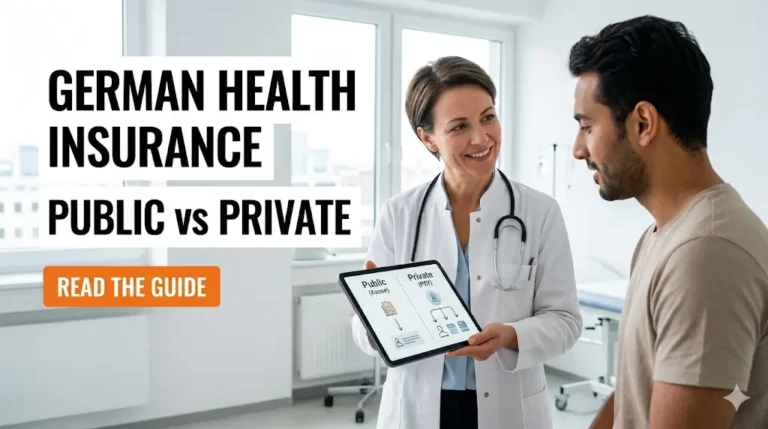
To get a better grip on these distinctions, you should look into Health Insurance in Germany: Understanding Public vs Private Coverage. You'll find that the system is split into two distinct tracks, and as a job seeker, you are often standing in a grey area between them. Most standard international plans lack the specific German legal language needed to satisfy a visa officer's checklist, which can lead to an immediate and frustrating rejection at your appointment.
The Consequences of a Gap in Coverage
If you let your insurance lapse or arrive without a policy that is recognized by German law, you aren't just risking a fine. You are risking your legal right to stay. When you eventually find a job and try to register for a permanent Krankenkasse, they may ask for proof of your previous insurance. If there is a gap, you might be forced to pay "back-payments" for the months you weren't covered, even if you never saw a doctor. This can result in a bill for thousands of euros that hits you just as you’re starting your new life.
Understanding How to Get Health Insurance in Germany: Step-by-Step for Newcomers is vital because it outlines the timeline you need to follow. Don't wait until you've landed in Frankfurt or Munich to start this process. You need your insurance certificate in hand before you even apply for your entry visa in your home country.
Public vs. Private Insurance for the Unemployed Expat
This is where the confusion usually hits its peak. Germany has a dual system: public (gesetzliche Krankenkasse) and private (private Krankenversicherung). For most people arriving as job seekers, the choice isn't really a choice at all—it's dictated by your previous status and your current age.
Can You Join the Public System as a Job Seeker
Generally speaking, if you have never worked in Germany before and you are coming from outside the EU, you cannot simply walk into a public provider like TK or AOK and sign up as a job seeker. The public system is primarily for employees, students, or those who have "earned" their way in through previous contributions. This is a hard pill to swallow for many who prefer the stability of public health care.
However, there are exceptions. If you were previously insured in a public system in another EU country, you might be able to transfer that status. But for the vast majority of Job Seeker visa holders coming from the US, India, or the UK, the public system is initially closed to you. You will need to look at private "incoming" or "expat" insurance as a bridge until you land that first contract.
When Private Insurance is Your Best Bet
For job seekers, specialized private plans are often the most realistic and affordable path. These are designed specifically to meet the requirements of the Ausländerbehörde. Providers like Feather Insurance offer plans that are tailor-made for expats, ensuring that all the necessary legal checkboxes—like outpatient care, hospital stays, and that pesky nursing care insurance—are included.
The benefit of these plans is that they are often much cheaper for a healthy young professional than a full-scale private policy or the voluntary public contributions. They are designed to be temporary. Once you sign a work contract with a salary above the "mini-job" threshold, you will typically transition into the public system anyway. If you want to know more about the long-term implications, check out Private Health Insurance in Germany: Benefits, Costs, and Eligibility.
The Role of Long-term Care Insurance
I cannot emphasize this enough: make sure your policy includes Pflegeversicherung. This is the long-term care insurance that covers you if you become chronically ill or disabled. In Germany, this is a mandatory add-on to any health insurance policy. Many "digital nomad" or "travel" insurances skip this to keep the price low. If your insurance certificate doesn't explicitly mention this, the visa officer might hand your documents back and tell you to come back when you're "properly" insured. This is one of the most common reasons for visa delays that I see in the expat community.
For a deeper dive into why this specific component is so crucial, you can read about Long-term Care Insurance (Pflegeversicherung): What It Is and Who Needs It. It might seem like an unnecessary expense when you're young and healthy, but it's a non-negotiable part of the German social security net.
Insurance for the Chancenkarte (Opportunity Card)
The Chancenkarte is the "new kid on the block" in German immigration law, and it has changed the game for many job seekers. It allows you to come to Germany for a year to look for work based on a points system. Because it is a relatively new visa category, there has been a lot of chatter about what kind of insurance is actually required for it.
The One-Year Requirement
Unlike the old 6-month job seeker visa, the Chancenkarte can be granted for up to a year. This means your insurance needs to cover that entire duration. The immigration office will look at the end date of your policy. If your insurance only lasts for 90 days, they might only grant you a 90-day residence permit, forcing you to go through the renewal process (and pay the fees again) much sooner than you’d like.
When applying for this specific permit, you should familiarize yourself with the Opportunity Card (Chancenkarte): Germany’s Points-Based Job-Seeker Visa Explained. This visa allows for "trial work" of up to 20 hours a week. This is a unique feature, but it also creates a unique insurance situation. If you start a trial job, you might suddenly become eligible for public insurance, but if you don't, you must remain on your private expat plan.
Dealing with the 20-Hour Work Limit
The Chancenkarte's allowance for part-time work is a lifesaver for your budget, but it can be a headache for your insurance provider. Some "incoming" insurances are strictly for people who are not working. If you take up a part-time gig to support yourself, you must inform your insurer. Failure to do so could void your coverage.
Brands like SafetyWing offer a level of flexibility that many traditional German insurers don't, but you have to be careful. While SafetyWing is excellent for the initial entry and the "nomad" phase, you need to ensure it meets the specific German requirements if you plan to convert that entry visa into a long-term residence permit at the local town hall.
Bridging the Gap to Permanent Residency
The ultimate goal for most Chancenkarte holders is to find a full-time position that leads to a Permanent Residence Permit (Niederlassungserlaubnis): How to Qualify in Germany. During this transition year, your health insurance is the thread that keeps your legal status together. If you find a job halfway through the year, you will move from your private expat plan to a standard public or private employee plan.
Comparing Your Insurance Options
When you are looking for coverage, you will likely encounter a few names repeatedly in the expat forums. It’s important to understand what each offers so you can choose the one that fits your specific visa situation and health needs.
| Insurance Type | Best For | Visa Compliance | Pros | Cons |
|---|---|---|---|---|
| Expat "Incoming" (e.g., Feather) | Job Seekers, Chancenkarte | High | Affordable, English support, visa-guaranteed | Temporary (up to 2-5 years only) |
| Digital Private (e.g., ottonova) | High-earners, freelancers | Very High | Fully digital, fast reimbursements, great app | Harder to qualify for as a pure job seeker |
| Nomad Insurance (e.g., SafetyWing) | Initial entry, short-term | Moderate | Very cheap, flexible, global coverage | Often lacks Pflegeversicherung; risky for residency |
| Public (Gesetzliche) | Employees, those with EU history | Absolute | Scaleable, family coverage included | Not available to most non-EU job seekers |
Feather Insurance: The Expat Favorite
Feather has built a reputation on being the "bridge" for newcomers. Their signup process is entirely in English, and they specifically offer a "Visa Health Insurance" plan. I've seen many people use this for their initial appointment at the Ausländerbehörde with zero issues. They understand the specific requirements for German visas, which takes the guesswork out of the process. If you're stressed about the paperwork, having a provider that guarantees their policy will be accepted is worth its weight in gold.
ottonova: For the Tech-Savvy
If you are a professional in a high-demand field and you expect to land a high-paying job quickly, ottonova is worth a look. They are a private insurer, but they operate like a tech company. Everything is handled via an app, including a digital doctor’s visit feature that can be a lifesaver when you’re still trying to figure out Navigating Medical Care in Germany: Doctors, Hospitals, and Pharmacies. However, be aware that full private insurance like this usually requires a certain income level or a history of being in the private system.
SafetyWing: The Flexible Option
SafetyWing is often the go-to for people who are "testing the waters." If you are entering Germany on a 90-day Schengen visa-free stay to look for a flat before applying for your Chancenkarte, SafetyWing is a great, low-cost way to stay covered. Just remember that once you go to the immigration office to get your actual residence permit sticker, you will likely need to upgrade to a more "German-compliant" policy that includes the required social contributions.
For more on the short-term side of things, check out Travel Health Insurance: What Expats Need for Schengen Visa & Short Trips. It’s a good starting point, but remember that a job seeker visa is a "National Visa" (D-Visa), which has higher standards than a standard tourist visa.
Costs and Budgeting for Your Coverage
Let’s talk money. Germany is not the cheapest place to live, and your health insurance will likely be one of your biggest monthly expenses after rent. For a job seeker or Chancenkarte holder, you can expect to pay anywhere from €70 to €150 per month for a basic, visa-compliant expat plan.
Premiums vs. Deductibles
In the US or other countries, you might be used to low premiums and high deductibles (the amount you pay out of pocket before insurance kicks in). In Germany, expat plans often have a very low deductible—sometimes €0—but the monthly premium is fixed. This is actually a blessing when you’re on a budget because it makes your monthly outgoings predictable. You won't get hit with a €2,000 bill just because you had to visit the emergency room after a cycling accident.
Hidden Costs to Watch Out For
While your basic plan will cover emergencies and GP visits, it might not cover everything. Dental care, for instance, is often limited in basic expat plans. If you think you’ll need a cleaning or a filling while you’re job hunting, you might want to look into Dental Insurance in Germany: Do You Need Extra Coverage for Teeth?.
Another thing to consider is medication. In Germany, you can't just buy everything over the counter at a supermarket. You have to go to an Apotheke. Even with insurance, you usually have to pay a small co-pay (usually €5 to €10) for prescription meds. I’ve broken this down more in the guide to Pharmacies in Germany (Apotheke): How to Get Medication and Advice. These small costs can add up if you have a chronic condition, so budget an extra €20-€30 a month just in case.
Price Increases Over Time
Many expat "incoming" plans have a price structure that increases as you get older. If you are over 35 or 40, you might find that the premiums jump significantly. This is because the German system assumes that older individuals will utilize the healthcare system more frequently. If you are a more mature job seeker, it is even more important to compare plans early to avoid a nasty surprise in your second or third month here.
Transitioning After You Find a Job
The moment you sign that work contract is a cause for celebration, but it also triggers a mandatory change in your insurance status. In Germany, if you earn over €538 a month (the current "mini-job" limit), you generally must be insured through the public system, unless you earn a very high salary (above the Versicherungspflichtgrenze) and choose to stay private.
The Move to Public Insurance
Once you are employed, your employer will pay half of your health insurance premiums, and the other half is deducted directly from your gross salary. This is a seamless process, but you have to choose a provider (a Krankenkasse). Most expats go with TK or Barmer because they have excellent English-language support.
You must inform your previous private or expat insurer as soon as you have your start date. They will usually cancel your old policy immediately so you don't end up paying for two plans at once. For a step-by-step on this, see Changing Health Insurance Providers: Can and Should You Switch?.
Staying Private as an Employee
If your salary is high enough (currently around €69,300 per year), you have the option to remain in private insurance. This can be tempting because the coverage is often "premium" and you might get appointments faster. However, it’s a long-term commitment. Once you go private as a high-earning employee, it can be very difficult to move back to the public system later in life.
Notifying the Authorities
Don't forget that your residence permit is often tied to your status. If you moved from a Chancenkarte to a Work Visa, the Ausländerbehörde will want to see your new insurance card. Keeping your paperwork in order during this transition is vital to ensure your path to residency remains smooth. I always tell my friends to keep a folder—physical or digital—with every insurance certificate they’ve ever had in Germany. You never know when a bureaucrat will ask for it.
Practical Tips for Your First Appointments
Getting the insurance is one thing; using it is another. The German medical system is excellent, but it can be intimidating if you don't speak the language fluently.
Finding an English-Speaking Doctor
Your insurance provider can often help you with this. Providers like ottonova and Feather have directories or concierge services. You can also use websites like Jameda or Doctolib to filter for "English" as a spoken language. It makes a world of difference when you can explain your symptoms without a translation app in your hand. For more tips, check out Finding English-Speaking Doctors: Resources and Tips for Expats.
What to Bring to the Doctor
When you go to your first appointment, you won't have a plastic insurance card yet if you're on a private expat plan. You will usually have a PDF "Insurance Certificate" (Versicherungsbescheinigung). Print this out! Even today, many German doctors’ offices prefer a piece of paper they can scan. You will also need your ID.
Understanding the Bill
If you are on an expat private plan, you will often have to pay the doctor upfront and then send the receipt to your insurance for reimbursement. This is different from the public system, where you just show your card and never see a bill. Make sure you have a small "emergency fund" in your bank account to cover these upfront costs while you wait for the insurance company to pay you back. If you’re confused by the lines on your invoice, Understanding German Medical Bills: Decoding Private Invoices and Co-Pays can help you decode the jargon.
Disclaimer
This guide is for informational purposes only and does not constitute legal or financial advice. Health insurance regulations in Germany are subject to change, and individual requirements may vary based on your specific visa type, age, and health history. Always verify the current requirements with the German Federal Foreign Office, your local Ausländerbehörde, or a qualified insurance professional before making a decision. Life in Germany is a marathon, not a sprint—getting your health insurance right at the start is the best way to ensure you have the stamina to reach the finish line.