Living in Munich vs Hamburg: A Practical Comparison
Deciding whether to plant your roots in the shadow of the Bavarian Alps or along the windy banks of the Elbe is a choice that defines your entire experience as a foreigner in Germany. I remember sitting in a small café in my home country, staring at two job offers—one in Munich and one in Hamburg—feeling like I was choosing between two entirely different countries rather than two cities. This guide provides a deep, boots-on-the-ground comparison to help you navigate the cultural, financial, and logistical realities of these two German powerhouses.
Disclosure: This post may contain affiliate links. We may earn a commission at no extra cost to you if you make a purchase through these links. Read full disclosure.
The Cultural Identity and Daily Vibe
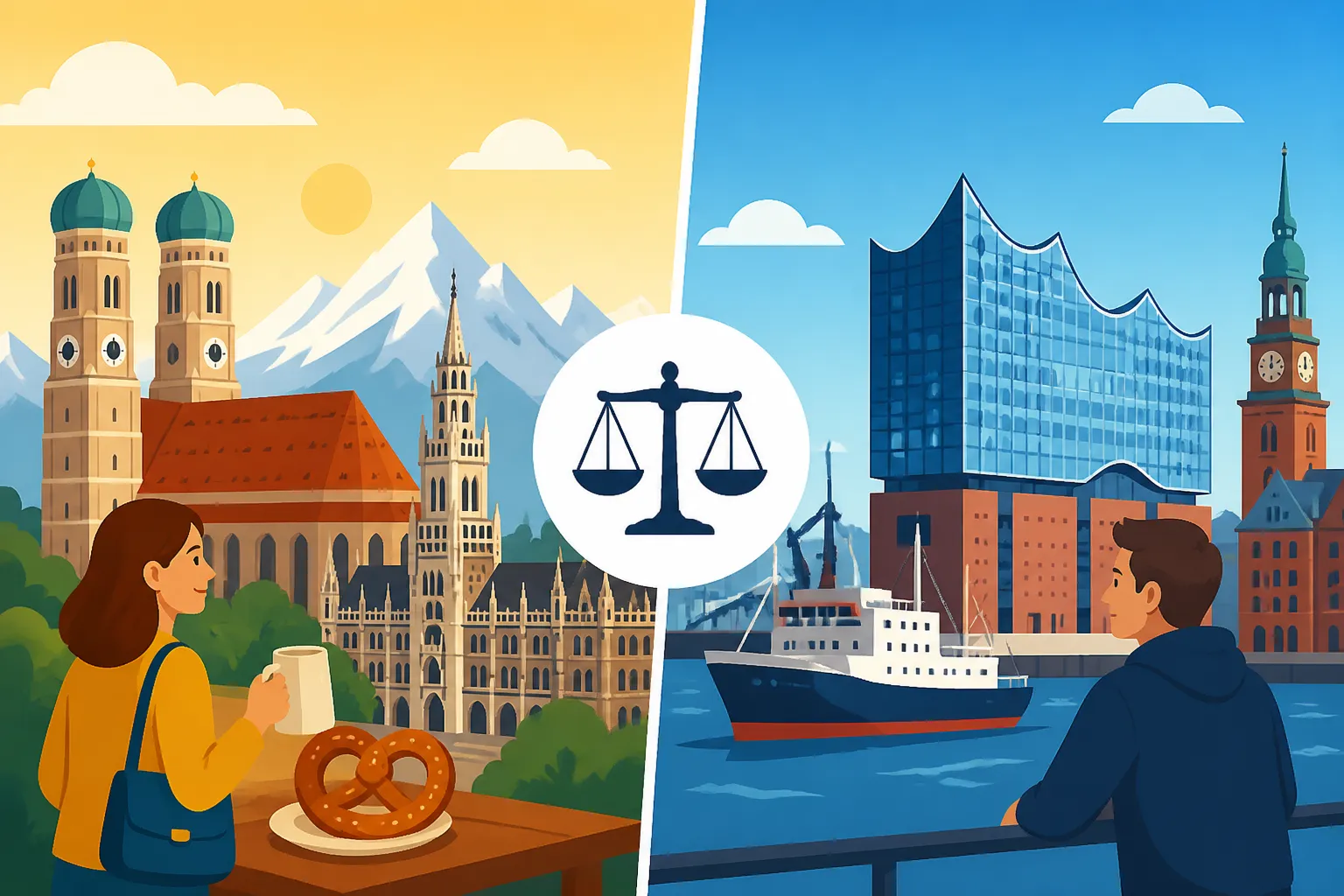
When you move to Munich, you are moving to the "Millionendorf," or the village of a million people. It feels like a city that has meticulously polished every cobblestone. There is an undeniable sense of order, wealth, and tradition that permeates everything from the pristine parks to the way people dress for work. People often joke that Munich is the northernmost city of Italy, and on a sunny day in the Leopoldstraße, you can actually feel it. The lifestyle is outdoorsy, conservative yet celebratory, and incredibly safe. You will see people in traditional Tracht—Lederhosen and Dirndls—not just during Oktoberfest, but at weddings, Sunday brunches, and local festivals. It is a city that takes its "Mia san Mia" (We are who we are) attitude seriously, which can feel both welcoming and slightly exclusionary if you don't fit the mold.
Hamburg, by contrast, is the "Gateway to the World." It is a city defined by its Hanseatic history, which translates into a culture of understated elegance, maritime grit, and a more liberal, seafaring soul. While Munich is bright and colorful, Hamburg is red-brick and grey-sky, but with a coolness that Munich often lacks. The locals, known as Hamburgers, are famously reserved—the "Nordic cool" is real. They won't become your best friend after one beer, but once you are in, you are in for life. The city feels more spacious because of the water; the Alster lake sits right in the center, and the massive Elbe river brings in giant container ships that remind you of the city's global connections every single day. If Munich is a glass of fine Weißbier in a sunny garden, Hamburg is a sharp gin and tonic in a dimly lit harbor bar.
Adjusting to these vibes takes time. I found that in Munich, my social life revolved around the seasons and the mountains, while in Hamburg, it was about the arts, the music scene, and the peculiar beauty of a rainy afternoon in a cozy café. Both cities offer a high quality of life, but they demand different versions of you. If you are someone who craves a "big city" feel with a bit of an edge, Hamburg wins. If you want a city that feels like a safe, luxury resort with immediate access to the best nature in Europe, Munich is your place. You can dive deeper into the specifics of the southern lifestyle in this Living in Munich: Expat Guide to the Bavarian Capital to see if the Bavarian way of life suits your personality.
The Housing Market Challenge
Let’s be honest: the housing market in both cities is a nightmare, but they are different flavors of "difficult." Munich is consistently the most expensive city in Germany. The competition for a flat is so fierce that people joke you need to provide a blood sample and your firstborn’s resume just to get a viewing. It is not uncommon for 50 people to show up for a single 15-minute viewing slot. Rents are high, and the "Kaltmiete" (cold rent) is only the beginning. You have to factor in the "Nebenkosten" (utilities and service charges), which have skyrocketed recently. For a newcomer, I always suggest looking at services like Wunderflats to find a furnished, mid-term apartment first. It takes the immediate pressure off having to find a permanent home in your first 30 days, which is nearly impossible in the Munich market.
Hamburg is also expensive, but it offers a bit more variety in terms of neighborhood "personalities." You have the posh, leafy areas like Eppendorf and Winterhude, the gritty and hip Sternschanze, and the family-friendly Ottensen. While still pricey, you might find that your Euro stretches just a tiny bit further in Hamburg than in Munich. However, the search process remains a full-time job. You will need your "Bewerbermappe" (application folder) ready with your Schufa record, your last three payslips, and a "Mietschuldenfreiheitsbescheinigung" (a document from your previous landlord stating you don't owe rent). If you are feeling overwhelmed by the terminology, check out our guide on Understanding German Rental Costs: Kaltmiete, Warmmiete, Nebenkosten to avoid being blindsided by hidden fees.
One thing that surprises many expats in both cities is the "empty kitchen" phenomenon. In many German rentals, the kitchen is considered furniture that the previous tenant takes with them. This means you might move into a beautiful flat in Hamburg-Altona only to find a room with pipes sticking out of the wall and no stove, sink, or cabinets. This is where Amazon Germany becomes your best friend for ordering everything from kitchen hardware to basic appliances that can be delivered quickly. Whether you are in the North or the South, the battle for housing requires patience and a very thick skin. Many people find it helpful to start their journey in a more flexible environment, and reading Living in Hamburg: A Guide to Germany’s Port City for Newcomers can give you a better idea of which districts in the North are currently "reachable" for expats.
Career Opportunities and Local Economy
Munich is a powerhouse of industry. It is the home of BMW, Siemens, Allianz, and a massive hub for the tech and aerospace industries. If you are an engineer or work in high-tech, Munich is like a gold mine. The salaries here are among the highest in Europe, which is lucky because you’ll need every cent for that rent we discussed. There is a very professional, "work hard, play hard" culture. Meetings start exactly on time, and there is a high expectation for formal qualifications. However, the "English-only" bubble is quite large in Munich due to the number of international corporations. You can often survive in the office with English, though your social life will suffer if you don't learn the local tongue.
Hamburg’s economy is more diverse but equally strong. It is one of the world's leading hubs for civil aviation (thanks to Airbus), a massive logistics center due to the port, and the media capital of Germany. If you are in marketing, journalism, or the creative arts, Hamburg feels much more like your natural habitat. The working culture in the North is often described as "straight-forward." There is less "Schischi" (fluff) than in the South. People say what they mean, and they value efficiency and honesty. While salaries might be slightly lower on average than in Munich, the cost of living—particularly housing—is often just enough lower to balance the scales.
For those moving without a job already lined up, or those looking to switch, the networking scene is vital. Munich’s networking often happens over a beer at a traditional Wirtshaus or at high-end industry events. In Hamburg, it’s more likely to be at a trendy co-working space or a maritime-themed gala. Regardless of the city, your first few weeks will involve a lot of logistics. I highly recommend getting an eSIM from Airalo as soon as you land. Having immediate data to navigate LinkedIn, Google Maps, and translation apps while you are between offices and interviews is a life-saver. You can also explore Finding an Apartment in Germany: Best Websites and Tips for Expats if you are moving specifically for a new role and need to find a place near your new office.
Cost of Living Breakdown
Budgeting for life in Germany requires a realistic look at your monthly outgoings. While both cities are in the top tier for costs, they hit your wallet in different ways. Munich is expensive across the board—groceries, dining out, and especially services. A simple lunch in the city center can easily set you back 15 to 20 Euros. However, the quality of everything, from public transport to public parks, is top-notch. You feel like you are getting what you pay for. In Hamburg, the costs are slightly more varied. You can find "cheap eats" in the vibrant immigrant neighborhoods or the student-heavy areas like the Grindelviertel more easily than you can in central Munich.
| Expense Category | Munich (Estimated) | Hamburg (Estimated) |
|---|---|---|
| 1-Bedroom Apartment (City Center) | €1,400 – €1,900 | €1,100 – €1,600 |
| Monthly Public Transport Pass | €49 (Deutschland-Ticket) | €49 (Deutschland-Ticket) |
| Meal for Two (Mid-range Restaurant) | €70 – €90 | €60 – €80 |
| Liter of Beer at a Restaurant | €5.50 – €6.50 | €5.00 – €6.00 |
| Monthly Utilities (85sqm flat) | €250 – €350 | €230 – €330 |
Public transport is a major factor in your budget. Both cities have incredible networks of U-Bahns (subway) and S-Bahns (suburban trains). Since the introduction of the 49-Euro "Deutschland-Ticket," the cost of commuting has been standardized, which is a huge win for expats. This ticket allows you to use all local and regional transport across the entire country. You can read more about how this works in our guide on Regional Trains and the Deutschland-Ticket Explained. Whether you are commuting from the outskirts of Munich or crossing the Elbe in Hamburg, the system is reliable, though everyone loves to complain about the "Deutsche Bahn" being late.
Shopping for essentials is another area where you'll notice small differences. While the big supermarket chains like Rewe, Edeka, Aldi, and Lidl have similar prices nationwide, the local markets are where the character shines. Munich’s Viktualienmarkt is a gourmet dream but can be very pricey. Hamburg’s Isemarkt, located under a railway bridge, is one of the longest open-air markets in Europe and offers a fantastic range of fresh fish and international produce. For more detailed budgeting advice, our Cost of Living in Germany: Budgeting Guide for Expats provides a broader look at how to manage your finances in the Eurozone.
Leisure, Nature, and the Great Outdoors
This is the category where the cities truly diverge. If you love the mountains, Munich is unbeatable. Within an hour by train, you can be at the Tegernsee or the Schliersee, or even at the foot of the Zugspitze, Germany’s highest peak. The weekends in Munich are about hiking in the summer and skiing in the winter. The city itself is incredibly green, with the Englischer Garten being larger than New York’s Central Park. The culture of the "Biergarten" is the soul of Munich’s leisure time. There is nothing quite like sitting under a chestnut tree with a Maß of beer and a Brezn (pretzel) that you bought from a local stand.
Hamburg’s beauty is more horizontal. It’s about the water. Sailing on the Alster, rowing through the canals of Winterhude, or taking a ferry down to the "Elbstrand" (the river beach) to watch the sunset over the harbor cranes. The air in Hamburg feels fresher, often carrying the scent of salt and rain. While Munich has the Alps, Hamburg has the North Sea and the Baltic Sea within a two-hour drive. The landscape is flat, making it a paradise for cyclists. If your idea of a perfect Sunday is a long walk along a windy pier followed by a fresh Fischbrötchen (fish roll), Hamburg will steal your heart.
The nightlife is another sharp contrast. Munich’s nightlife is often described as "chic." The clubs are high-end, and there is a definite dress code in the popular spots around Maximiliansplatz. It’s a city that likes to see and be seen. Hamburg, on the other hand, is home to the Reeperbahn in Sankt Pauli—one of the most famous (and infamous) entertainment districts in the world. It’s messy, loud, historic, and incredibly fun. From underground techno bunkers to legendary live music venues where the Beatles got their start, Hamburg’s night scene is much more diverse and approachable. If you plan on exploring the dining and social scene, it’s worth brushing up on German Dining Etiquette: Eating Out, Tipping, and Table Manners so you know how to handle the bill and the service expectations in both cities.
Integration, Language, and Making Friends
Making friends in Germany is often described as "difficult," but it's really just a different process. In Munich, the social circles are often established early in life. Bavarians are very proud of their local identity, and it can take a while to "break in." However, because there are so many expats, there is a massive international community that is very welcoming. Joining a "Verein" (a club)—whether for football, hiking, or even traditional dancing—is the secret key to the city. Bavarians love a shared activity.
In Hamburg, the barrier is the "Nordic reserve." People are polite but distant at first. I once lived in a building in Hamburg for six months before a neighbor said more than "Moin" to me. But once I helped that neighbor carry a heavy package from Amazon Germany up the stairs, the ice broke, and we ended up sharing many drinks. In the North, friendship is earned through consistency and reliability. Once you are considered a friend, you are treated like family. Hamburgers value honesty and dry humor, so don't be offended by a bit of "Nordic sarcasm."
For both cities, the language remains the biggest hurdle. While you can get by with English in many professional settings, your real life starts when you can speak German. In Munich, you’ll encounter the Bavarian dialect, which can sound like a different language entirely (even to other Germans!). In Hamburg, the accent is clearer, but you'll hear "Moin" used at all times of the day—morning, noon, and night. If you're struggling to build a social circle, check out our tips on Making Friends in Germany: Social Tips for Expats. Understanding the nuances of Public Transport Tickets and Passes: Navigating German Transit Systems will also give you the confidence to travel to different neighborhoods and attend meetups without getting lost or fined.
Weather and Climate Realities
We have to talk about the weather because it will affect your mood more than you think. Munich has a continental climate. The winters are colder and snowier than in the North, which is great for the Christmas markets and skiing. The summers are hot and can be quite humid, with legendary thunderstorms that roll in from the Alps. One unique phenomenon in Munich is the "Föhn"—a warm, dry wind from the mountains that can clear the sky to a piercing blue but is also blamed for giving half the city a headache.
Hamburg’s weather is… legendary for the wrong reasons. They call it "Schietwetter." It is characterized by "Schmuddelwedda"—a mix of drizzle, wind, and grey skies that can last for weeks. It rarely gets as cold as Munich, but the dampness makes it feel colder. The wind in Hamburg is no joke; it will destroy a cheap umbrella in seconds. However, when the sun does come out in Hamburg, the city transforms into one of the most beautiful places on earth. The light reflecting off the water is magical. For a realistic preparation for these conditions, see our Weather in Germany: Seasonal Guide and How to Prepare.
Ultimately, your choice between Munich and Hamburg comes down to what you want to see when you look out your window and who you want to be in your spare time. Munich offers a structured, high-end, nature-focused life with a strong sense of tradition. Hamburg offers a creative, maritime, liberal atmosphere with a global outlook. Both are incredible places to call home, but they will give you two very different versions of the "German experience."
Disclaimer
The information provided in this article is based on personal expat experiences and general research. Laws, prices, and city regulations in Germany change frequently. This guide is for informational purposes only and does not constitute legal, financial, or official immigration advice. Always check with official local authorities (such as the Stadtverwaltung or Ausländerbehörde) for the most current information regarding your specific situation.