Data Coverage on Long-Distance Cycle Paths: Navigation Without Dropouts
Ah, Germany! A country of stunning landscapes, charming villages, and seemingly endless, well-maintained cycle paths. But here's the kicker that often catches even the savviest expat or tourist off guard: while the paths themselves are a dream, relying solely on your phone's data for navigation in some of those idyllic, remote stretches can quickly turn into a nightmare of dropped signals and frozen maps. This guide is here to shed light on why data coverage can be so frustratingly inconsistent on Germany's long-distance cycle routes and, more importantly, to introduce you to a game-changing solution that keeps you connected and confidently pedaling forward, no matter how far off the beaten track you venture.
Disclosure: This post may contain affiliate links. We may earn a commission at no extra cost to you if you make a purchase through these links. Read full disclosure.
Navigating the Digital Divide: Understanding Data Coverage on Germany's Scenic Cycle Paths
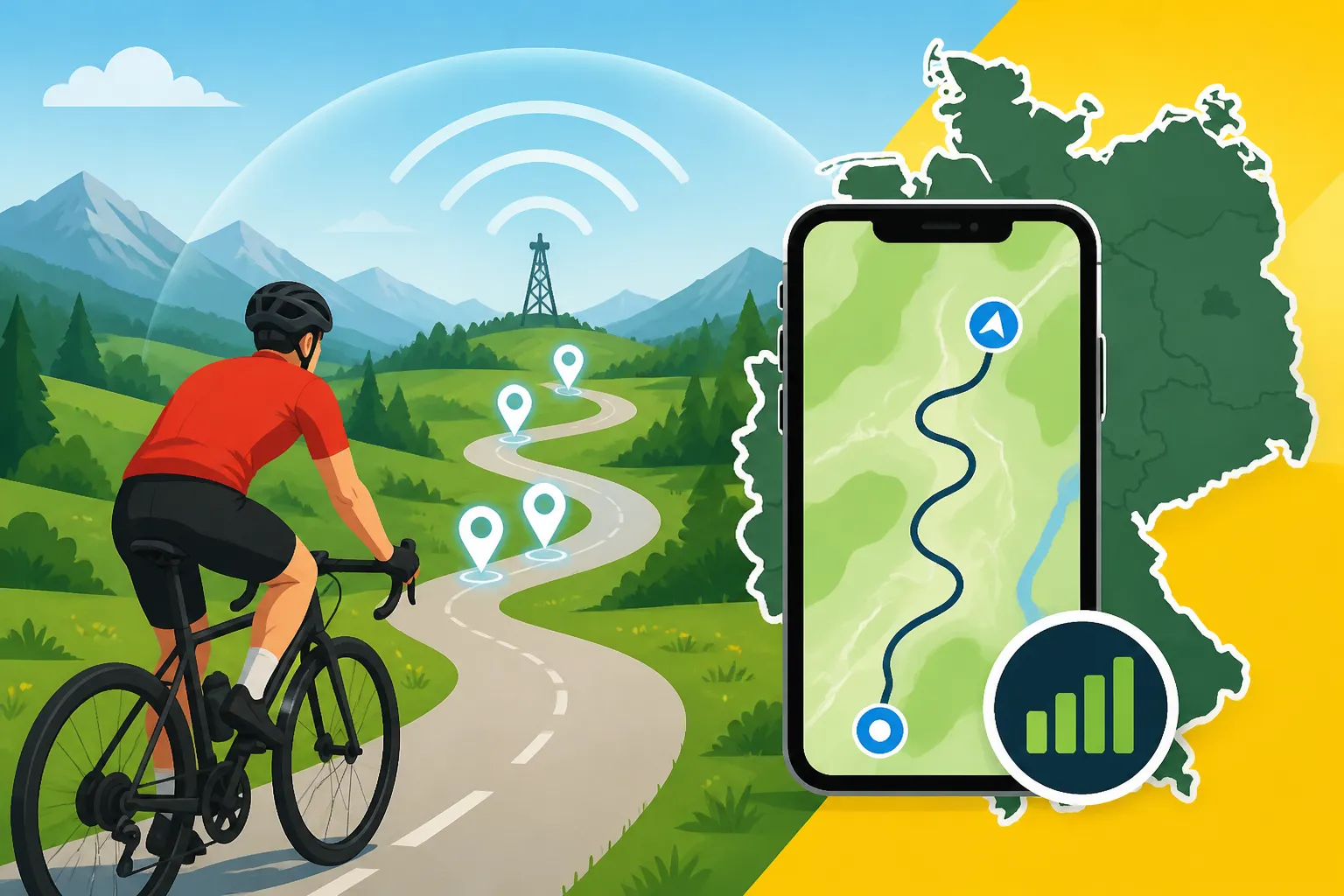
Germany boasts an incredible network of cycling routes, from the picturesque Elbe Cycle Path to the challenging trails in the Alps. You picture yourself cruising along, phone mounted on your handlebars, Google Maps or Komoot guiding your way, maybe even streaming some tunes. idyllic, right? Then, suddenly, the map freezes. The little blue dot stops moving. You’re in the middle of nowhere, surrounded by fields or dense forest, and your data connection has vanished into thin air. It’s a classic expat frustration, one that can quickly turn a relaxing tour into a mini-crisis.
The Unspoken Challenge: Why Rural Areas Lag Behind
It’s true that Germany has invested heavily in digital infrastructure, but the reality on the ground, especially once you leave the bustling cities, can be a stark contrast. While major urban centers enjoy robust 4G and increasingly 5G networks, the rollout in rural areas has been slower and more fragmented. This isn't just a German problem, of course, but it's particularly noticeable when you're reliant on connectivity for something as crucial as navigation on an unfamiliar cycle path.
Think about it: many of these long-distance routes, like portions of the Rhine Cycle Path or those weaving through the Black Forest, deliberately take you through regions renowned for their natural beauty and tranquility. These are precisely the areas where population density is low, making it less economically viable for providers to build out extensive cell tower infrastructure. You might find a strong signal in a small village, only for it to vanish entirely two kilometers down the road as you enter a forested section or a valley. The topography itself plays a huge role; hills, dense woods, and even certain types of soil can effectively block or degrade signals. Different mobile network providers in Germany – Telekom, Vodafone, and O2 – each have their own coverage maps, and what's strong for one might be a dead zone for another in a specific spot. This patchwork nature means that even if you have a German SIM card, you’re often beholden to the whims of a single network's reach.
More Than Just Maps: The Hidden Costs of Poor Connectivity
When your data drops out, it's not just about getting lost (though that's certainly stress-inducing when you're miles from your pre-booked guesthouse). The ripple effects of poor connectivity can impact your entire cycling adventure.
Firstly, navigation. Modern cyclists, myself included, often rely on apps like Komoot, Outdooractive, or Google Maps. These apps are fantastic for planning routes, getting turn-by-turn directions, and discovering points of interest. But if you haven't downloaded the maps for offline use (and honestly, who remembers to do that for every single segment of a multi-day tour?), a data blackout means you're flying blind. Suddenly, that quaint village café you planned to stop at is just a memory, and you're left guessing at crossroads.
Secondly, safety and emergencies. This is perhaps the most critical aspect. If you have an accident, a mechanical issue with your bike that you can't fix, or suddenly feel unwell, having a reliable connection is paramount. Trying to dial Emergency Numbers in Germany: Calling 112, Poison Control, and More only to find "No Service" can be terrifying. Even simply looking up the nearest bike repair shop or train station to bail out of a difficult section becomes impossible.
Thirdly, communication and convenience. Perhaps you need to let your travel companions know you're running late, update your family on your progress, or even just check the weather forecast. These little conveniences become huge stressors when you’re cut off. Imagine trying to book a last-minute accommodation in Germany because your initial plans fell through, or researching German Regional Dishes Every Visitor Should Try for dinner, only to be met with a spinning loading wheel. These are real scenarios that can dampen the joy of your trip. The hidden cost isn't just lost time; it's lost peace of mind and potentially compromised safety.
The Crucial Role of Multi-Network Access
Given this digital patchwork, what’s a touring cyclist to do? The key is finding a way to not be tied to a single network. If one network's signal fades, you want your device to be able to seamlessly hop onto another available network. Traditionally, this meant buying multiple physical SIM cards from different providers – a logistical headache, especially if you're only in Germany for a limited time. Thankfully, technology has advanced, offering solutions that make multi-network access not just possible, but incredibly simple. This is where modern connectivity solutions, particularly eSIMs, come into their own. They're designed for the modern traveler who expects to stay connected, no matter where their adventures take them, whether it's Hiking in Germany: The Black Forest, Alps, and Beyond or cycling through the vineyards of the Moselle.
Your Connectivity Lifeline: Why eSIMs, Especially Airalo, Are a Cyclist's Best Friend
The dread of seeing "No Service" when you're miles from the next town on your bike path is a universal expat pain. For years, the solutions were clunky: hope for Wi-Fi, carry a local SIM (and hope its network covers your route), or painstakingly download offline maps. But let me tell you, as someone who's spent years navigating these digital pitfalls, eSIM technology is an absolute game-changer, and one provider in particular has really nailed it for travelers in Germany: Airalo.
What Exactly is an eSIM and How Does it Work for Travelers?
So, what's an eSIM? It's essentially a digital SIM card. Instead of a tiny plastic chip you have to physically insert and remove from your phone, an eSIM is embedded directly into your device's hardware. This means you can store multiple eSIM profiles on your phone and switch between them with a few taps on your screen. No more fumbling with paperclip tools, losing tiny SIM cards, or waiting in line at a phone store in a foreign country.
For travelers, this is revolutionary. Imagine landing in Germany, opening an app, buying a data plan, and instantly connecting to a local network – all before you even leave the airport. That's the power of an eSIM. It frees you from the limitations of a physical SIM, offering unparalleled flexibility and convenience. You can even keep your home country's physical SIM active for calls and texts while using an eSIM for data, giving you the best of both worlds. It truly makes setting up Mobile Data and eSIMs for Travel in Germany incredibly straightforward.
Why Airalo Stands Out for German Cycle Adventures
Now, why Airalo specifically? Because they understand the unique needs of people on the move, especially those like us exploring Germany's beautiful, sometimes digitally challenging, countryside. Airalo isn't just another eSIM provider; they aggregate local network access, giving you the best possible coverage. This is absolutely critical for cyclists on long-distance routes.
Here's why Airalo becomes your hero on those German cycle paths:
- Reliable Coverage: Airalo partners with multiple local networks in Germany. This means when you buy an Airalo eSIM for Germany, your phone isn't just stuck to one provider. If Vodafone's signal is weak in a valley you're cycling through, your Airalo eSIM will likely connect you to Telekom's network if it's stronger there (and vice-versa). This multi-network access significantly reduces the dreaded "no signal" moments, giving you far more consistent data coverage than a single local SIM ever could. This is exactly what you need when you're miles from civilization and relying on your phone for navigation and safety.
- Flexibility & Convenience: Planning a multi-day tour along one of the Cycling Routes in Germany: The Rhine, Elbe, and More? You can purchase a data package tailored to your trip duration and data needs before you even leave home. Got a longer trip planned, perhaps exploring The Black Forest: Villages, Trails, and Cuckoo Clocks and then heading up north? Airalo offers regional Europe-wide plans too, meaning you can travel across borders without worrying about new SIM cards. This unparalleled flexibility means you can adapt your connectivity to your travel plans, not the other way around.
- Cost-Effective: Let's be honest, roaming charges from your home provider can be astronomical. And while local SIM cards are an option, buying a specific plan for data only through Airalo can often be more cost-effective, especially for shorter trips. You only pay for what you need, and you avoid the hassle of canceling contracts or dealing with foreign currency issues when topping up.
- Ease of Use: Activating an Airalo eSIM is incredibly simple. You download the Airalo app, choose your destination (Germany or a Europe-wide plan), select a data package, and follow the clear instructions to install the eSIM. It literally takes minutes. This means less time wrestling with technology and more time enjoying your cycling adventure. Imagine the relief of having your data sorted without any fuss, giving you the freedom to explore.
Airalo really shines by removing the biggest headache of digital connectivity for international travelers and expats. It allows you to stay connected, navigate confidently, and feel secure knowing you have a reliable data lifeline. For any serious cyclist exploring Germany, having Airalo on your phone is like having an invisible, always-on guide and safety net.
Activating Your Airalo eSIM: A Seamless Setup for Your Journey
The beauty of Airalo is its straightforward setup, a welcome relief from the typical German bureaucracy we expats often face. Here’s a general step-by-step guide to get your Airalo eSIM ready for your German cycling adventure:
- Check Device Compatibility: First things first, ensure your smartphone supports eSIM technology. Most modern iPhones (XS onwards), Google Pixels (3 onwards), and many newer Samsung Galaxy models are compatible. A quick check on Airalo's website or your phone's settings will confirm this.
- Download the Airalo App: Head to your app store (iOS or Android) and download the free Airalo app. This is your command center for managing your eSIMs.
- Choose Your Destination and Plan: Open the app and search for "Germany" or a relevant "Europe" regional plan if you're also cycling in neighboring countries. You'll see various data packages available, typically ranging from 1GB for a week to larger amounts for a month or more. Consider how much data you usually use for navigation, messaging, and light browsing.
- Hypothetical Scenario: You're planning a 10-day tour. A 5GB plan for 30 days might be perfect, giving you plenty of data and peace of mind without worrying about running out mid-tour.
- Purchase Your eSIM: Once you've selected your plan, proceed to purchase it within the app. Airalo accepts various payment methods, making it super convenient.
- Install the eSIM: This is where the magic happens. The app will guide you through the installation process. You'll typically have two options:
- Direct Installation: The easiest method. The app will prompt you to install the eSIM directly to your device. Simply follow the on-screen instructions.
- QR Code or Manual Installation: If direct installation isn't possible, Airalo will provide a QR code to scan (using your phone's camera via Settings > Mobile Data > Add Data Plan) or manual details to enter. You might need a second device to display the QR code, or you can print it.
- Activate and Select: Once installed, you'll need to enable your new eSIM in your phone's settings. You can name it something memorable, like "Germany Cycling Data." Make sure to set this eSIM for mobile data usage while keeping your primary SIM (if you have one) for calls/texts. Critically, remember to enable "Data Roaming" for your Airalo eSIM if you're not seeing a connection – this allows it to connect to the various local networks it partners with, but don't worry, with Airalo, this is included in your plan, not an extra roaming charge!
It's really that simple. In just a few minutes, you'll have reliable data coverage, letting you focus on the stunning German landscapes instead of worrying about connectivity. This setup is a breath of fresh air compared to traditional methods of Setting Up a Phone Plan in Germany: Prepaid vs Contract and can save you a lot of time and potential headaches.
Beyond Connectivity: Essential Strategies for Flawless Cycling Navigation and Safety
Even with the best eSIM solution like Airalo providing excellent data coverage, smart planning and preparation are always key to a truly stress-free long-distance cycling trip in Germany. Technology is a fantastic enabler, but it's not foolproof, and having a few analogue or backup strategies can make all the difference, especially when you're Staying Safe in Germany: Common-Sense Tips for Travelers.
Offline Maps and GPS: Your Indispensable Backup
Remember that frustrating moment when your map froze? That's precisely why offline resources are non-negotiable.
- Download Maps Religiously: Before you embark on your daily route, always download the relevant sections of your chosen navigation app (Komoot, Outdooractive, Google Maps) for offline use. Most apps offer this feature. This way, even if you lose all signal, your GPS will still know where you are, and you'll have the map data to guide you. It’s like having a digital safety net.
- Invest in a Dedicated GPS Device: For serious touring cyclists, a dedicated cycling GPS device (like a Garmin Edge or Wahoo Elemnt) is a fantastic investment. These devices use satellite navigation and often come with preloaded maps or allow for easy offline map uploads. They are less reliant on phone signal and often have superior battery life, designed specifically for multi-day adventures. The screen is also usually more visible in bright sunlight than a phone.
- Old-School Paper Maps: Yes, really! While less common now, a good old-fashioned paper map of the region can be a lifesaver. They don't run out of battery, they're impervious to signal dropouts, and sometimes, tracing your finger along a physical map is just a more satisfying way to plan. Plus, they can make for a great souvenir! You can often find detailed cycling maps at local bookstores (Buchhandlungen) or tourist information centers (Tourismusinformation).
Battery Life and Power Banks: Essential Gear
Your phone, your navigation, your lifeline – it's all useless without power.
- Optimize Phone Settings: Before you even set out, tweak your phone settings. Reduce screen brightness, turn off unnecessary notifications, close background apps, and set your screen to turn off quickly. Use airplane mode in areas where you know there’s no signal, as your phone wastes a lot of battery constantly searching for a network.
- Portable Power Banks: Carry at least one, preferably two, fully charged power banks. A 10,000 mAh power bank can typically charge a smartphone 2-3 times. For longer trips, consider a larger capacity. Look for power banks that support fast charging for both the bank itself and your devices.
- Dynamo Chargers: For the truly self-sufficient, a hub dynamo charger can be a fantastic addition. These ingenious devices convert the energy from your pedaling into electrical power, charging your devices as you ride. They require a specific wheel setup but offer infinite charging possibilities as long as you keep moving.
- Solar Chargers: While less reliable in Germany's often cloudy weather, a small solar panel can provide a trickle charge or top up a power bank on sunny days. It's a nice supplementary option.
Local Knowledge and Contingency Plans
Sometimes, the best technology is local wisdom.
- Learn Basic German Phrases: Even if you mostly get by in English, knowing some Survival German for Travelers: Key Phrases to Learn First can be incredibly helpful. Phrases like "Ich habe mich verirrt" (I'm lost), "Wo ist die nächste Stadt?" (Where is the next town?), or "Brauche Hilfe" (I need help) can go a long way when you need to ask for directions or assistance from locals who might not speak English.
- Carry Physical Emergency Contacts/Info: In addition to your phone, carry a small laminated card with emergency numbers, your accommodation details, and any critical medical information. If your phone is lost or dead, this card becomes invaluable.
- Inform Someone of Your Route: Always let a friend or family member know your planned route and approximate arrival times, especially for solo trips. If you don't check in, they'll know where to start looking.
- Know Your Pit Stops: Research major towns or villages along your route beforehand where you expect to find a reliable signal, a café with Wi-Fi, or even a train station to bail out if needed. Knowing where you can reconnect or find help gives you immense peace of mind. Checking in at your Short-Term Accommodation in Germany: Options for Your First Weeks or each night's guesthouse is a good routine.
By combining the reliable connectivity offered by an Airalo eSIM with these practical strategies, you’re not just prepared; you’re empowered to enjoy every pedal stroke of your German cycling adventure, knowing you’re connected and safe, no matter where the path takes you.
Disclaimer
Please remember that while I strive to provide accurate and up-to-date information based on my knowledge and accessible data, conditions in Germany can change. Connectivity, regulations, and services are subject to continuous updates. Always double-check current requirements and information with official sources before making travel or purchasing decisions.